

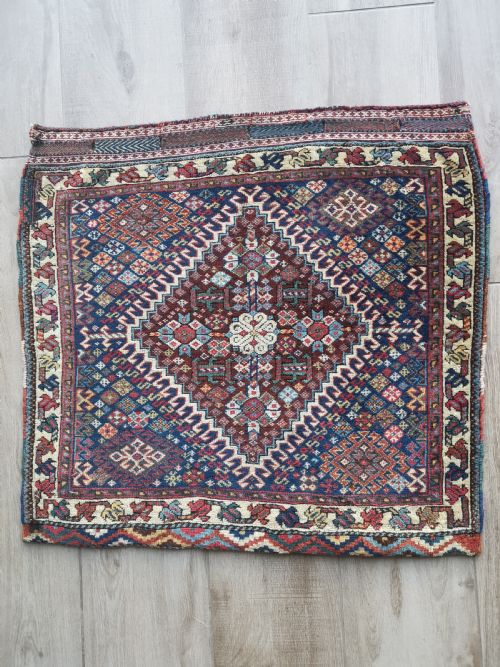
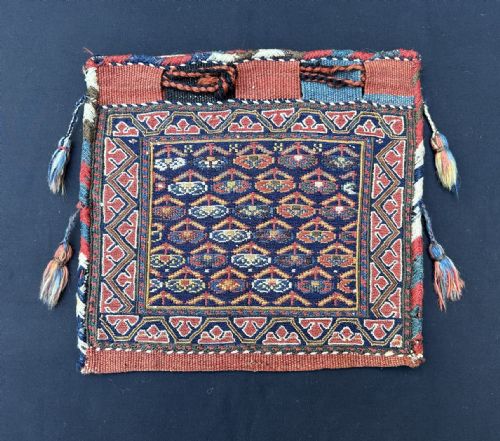
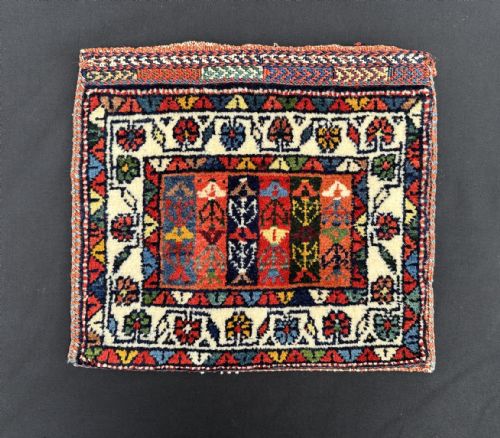
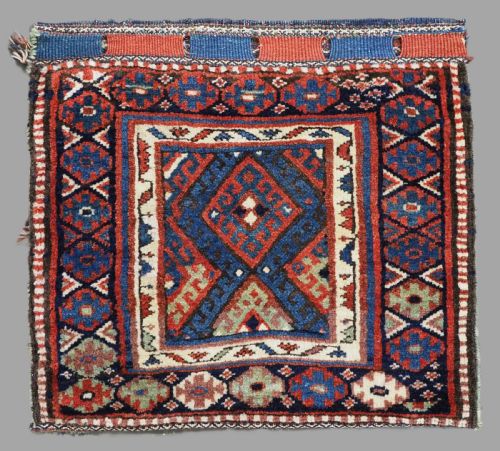

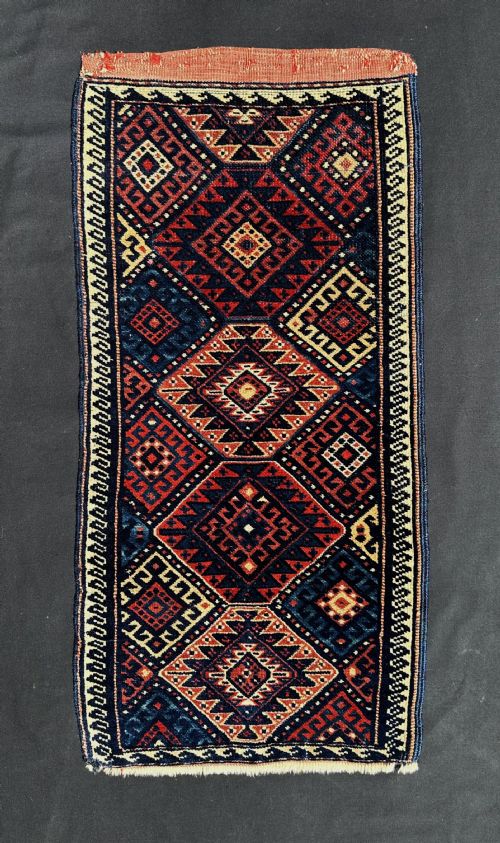


Red Persian Bag Face
A red persian bag face is the front panel of a nomadic storage sack woven in wool.
Red Persian Bag Face
A red persian bag face represents the cut or preserved front of a nomadic utility sack made by tribal groups across Persia. When collectors search for a red persian bag face, they encounter pieces originating from confederations such as the Qashqai, Afshar, Shahsavan, and various Kurdish tribes.
These textiles served practical functions for transport and storage within tribal life before being separated from their original backs. Surviving examples date from the mid-nineteenth century through to the early twentieth century.
Formats range from square cushion fronts to rectangular saddlebag faces and smaller personal carriers known as chantehs. The red ground dominates many of these compositions, often paired with geometric or tribal motifs woven in wool.
How They Were Made
Weavers constructed these pieces using hand-spun wool for the pile and foundation yarns, sometimes paired with cotton warps in later examples. Natural dyes and vegetable colourants provide the varied red tones and secondary hues seen across the surface.
Techniques include symmetrical or asymmetrical knotting alongside flatweave sections, soumak work, and plain weave backs where entire bags survive intact. The wool fibres retain natural lanolin, contributing to the tactile quality of the pile.
Tribal attributions on this page include Qashqai, Afshar, Shahsavan, Kurdish, Lori-Bakhtiari, and Baluch traditions from across Persia.
What Varies in Quality
Quality rests upon the handling of the wool, the clarity of the natural dyes, and the precision of the tribal design work. Tightly packed knots and resilient pile distinguish finer weaving from looser, coarser production.
The complexity and crispness of motifs such as boteh, tile patterns, or animal forms dictate the visual impact of the piece. Preservation of the original edges and extent of wear also shape the standing of individual bag faces.
The Red Persian Bag Face Glossary
- Khorjin
- A traditional double-sided saddlebag used by nomadic groups for transport. Most surviving examples have been separated into individual bag faces.
- Chanteh
- A small personal carrier or vanity bag woven by tribal makers for intimate possessions. These pieces often display high technical precision in a compact format.
- Sumac
- A warp-wrapping flatweave technique that produces crisp, patterned surfaces without a cut pile. Shahsavan weavers utilised this method frequently for storage bags.
- Boteh
- A recurring paisley or almond-shaped motif found across Persian tribal weaving. The design appears frequently on Afshar and Qashqai bag faces.
- Natural Dyes
- Colourants derived from plant and mineral sources prior to the widespread adoption of synthetics. These dyes yield the specific red and secondary tones characteristic of nineteenth-century pieces.
Red Persian Bag Face: Frequently Asked Questions
What is a red persian bag face?
A red persian bag face is the decorative front panel of a nomadic storage sack. These textiles were produced by tribal weavers across nineteenth-century Persia.
Nomads utilised these bags for packing household goods on animals. Collectors now display the surviving fronts as independent textile art.
How were these bags used?
Tribal families packed these sacks with grain, bedding, and personal belongings during seasonal migrations. The double bags hung across pack animals for transport.
When the bags wore out or families settled, the durable front panels were often cut away and preserved. Smaller versions served as vanity bags or personal carriers.
How do I care for a bag face?
Keep textile pieces out of direct sunlight to protect the natural wool dyes from fading. Gentle vacuuming with a low suction setting removes dust without damaging the pile.
Avoid hanging heavy pieces by a single point to prevent distortion of the foundation. Professional textile cleaning should be utilised if deeper maintenance is required.
Which tribes made these pieces?
Weaving groups such as the Qashqai, Afshar, Shahsavan, and Kurdish tribes produced these storage pieces in different regions of Persia. Each group brought distinct regional palettes and geometric repertoires to their work.
Attributions rely on specific border motifs, colour combinations, and structural characteristics typical of nineteenth-century nomadic production.