

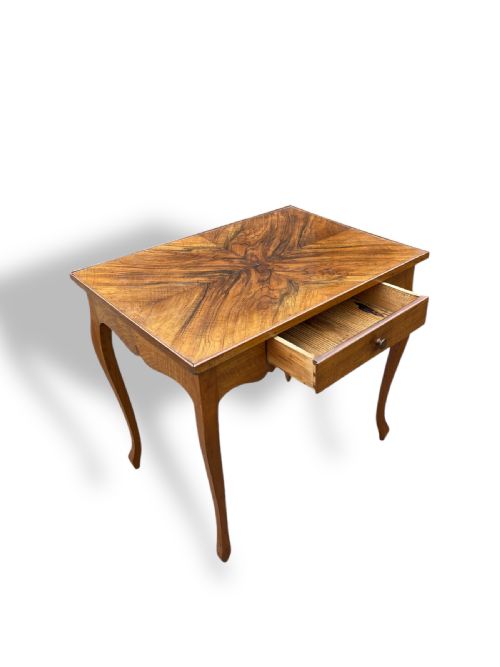


Quarter Veneered Table
A quarter veneered table brings precision timber work into a room, using matched grain sections to create a geometric surface pattern.
Quarter Veneered Table
A quarter veneered table uses cut sections of timber arranged so the grain patterns mirror one another across the surface. When searching for a quarter veneered table, buyers encounter examples ranging from seventeenth century lowboys to twentieth century occasional tables and bedside cabinets.
The form varies considerably across the periods represented, including French occasional tables, centre tables, and side tables. Walnut appears most frequently, often complemented by featherbanding or ebony details.
How they were made
Cabinet makers sliced thin timber sheets to lay over a secondary wood base, arranging four matching pieces to form symmetrical panels. Walnut, mahogany, rosewood, and ebony veneer were applied carefully to flat surfaces such as table tops and lowboy drawers.
Mounts in ormolu and brass alongside carved wooden bases provide structural support and decorative contrast to the timber surfaces. Joinery techniques varied from early pegged frames to later revival methods depending on the century of manufacture.
Walnut is the most frequent primary material seen across these quarter veneered tables, appearing alongside mahogany, rosewood, and ebony.
What varies in quality
Quality rests in the precision of the grain matching across the four sections of the top and the stability of the underlying timber. Finer pieces demonstrate careful selection of figured veneers that age uniformly and retain tight joints without lifting.
The integration of secondary decorative elements, such as featherbanding, brass framing, or ormolu mounts, distinguishes standard production from exceptional cabinet work. Surface preservation also plays a part, as original patination on walnut and mahogany alters the visual depth of the timber.
Joseph Windmills·Francois Linke
The Quarter Veneered Table Glossary
- Quarter veneer
- Slices of timber cut from the same log section and arranged in sets of four to create a symmetrical pattern on a surface. This technique highlights the natural figuring of woods like walnut and mahogany.
- Lowboy
- A small side table or dressing table featuring drawers, commonly raised on tall legs. Eighteenth century examples frequently incorporate quarter veneered tops and featherbanding.
- Featherbanding
- Inlay work using narrow bands of veneer arranged in a herringbone pattern around the edge of a table top. It frames the central quarter veneered panels.
- Ormolu
- Gilt bronze ornamentation applied to furniture, particularly common in French revival pieces. It provides a metallic contrast to rosewood and walnut timbers.
- Occasional table
- A small, movable table designed for specific minor uses within a room. These appear across Edwardian and later periods in various timber finishes.
Quarter Veneered Table: Frequently Asked Questions
What is a quarter veneered table?
A quarter veneered table is a piece of furniture featuring a wooden top constructed from four matching slices of timber grain laid symmetrically. This method creates geometric patterns that showcase the natural figuring of woods like walnut and mahogany.
These tables span multiple centuries, appearing as lowboys, centre tables, and occasional pieces across Georgian, Victorian, and later periods.
How do I identify the period?
Dating relies on observing the overall form, secondary woods, and decorative techniques such as featherbanding or brass mounts. Seventeenth and eighteenth century pieces often present as lowboys or clock cases, while later nineteenth and twentieth century examples include centre tables and nests.
Construction methods and framing styles also shift across eras, moving from pegged joints to machine-cut elements in twentieth century items.
Where were these tables used?
These tables served various practical functions in historic interiors, from central display surfaces in grand rooms to bedside cabinets and side storage tables. Lowboys functioned as small desks or dressing surfaces with drawer space.
In modern rooms, they work well as focal points for lamps, clocks, or decorative objects while adding warmth through figured timber.
What woods were used?
Walnut is the predominant timber found on these pieces, frequently paired with featherbanding or ebony veneer. Other materials include mahogany, rosewood, and oak for structural frames.
Decorative accents often incorporate brass and ormolu mounts, enhancing the visual contrast against the dark polished veneers.