




Putti Bronze Timepiece
A putti bronze timepiece brings classical sculpture and precision engineering together, offering a decorative focal point that defines a period interior.
Putti Bronze Timepiece
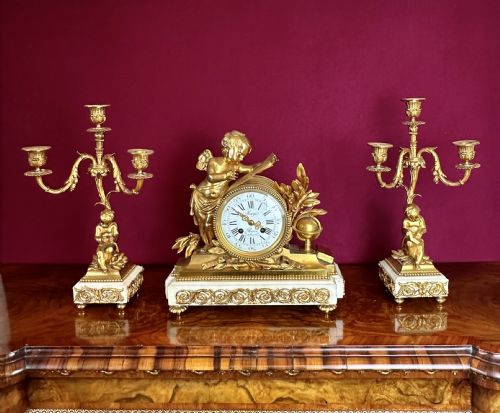
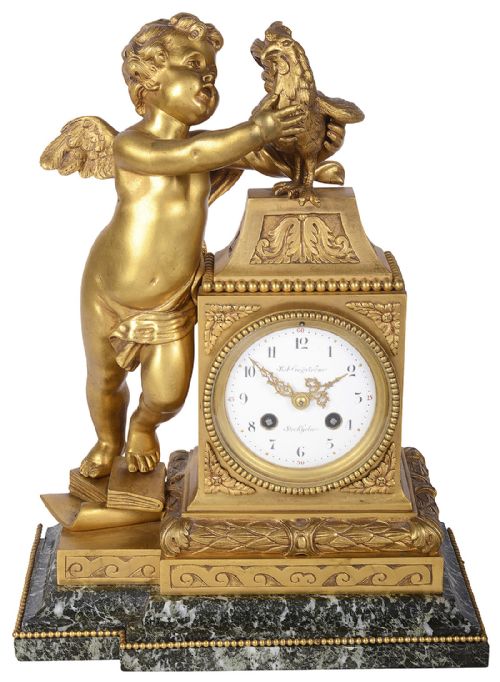
A putti bronze timepiece combines cast metal figures of cherubs or putti with a functioning clock mechanism, predominantly originating from nineteenth-century French workshops. Buyers searching for a putti bronze timepiece will encounter mantel clocks, table clocks, and garniture sets featuring figures cast in patinated or gilt bronze.
The dominant aesthetic draws heavily on French Rococo Revival, Louis XVI, and Empire styles, placing winged infants alongside floral garlands, classical columns, and architectural plinths. Most examples pair bronze castings with contrasting materials such as white or variegated marble bases and enamelled dials.
Mantel clocks form the largest group on this page, often accompanied by side pieces in garniture sets. These pieces range from compact table clocks on simple bronze plinths to substantial architectural mantel clocks bearing maker signatures from Paris and London.
Determinants of quality
The crispness of the bronze chasing dictates the visual success of the piece, separating finely hand-chased figures with expressive facial details from softer, mass-produced castings. Master bronziers invested considerable labour into sharpening feather, hair, and drapery details after the initial casting process.
The integration of the movement with the case, the quality of the enamel dial work, and the presence of signed Parisian or London movements distinguish high-tier examples. Furthermore, substantial variegated marble plinths and complete matching garniture sets elevate the status of an individual timepiece.
The listings span the nineteenth century, capturing Victorian taste alongside earlier Regency and Louis XVI revival movements.
Le Roy Paris·Leon Message·Jollet et Cie·John Bennett·Henry·Japy Freres
The Putti Bronze Timepiece Glossary
- Ormolu
- Gilded bronze produced by applying a mercury and gold amalgam to a bronze base and heating it until the mercury vaporised. This technique creates a rich, matte golden surface characteristic of fine nineteenth-century French clock cases.
- Putti
- Plump, winged infant figures, often representing cherubs or cupids, frequently incorporated into classical and Rococo decorative arts. They appear alongside timepieces leaning against clock dials, holding floral garlands, or riding atop marble plinths.
- Garniture
- A set of matching decorative objects designed to be displayed together on a mantelpiece, typically consisting of a central clock flanked by two matching vases or candelabra. These sets share identical ormolu mounts, marble bases, and stylistic motifs.
- Fusee
- A conical pulley used in mechanical clocks to maintain an even drive force as the mainspring unwinds. This mechanism improves timekeeping accuracy across the power reserve.
- Cartel clock
- A wall-mounted clock featuring an ornate frame made of wood, metal, or ormolu rather than a standard wooden case. These pieces display elaborate scrolling foliage and figural mounts directly against the wall.
Putti Bronze Timepiece: Frequently Asked Questions
What is a putti bronze timepiece?
A putti bronze timepiece is a mechanical clock featuring cast bronze figures of cherubs or putti, typically produced in France or Britain during the nineteenth century. These decorative objects combine precision clockwork with sculptural art.
They served as functional timekeepers and status symbols for wealthy Victorian and continental interiors, placed prominently on mantelpieces and tables.
How do I identify a French nineteenth-century clock?
French clocks from this era often feature cast ormolu mounts, enamelled dials with Arabic or Roman numerals, and signatures from Paris foundries on the movement plates. Stylistic cues include Rococo scrolls, Louis XVI symmetry, and Empire classical motifs.
The use of fire-gilt bronze, high-relief chasing on the putti figures, and heavy marble bases also points directly to nineteenth-century French manufacturing standards.
What is a clock garniture set?
A clock garniture is a matched decorative set comprising a central timepiece accompanied by two side ornaments, such as urns, candelabra, or vases. They were designed to create a balanced, symmetrical display across a mantelpiece.
Collectors prize complete garniture sets because the materials, ormolu casting styles, and marble bases match perfectly across all pieces.
How should I care for an antique bronze clock?
Keep antique bronze clocks away from direct sunlight, excessive moisture, and fluctuating temperatures to protect the marble bases and the delicate ormolu surface. Dust gently with a soft, dry cloth without applying chemical cleaning products.
Mechanical movements require periodic professional servicing by a qualified horologist to clean the gears and ensure accurate timekeeping without wearing down historic components.