






Provence Landscape Art
Provence landscape art captures the light and rugged terrain of the South of France through oils, gouache and charcoal.
Provence Landscape Art
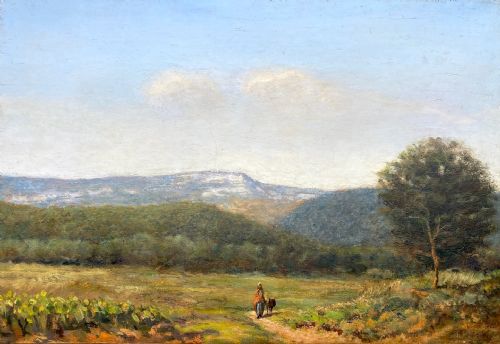
Provence landscape art brings the light, olive groves and coastal scenes of the Mediterranean directly to the wall through paintings and drawings. You will most frequently meet oil on canvas works spanning from the late nineteenth century through to the mid-twentieth century.
The subjects range from tranquil farmhouses and washerwomen by streams to craggy stone paths and coastal ports. These pieces record the distinct vegetation and architecture of regions such as the Alpilles and Toulon.
Examples stretch across multiple decades, showing shifts from nineteenth-century realism and Barbizon traditions through to post-impressionist brushwork and mid-century abstract modernism.
Materials and technique
Artists record these southern views primarily using oil paint applied to canvas, panel or paper. The handling of the medium shifts from the careful tonal work of nineteenth-century pieces to the vibrant, expressive application seen in later modernist works.
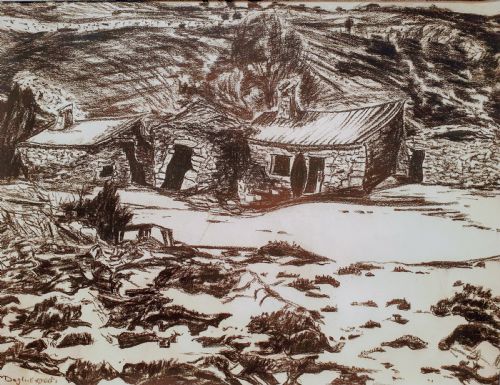
Works on paper utilise gouache or charcoal, allowing for rapid execution and graphic clarity when capturing windy mistral days or abstract Mediterranean compositions. Support materials range from simple wood panels to heavy woven canvas stretched over wooden frames.
Current listings feature works in oil, gouache and charcoal spanning the 1870s to the 1960s.
Assessing quality
Quality rests in the handling of light and atmospheric depth, distinguishing works that merely record a southern view from those that capture the specific heat and dust of the region. Confident brushwork and a coherent palette elevate a composition above standard decorative output.
The integration of support and medium also marks the tier of a piece, whether it is a substantial oil on canvas with rich impasto or a finely controlled gouache on paper that retains its original vibrancy.
The Provence Landscape Art Glossary
- Gouache
- An opaque water-based paint that dries to a matte finish. It allows artists to build dense blocks of flat, vibrant colour on paper supports.
- Barbizon School
- A nineteenth-century French movement focused on direct observation of nature. It prioritised tonal harmony and loose, naturalistic brushwork over academic finish.
- Impasto
- Paint applied thickly to a canvas or panel so that it stands out from the surface. This technique lets the artist retain the physical gesture of the brush.
- Post-Impressionism
- A diverse late nineteenth and early twentieth-century style that builds upon impressionist light studies. It emphasises symbolic colour, expressive brushwork and structural forms.
Provence Landscape Art: Frequently Asked Questions
What periods do these landscapes cover?
The available selection spans from the late Victorian era and the nineteenth century through to the interwar period and mid-century modernism.
Works range from nineteenth-century academic interpretations to 1950s abstract compositions.
Where were these scenes painted?
Artists worked across the South of France, focusing on specific locations including the Alpilles mountain range, Toulon harbour and rural farmhouses.
Subjects also encompass coastal ports along the Mediterranean and inland olive groves.
What mediums are used in these works?
Paintings utilise oil on canvas or panel, capturing the intense southern light through layered pigment.
Drawings and works on paper employ charcoal or gouache for graphic precision and flat colour.
How do modernist and older pieces differ?
Nineteenth-century and early twentieth-century examples tend toward descriptive realism and atmospheric tonal observation.
Mid-century pieces introduce abstracted forms, simplified geometry and heightened colour relationships.