
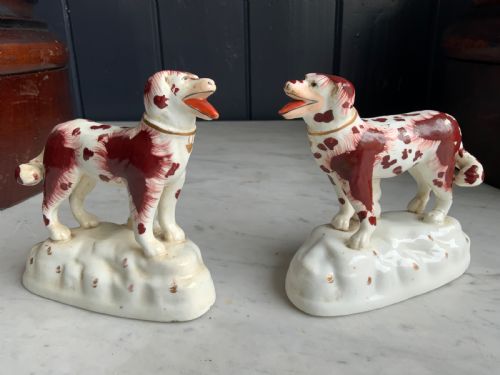
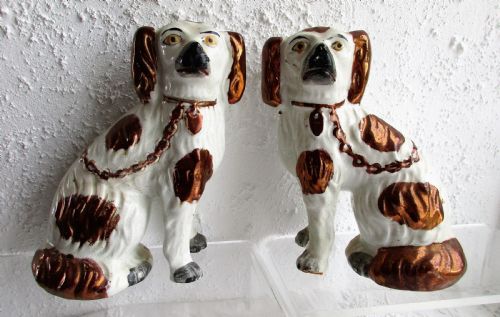


Porcelain Spaniel Figurines
Porcelain spaniel figurines are mantelpiece companions that bring character to a room, and you are looking at pairs and groups modelled as faithful dogs.
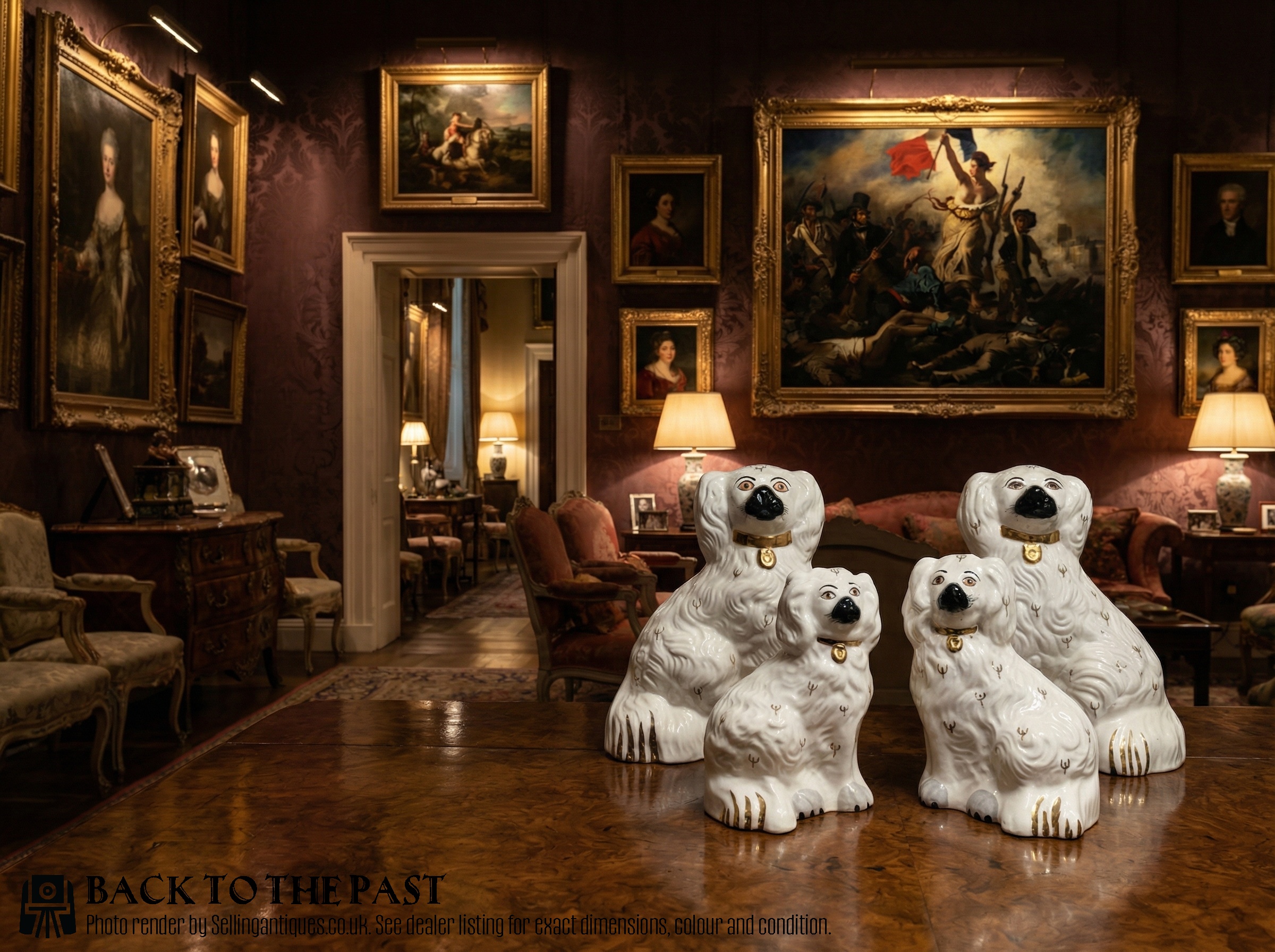
Porcelain Spaniel Figurines
When you search for porcelain spaniel figurines, you are looking at decorative figures and decorative objects designed to sit on hearths and sideboards. The pieces available here span several decades, including Victorian examples alongside earlier Regency and mid-nineteenth-century pairs.
You will most commonly meet pairs of Staffordshire pottery and porcelain dogs in various finishes, from plain white to gilt-accented and copper lustre. The selection also includes seated spaniels on cushions and larger collections modelled in pairs or groups.
Most entries belong to the broader Victorian tradition of mantel ornaments, though earlier Chinese Export figures and later twentieth-century works also appear. These ceramic figures served as domestic ornaments for middle-class interiors, often arranged at either end of a mantelpiece.
How they were made
Certain pieces feature applied details such as encrusting on blue cushions, whilst others rely on hand painting and copper lustre finishes to create depth. The firing process fixed these enamels and glazes to the ceramic base, producing the glossy surfaces seen on the finished dogs.
Listings feature earthenware, porcelain, and ceramic materials across Victorian, Regency, and twentieth-century periods.
What varies in quality
The application of glaze, gilt, and enamel also marks the difference between standard production pieces and superior works. Richer copper lustre and precise gilding elevate the visual impact of a pair.
Royal Doulton·Beswick
The Porcelain Spaniel Figurines Glossary
- Porcelain
- A white, vitrified ceramic material fired at high temperatures to produce a hard, non-porous body. It forms the finer substrate for certain imported and domestic animal figures.
- Earthenware
- A porous ceramic body fired at lower temperatures, commonly used for nineteenth-century Staffordshire pottery figures. It requires a glaze to become impermeable to liquids.
- Copper Lustre
- A metallic glaze finish that imparts a coppery sheen to the ceramic surface. It was frequently applied to Victorian Staffordshire dogs for decorative effect.
- Enamel
- Opaque vitreous paint applied over the glaze and fired at a lower temperature to add colour details. It provides the black patches, eyes, and collars on the spaniels.
- Gilt
- A thin layer of gold or gold-coloured paint applied to highlights such as chains, lockets, and collars. It signals a more decorative finish on Victorian pairs.
Porcelain Spaniel Figurines: Frequently Asked Questions
Where were porcelain spaniels displayed?
These ceramic figures were traditionally placed on either end of a fireplace mantelpiece in nineteenth-century homes.
Pairs faced inwards toward each other, a symmetrical arrangement that suited the formal interiors of the period.
Why do these dogs come in pairs?
Mantelpiece ornaments of the Victorian era were almost exclusively designed as matching pairs to create balance across a hearth.
One dog would sit on the left side of the fireplace and its counterpart on the right.
How do I date a spaniel figurine?
Dating relies on stylistic clues such as the modelling, the presence of copper lustre, or specific glaze characteristics.
Nineteenth-century Staffordshire pieces often show distinct moulding styles compared to later twentieth-century productions.
What is a comforter spaniel?
Comforter spaniels are the Staffordshire ceramic dogs modelled after Queen Victoria's own pet spaniel, Dash.
They became immensely popular household ornaments throughout the Victorian period.