



King Charles Spaniel Figures
King Charles spaniel figures are enduring ceramic and metal companions that bring nineteenth-century hearths directly into a modern room.
King Charles Spaniel Figures
When you search for king charles spaniel figures, you are looking at ceramic, metal and painted representations of this loyal dog breed across several centuries. The selection on this page centres predominantly on Staffordshire earthenware pairs from the Victorian period, sitting alongside cast iron doorstops, bronze inkwells and enamel snuff boxes.
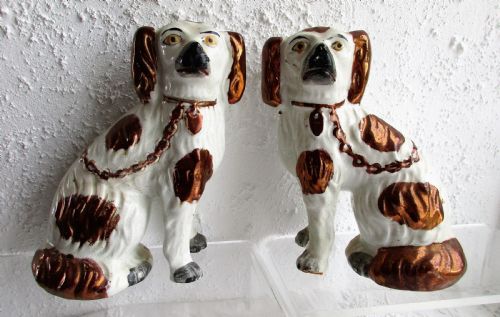
Most pieces you will encounter take the form of seated ceramic spaniels, often modelled as pairs intended to flank a fireplace. The forms range from small Staffordshire figurines and Toby jugs to Royal Doulton productions and Beswick dogs.
Beyond pottery, the evidence includes works on paper and metal objects, showing that artists and makers rendered these spaniels in watercolour, cast iron and gilt bronze. English traditional and Georgian styles also appear, grounding the selection in historical domestic craft.
How they were made
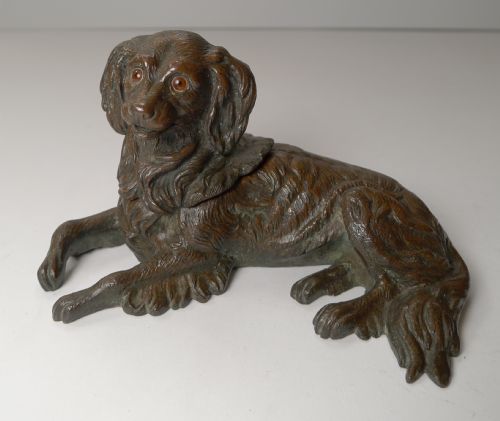
Metalworkers cast bronze and iron versions to serve functional roles as doorstops and inkwells, applying patination or gilding to the surfaces. Enamellers decorated small copper snuff boxes with fine painted portraits of cavalier spaniels, while watercolourists applied pigment to paper.
One military gentleman and lady spend their time exercising king charles spaniels in a nineteenth-century watercolour.
What varies in quality
Materials and execution also set pieces apart, moving from mass-produced earthenware to heavier cast bronze inkwells or finely detailed Bilston enamel boxes. The fidelity of the canine likeness and the preservation of original paint or glaze determine the standing of each piece.
Royal Doulton·Beswick·Bilston
The King Charles Spaniel Figures Glossary
- Staffordshire pottery
- Earthenware figures and vessels produced in the potteries of Staffordshire, England, famous for domestic animal ornaments. These spaniels were staples of Victorian mantelpieces.
- Copper lustre
- A metallic glaze technique that imparts a shimmering copper sheen to pottery surfaces. Makers applied this glaze over earthenware before a secondary firing.
- Stoneware
- A dense, impermeable ceramic fired at higher temperatures than earthenware. It offers greater durability and a heavier weight in early figures.
- Bilston enamel
- Painted enamel work produced in the Staffordshire town of Bilston during the eighteenth century. Artisans fused powdered glass to copper bases before hand-painting miniature scenes.
- Comforter spaniels
- The nineteenth-century term for Staffordshire pottery spaniels placed on hearths as domestic ornaments. They earned this name because owners treated them almost like real pets.
King Charles Spaniel Figures: Frequently Asked Questions
What are Staffordshire comforter spaniels?
Staffordshire comforter spaniels are ceramic dog figures produced in pairs during the nineteenth century to sit on either side of a fireplace. Households placed them on mantels as decorative domestic companions.
Potters painted their coats, chains and lockets by hand, creating charming ornaments that remain highly collectible today.
How do I date an antique spaniel figure?
Dating relies on examining the clay body, glaze characteristics, and painting style. Earlier pieces from the early nineteenth century often feature heavier stoneware or simpler earthenware modelling.
Victorian examples frequently display copper lustre accents and distinctive facial expressions. Comparing the base construction also helps establish the period of manufacture.
Were these spaniel figures always made in pairs?
Many Staffordshire spaniels were modelled and sold as symmetrical pairs to adorn mantelpieces or sideboards. Each dog faced inward toward the centre of the display.
However, individual figures, Toby jugs, doorstops and inkwells were also produced as single functional or decorative items.
How should I clean antique ceramic spaniels?
Cleaning requires a soft, dry brush or a gently dampened cloth to remove dust from the glazed surfaces. Avoid soaking antique ceramics or using harsh chemical cleaners that might damage hand-painted enamel or gold paint.
Gentle care preserves the fragile surface details and original finishes accumulated over the centuries.