
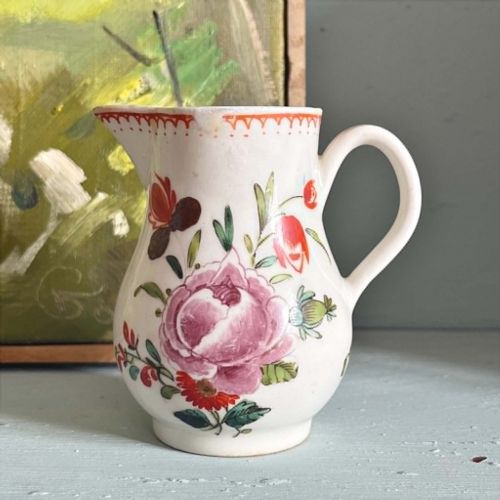


Polychrome Porcelain Jug
A polychrome porcelain jug brings bright enamel palettes and fine ceramic forms to the table, offering a glimpse into eighteenth and nineteenth century dining.
Polychrome Porcelain Jug
When searching for a polychrome porcelain jug, a buyer is looking at small creamers, milk jugs, ewers, and sauce boats painted in vibrant enamels. These vessels date primarily from the eighteenth century, including Georgian examples and Chinese export pieces.
The most common version met on this page is the eighteenth-century cream jug or creamer, often featuring floral motifs, armorial designs, or animal forms such as dolphin handles. Pieces span soft-paste and hard-paste porcelain, reflecting both English factories like Bow, Derby, Worcester, and Liverpool, alongside continental and Chinese export wares.
Beyond standard creamers, the form extends to mugs, milk jugs with covers, and complete tea services. These functional vessels served the tea table and dining room, combining utility with decorative hand-painted colour.
What varies in quality
Quality in a polychrome porcelain jug rests on the crispness of the moulding and the precision of the hand-painted enamel work. Finer pieces display confident brushwork and balanced compositions, particularly in floral or armorial subjects.
The sophistication of the porcelain body itself also distinguishes the work, from the early soft-paste bodies of English factories to the refined hard-paste porcelain of Meissen and Chinese export wares. Preservation of the enamel colours and any applied gold leaf directly influences the standing of the piece.
Listings feature eighteenth-century soft-paste and hard-paste porcelain alongside nineteenth-century revival styles.
Bow·Derby Porcelain·Meissen·Worcester Porcelain·Minton·Herculaneum
The Polychrome Porcelain Jug Glossary
- Polychrome
- Decorated in multiple colours. This term describes ceramics painted with a varied palette of enamel pigments.
- Soft-paste porcelain
- An artificial porcelain composition fired at lower temperatures than true hard-paste porcelain. English factories frequently utilised soft-paste formulas in the eighteenth century.
- Ewer
- A pitcher with a large spout and a handle, often shaped with an elongated lip for pouring. Cream ewers served milk or cream at tea tables.
- Enamel
- Opaque glass-like paint applied to fired ceramic surfaces. Artisans used enamel colours to create bright pictorial scenes and floral motifs.
- Armorial
- Decorated with a coat of arms. Chinese export and European factories painted these heraldic symbols for specific patrons.
Polychrome Porcelain Jug: Frequently Asked Questions
What is a sparrowbeak jug?
A sparrowbeak jug is a small eighteenth-century cream jug featuring a short, pinched spout resembling a bird's beak. These diminutive vessels were designed for pouring cream at the tea table.
They typically feature delicate hand-painted polychrome floral decoration and loop handles. Their compact form makes them distinct among domestic ceramics of the period.
How do I care for antique porcelain?
Antique porcelain requires gentle hand washing in warm water with mild soap. Avoid soaking pieces, particularly soft-paste items or those with delicate enamel and gold leaf decoration.
Display them away from direct sunlight and sudden temperature changes. Stable cabinet storage protects these fragile ceramic bodies from accidental impact.
What is a dolphin ewer?
A dolphin ewer is a cream boat or jug moulded with a sea mammal handle or support. The tail or body of the dolphin forms the handle of the vessel.
Factories like Worcester and Derby produced these sculptural pieces during the eighteenth century. They combined classical marine motifs with practical pouring spouts.
How do I tell soft-paste from hard-paste?
Soft-paste porcelain has a warmer, softer glaze appearance and can sometimes show tiny bubbles or imperfections under magnification. It was fired at lower temperatures by early English potteries.
Hard-paste porcelain, common in continental and Chinese export wares, feels denser, rings more clearly when tapped, and resists scratching. The paste composition dictates both the weight and translucency of the vessel.