





Plein Air Oil Painting
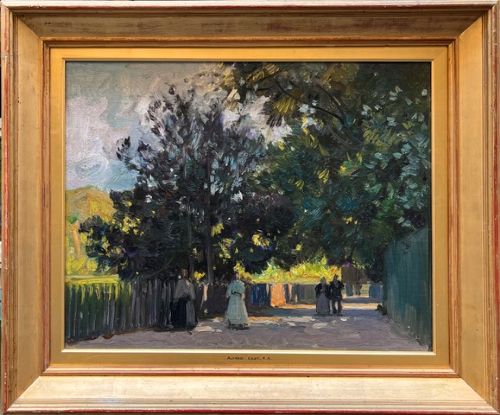
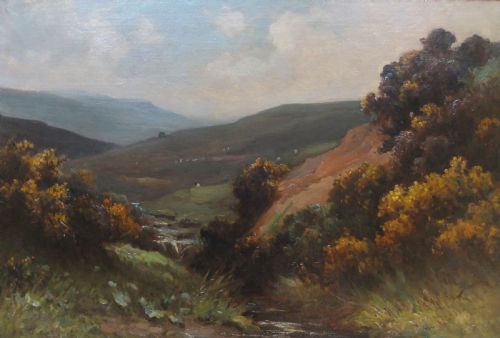
These plein air oil painting works capture direct observation of light and landscape, offering an authentic window into historic outdoor studios.
Plein Air Oil Painting
A plein air oil painting represents the tradition of working outdoors to capture immediate atmospheric effects and natural light. When exploring a plein air oil painting, buyers encounter landscape paintings, river scenes, and coastal views created across the nineteenth and twentieth centuries. These works span British Impressionism, French Impressionism, Post-Impressionism, and the Barbizon School, recording scenery from Cornwall to California.
The selections available range from Victorian river paths and 1870s Norman landscapes to 1930s French post-impressionist boards. Canvases and panels depict figures by rivers, chateaux, moorland streams, and marine sunsets. Each piece reflects the specific locale and moment observed by the painter outdoors.
Materials and methods
Artists painted directly onto canvas, wood panels, oil on paper on panel, or board using oil paint. These supports received pigment applied rapidly in the open air to secure transient effects of weather and sunlight.
Many works retain their original gilt wood frames, housing the oil painting securely while complementing the palette of the landscape or seascape within.
Listings feature oil paintings on canvas, wood panel, and board across Victorian, 19th-century, and 20th-century periods.
Assessing quality and execution
Quality rests in the handling of light, brushwork energy, and the fidelity of the atmospheric impression. Stronger works convey depth and immediacy with confident pigment application, whereas weaker examples lack spatial conviction or fail to capture the light of the scene.
The harmony of the composition and the preservation of the painted surface dictate the standing of a piece. Original framing also contributes to the integrity of the surviving artwork.
Sidney A. Court·Sir Alfred East·Honore Cavaroc·Ernest Higgins Rigg·Edmond Defonte·Fred Stead·Pierre Peltier·Kershaw Schofield·Kenneth Washburn·Henri Harpignies
The Plein Air Oil Painting Glossary
- Plein air
- The practice of painting outdoors to directly observe landscape and light. This method prioritises speed and directness to capture shifting atmospheric conditions.
- Barbizon School
- A mid-nineteenth-century French art movement focused on naturalistic landscape painting. Artists associated with this group worked in the forest of Fontainebleau to record unidealised nature.
- Impressionism
- A nineteenth-century movement characterised by relatively small, thin, yet visible brush strokes and an emphasis on accurate depiction of light. Practitioners sought to record everyday subjects captured in outdoor settings.
- Chiaroscuro
- The use of strong contrasts between light and dark to give a sense of volume to three-dimensional objects and figures. This technique adds dramatic depth to landscape compositions.
- Post-Impressionism
- A predominantly French art movement that developed from Impressionism, extending its boundaries while rejecting its limitations. Artists retained vivid colours and thick application of paint while exploring broader geometric forms.
Plein Air Oil Painting: Frequently Asked Questions
What is plein air painting?
Plein air painting is the act of painting outdoors to capture the direct effects of light and weather on a landscape.
Artists take their canvases and oil paints into the open air to record natural scenery as it appears in real time.
How do I date an antique oil painting?
Dating relies on recorded signatures, exhibition labels, stylistic movements, and the physical composition of the canvas or panel.
Examining the wooden stretcher, the backing materials, and the style of the gilt frame often provides further chronological context.
Where were these landscape paintings made?
These works were produced outdoors across various locations in Britain, France, and California.
Common subjects include rivers, coastal areas, forests, and meadows observed directly by the artist.
How should I care for an oil painting on panel?
Oil paintings on panel require stable indoor humidity and temperature to prevent the wood from warping or cracking.
Keeping the artwork away from direct sunlight and untreated heat sources preserves the oil paint and the underlying support.