
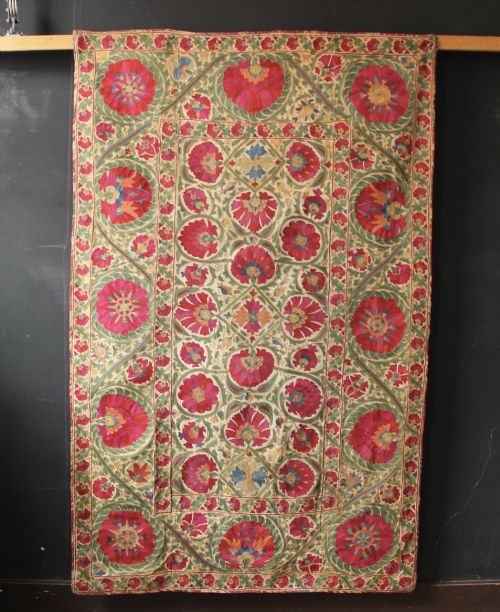


Pink Silk Wall Hanging
These pink silk wall hanging textiles bring rich Central Asian and Indian colour into a room with their striking embroidered designs.
Pink Silk Wall Hanging
A pink silk wall hanging typically appears as a suzani embroidery panel, a silk ikat panel, or an embroidered velvet textile from Central Asia or India. These pieces originate from periods spanning the nineteenth century through the early twentieth century, including regions such as Bukhara, Samarkand, and Shahrisabz.
Collectors frequently encounter Uzbek suzani panels worked in silk on a cotton ground, alongside gentleman's coats known as khalat and traditional Indian embroidery on velvet. The selection includes items attributed to specific tribal groups such as the Lakai, alongside larger nim suzani covers.
How they were made
Maker execution relies on silk embroidery threads applied to supporting foundations of woven cotton or velvet. Artisans constructed these textiles using traditional needlework techniques native to Central Asian and Indian workshops.
Ikat production involves warp-resist dyeing of the silk threads before weaving, producing characteristic feathered pattern edges. Embroidery panels utilise fine stitching over hand-drawn or block-printed botanical and geometric motifs.
Some gentleman's coats led such sheltered lives they still retain their original lining silks, looking as bright as the day they left Samarkand.
What varies in quality
Visual impact depends upon the density of the silk embroidery and the complexity of the polychrome palette. Finer examples display meticulous needle tension and sophisticated compositional balance across the textile surface.
The integrity of the ground material, whether cotton or velvet, and the preservation of the original hand-dyed hues distinguish standard workshop output from exceptional regional pieces.
The Pink Silk Wall Hanging Glossary
- Suzani
- An embroidered tribal textile from Central Asia, traditionally worked with silk thread on a cotton foundation. These panels were often created as part of a bride's dowry.
- Ikat
- A dyeing technique where yarn is resist-dyed before weaving to create patterned fabrics with characteristic hazy outlines. Silk ikat panels formed garments or decorative domestic furnishings.
- Nim suzani
- A smaller scale or half-size embroidered wall hanging panel from Central Asia. These versions offer concentrated decorative detail in a compact format.
- Khalat
- A traditional long coat worn across Central Asia, frequently fashioned from patterned silk ikat or striped becasab fabric. Surviving examples are often displayed as textile wall art.
- Velvet
- A woven tufted fabric with a dense pile, used as a heavy ground material for traditional Indian embroidery. Velvet panels provide a rich textural contrast to flat silk threadwork.
Pink Silk Wall Hanging: Frequently Asked Questions
How do I hang a textile securely?
Mounting requires a padded conservation batten or a discreet sleeve stitched to the reverse of the textile. This distributes the weight evenly across the entire upper edge.
Avoid using direct pins or nails through the fabric itself, as this strains the historic silk threads and cotton foundations.
Where were these textiles originally made?
The pieces originate primarily from Central Asian historical centres such as Bukhara, Samarkand, and Shahrisabz, produced by regional artisans and tribal groups including the Lakai.
Additional examples stem from traditional Indian embroidery workshops working on velvet and cotton supports.
How should I clean my wall hanging?
Surface dust should be removed gently using low-suction vacuum attachments protected by mesh screening. Professional textile conservators should handle any deeper cleaning.
Water washing risks dye bleed, especially on nineteenth-century natural silk dyes.
Can I display these textiles in direct sunlight?
Direct exposure to strong sunlight will fade natural silk dyes and weaken historic fibres over time. Position your wall hanging away from unshaded windows.
Utilising UV-filtered museum glass if framing, or keeping pieces in indirect room light, preserves the vibrant colours.