
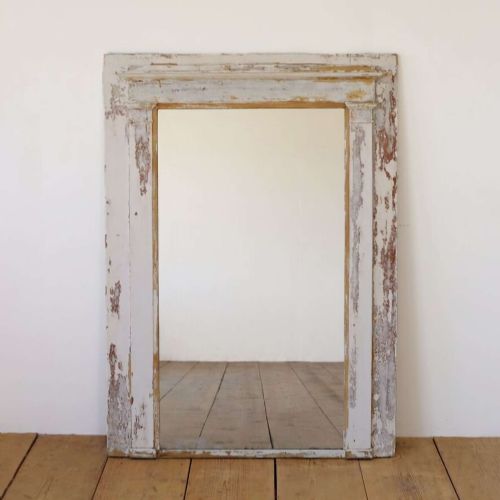
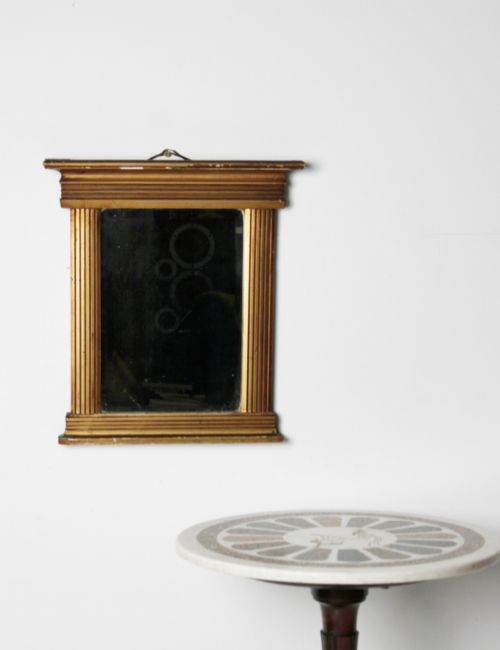

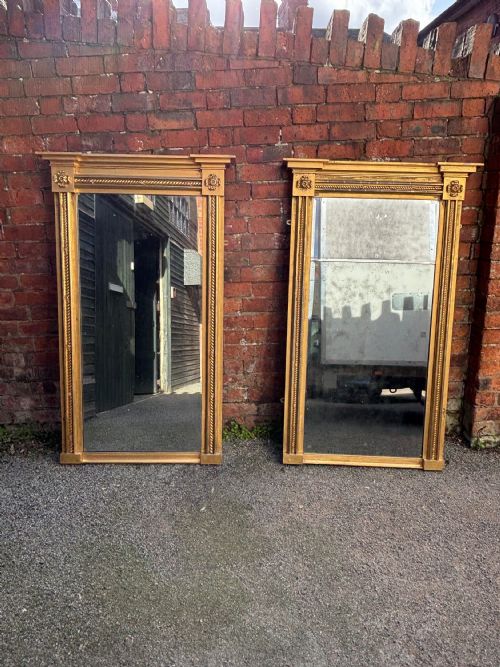


Pilaster Wall Mirror
A pilaster wall mirror brings architectural proportion and light to a room, built around the upright classical columns that frame the glass.
Pilaster Wall Mirror
A pilaster wall mirror frames reflection with structural verticality, drawing the eye upwards through architectural form. These pieces emerge chiefly from the nineteenth century, spanning Regency, George IV, and Victorian eras.
The selection ranges from compact pier mirrors designed for narrow wall spaces between windows to grand overmantel mirrors meant to sit above a fireplace. Makers of the period often turned to neoclassical and French neoclassical vocabularies to structure the surrounds.
Most examples rely on giltwood, gesso, or mahogany, occasionally incorporating painted finishes or silver leaf. A buyer seeking a pilaster wall mirror finds both intimate hanging hall pieces and large overmantel formats.
How they were made
Makers constructed these frames from primary timbers such as softwood or mahogany, applying layers of gesso to build up crisp architectural mouldings and relief ornament. Composition material often filled out the intricate neoclassical swags and capitals before gilding.
Giltwood surfaces received thin layers of gold leaf over bolus, while other frames utilised faux marble paint or silver leaf to mimic costly stone and metal. Verre eglomise panels frequently decorated the upper sections above the main mirror glass.
The listings span the nineteenth century, incorporating Regency, George IV, and Victorian periods alongside Neoclassical styles.
What varies in quality
The crispness of the carved detail and composition ornament determines the visual weight of the frame, distinguishing sharp architectural definition from softened or worn execution. Finer examples retain their original gilding and integrated verre eglomise panels without extensive re-working.
The selection of timber beneath the gesso and the proportion of the pilasters relative to the glass plate dictate the overall balance of the piece. Superior craftsmanship shows in the seamless joining of the architectural elements and the depth of the carved capitals.
The Pilaster Wall Mirror Glossary
- Pilaster
- A rectangular column that projects slightly from a wall, forming the vertical framing members of these mirrors. It mimics a classical pillar but serves a decorative rather than load-bearing function.
- Pier mirror
- A tall, narrow mirror specifically designed to hang on the wall space between windows. These pieces often feature pilasters and matched the vertical proportions of nineteenth-century rooms.
- Verre eglomise
- A cold-painting and gilding technique applied to the rear of glass panels. It frequently appears in the upper frieze of Regency mirrors.
- Gesso
- A plaster-like mixture applied to wood frames to create a smooth surface for gilding or to be moulded into relief decoration. Its application depth affects the sharpness of the final ornamentation.
- Overmantel mirror
- A wide mirror designed to sit directly upon the mantelpiece above a fireplace. These large formats often incorporate architectural framing to anchor the hearth.
Pilaster Wall Mirror: Frequently Asked Questions
Where should I hang a pilaster wall mirror?
These mirrors suit spaces where vertical lines require emphasis, such as narrow wall piers or above a mantelpiece where the architectural frame can anchor the room.
Overmantel versions balance the width of a fireplace, while smaller pier and hall mirrors make narrow passage walls feel more expansive.
How do I identify a Regency mirror?
Regency pieces often display neoclassical motifs, eglomise glass panels, and disciplined architectural framing using giltwood or mahogany.
The presence of reeded pilasters and classical proportions typically points toward early nineteenth-century manufacture.
What is the difference between pier and overmantel mirrors?
Pier mirrors are built tall and narrow to fit the wall space between windows, whereas overmantel mirrors span wider horizontal proportions for fireplaces.
Both styles frequently utilise pilasters, but their scale and intended placement within a nineteenth-century interior differ entirely.
Are these frames made of solid gold?
No, the frames consist of woods like softwood or mahogany coated in gesso and composition ornament, finished with a thin layer of gold leaf or gilt.
This technique provided the appearance of solid gold or gilded bronze while keeping the large architectural structures at a manageable weight.