
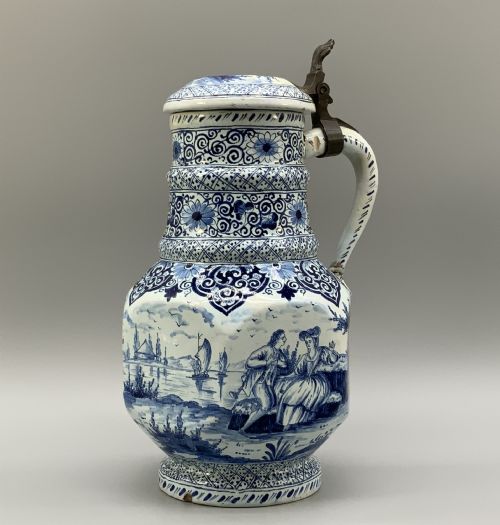
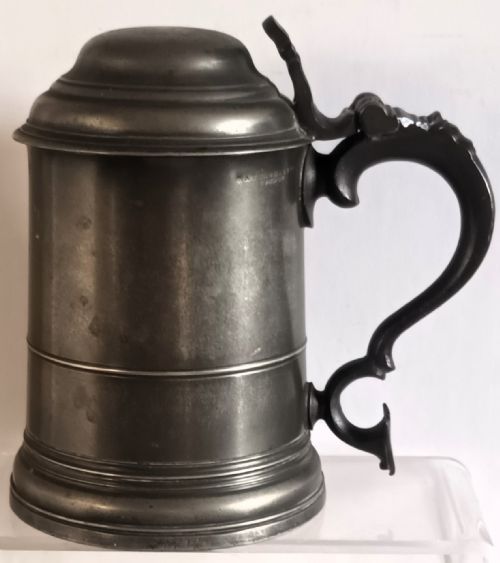


Pewter Lidded Stein
These pewter lidded stein examples combine metal and ceramic or plate to hold ale and cider with robust, practical engineering.
Pewter Lidded Stein
A pewter lidded stein bridges utilitarian drinking vessels and decorative craft, appearing across the eighteenth and nineteenth centuries in forms from plain tavern tankards to elaborate continental flagons. When you examine a pewter lidded stein on this page, you encounter pieces spanning Georgian, Victorian, Edwardian, and Arts and Crafts eras, originating from English, German, and Dutch workshops.
The domestic and tavern origins of these vessels mean they served heavy daily use in homes and public houses. English quart and pint measures sit alongside Westerwald salt-glazed stoneware, tin-glazed earthenware, and German faience, all unified by hinged metal lids designed to keep contents covered.
Continental examples often feature moulded or painted ornament, such as cobalt decoration and historicist motifs, while British pieces tend to prioritise clean metal surfaces and maker touchmarks. This variety reflects distinct regional drinking traditions across Britain, Germany, and the Netherlands.
How They Were Made
The construction of a pewter lidded stein relies on the pairing of cast or spun metal with ceramic bodies, glass, or plated copper. Pewter forms the lids, thumbpieces, hinges, and sometimes the entire body, alloyed to balance malleability with structural strength.
Ceramic bodies utilise salt-glazed stoneware or tin-glazed earthenware, shaped on the wheel and fired before mounting with metal mounts. Platings of silver and Old Sheffield Plate apply thin layers of precious metal over base metals to achieve a brighter finish.
Hinged thumbpieces require precise metalworking to ensure the lid lifts cleanly without straining the handle joint. Handles are securely soldered or riveted to the body to withstand the weight of a full measure of liquid.
Listings feature pieces in pewter, stoneware, copper, and silver plate across the eighteenth, nineteenth, and early twentieth centuries.
What Varies in Quality
Quality in a pewter lidded stein is dictated by the crispness of the casting, the integrity of the metal alloy, and the harmony between lid and vessel. Finer pieces display sharply defined touchmarks, well-fitted hinges that operate smoothly without lateral play, and balanced proportions.
Makers who invested care in decoration - such as Archibald Knox for Liberty & Co - achieved sculptural distinction through Celtic motifs and considered surface textures. Conversely, utilitarian tavern pieces prioritise heavy gauge metal over ornament, valuing durability and capacity marks above artistic flourish.
Watts & Harton·Archibald Knox for Liberty & Co·Burgum & Catcott
The Pewter Lidded Stein Glossary
- Touchmark
- A stamp or hallmark struck into pewter by the maker or guild to denote origin and standard. These marks allow researchers to attribute pieces to specific workshops.
- Westerwald
- A German region renowned for salt-glazed stoneware production, frequently featuring cobalt blue incised decoration. Pieces from here often form the ceramic body of continental lidded vessels.
- Old Sheffield Plate
- A composite material made by fusing a thin sheet of silver to a thicker copper base. It was widely used for tankards before the invention of electroplating.
- Thumbpiece
- The small lever attached to the lid of a tankard, allowing the drinker to push the lid open with a single thumb. Its design often aids in dating the piece.
Pewter Lidded Stein: Frequently Asked Questions
What is a pewter lidded stein?
A pewter lidded stein is a drinking vessel featuring a hinged metal lid attached to a body made of pewter, stoneware, earthenware, or glass.
These pieces were historically used for beer, ale, and cider in homes and taverns across Britain and continental Europe.
How do I date an antique stein?
Dating relies on stylistic clues, maker touchmarks, ceramic types, and the shape of the thumbpiece and handle.
Georgian and Victorian pieces exhibit distinct shifts in weight, metal composition, and decorative motifs that help narrow their era of manufacture.
Were these vessels used daily?
Most of these pieces served practical functions in households, inns, and guild halls for holding everyday drinks.
Their robust construction in pewter and stoneware ensured they could endure heavy handling and frequent washing.
How do I clean pewter safely?
Pewter requires gentle washing with warm soapy water and thorough drying to preserve its soft finish.
Avoid abrasive cleaners or aggressive polishing that can remove historic patination and soften maker marks.