
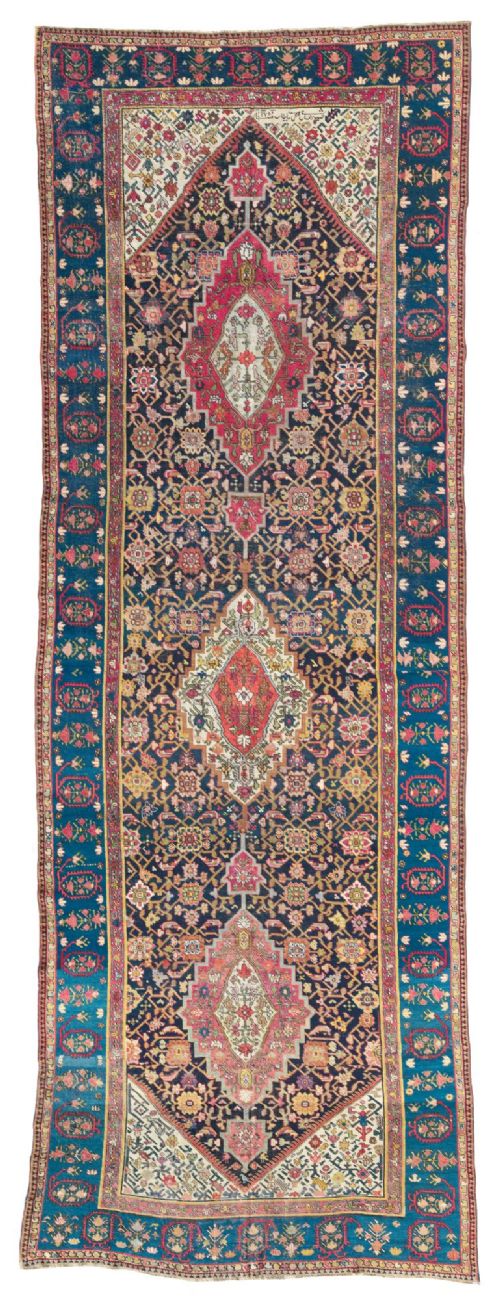


Persian Kelleh Runner
A persian kelleh runner is a long, narrow format woven carpet originating from Persia, valued for its striking room-length presence and rich tribal iconography.
Persian Kelleh Runner
A persian kelleh runner represents a specific elongated room format, bridging the proportion between a standard scatter rug and a full-sized carpet. The pieces seen here span from the mid nineteenth century through to the early twentieth century, originating from weaving centres across Persia including Bidjar, Malayer, Hamadan, and Kurdish regions.
Makers include various tribal and village groups such as the Luri, Qashqai, Khamseh, and Shashavan, alongside distinct regional workshops. The formats run narrow and long, traditionally designed to fit specific architectural spaces in Persian homes.
The aesthetic falls under traditional Persian, tribal, and nomadic styles, incorporating classic motifs such as the boteh, tree of life, crab pattern borders, and dragon borders. These textiles function as durable floor coverings that bring considerable historical depth to an interior.
Materials and Construction
These carpets are constructed primarily using wool and cotton foundations, with many examples utilising hand-spun wool for the pile. This natural material choice gives the surface resilience and a varied absorption of dye over decades of use.
The hand-knotting technique executed by village and nomadic weavers ensures a dense, durable structure capable of withstanding heavy foot traffic. Foundation threads of cotton provide structural stability to the elongated format.
Current listings feature hand-spun wool and cotton materials across runner formats dated from 1850 to 1930.
Assessing Quality and Character
Quality in these runners rests upon the density of the knotting and the crispness of the drawing within the tribal motifs. Superior examples display precise geometry in borders like the Harshang design and clear definition in pictorial elements such as the tree of life.
The handle of the wool and the vibrancy of the saturated dyes separate standard village production from exceptional tribal weaving. Natural colour variation across the field adds a visual depth that flat, uniform chemical dyes cannot replicate.
The Persian Kelleh Runner Glossary
- Kelleh
- A large format carpet that is longer than it is wide, traditionally positioned on the floor of a Persian reception room.
- Boteh
- A stylised almond or paisley motif representing a floral spray or cypress tree, frequently repeated across the field.
- Harshang
- A traditional crab-like geometric border pattern often found in North West Persian weaving.
- Pile
- The cut surface of the knotted wool yarn that forms the soft upper layer of the carpet.
Persian Kelleh Runner: Frequently Asked Questions
Where were persian kelleh runner carpets placed?
These elongated carpets were traditionally laid along the sides of a larger room or down the centre of long reception spaces in Persian houses.
Their narrow proportions suited specific architectural layouts, framing the floor space differently than a square or standard rectangular carpet.
How do I identify a Kurdish kelleh?
Kurdish examples typically feature robust wool, saturated colour palettes, and strong geometric or stylised floral borders such as dragons or boteh.
Weavers in the Kurdish regions utilised sturdy construction methods that resulted in heavy, durable runners designed for longevity.
What is a tree of life motif?
The tree of life is a symbolic design representing growth, eternity, and the connection between earth and the heavens.
In these runners, it appears as a central pictorial element surrounded by floral and tribal geometry.
How do I care for an antique wool runner?
Protect the antique wool pile by placing a breathable, high-quality rug underlay beneath the piece to prevent slipping and reduce friction.
Vacuum gently without using a rotating brush roll, and consult a specialist in historic textiles for professional cleaning.