




Period Round Mirror
A period round mirror brings deep focus and historic weight to a room, catching the light in a way flat glass never manages.
Period Round Mirror
When you search for a period round mirror, you enter a field dominated by convex wall mirrors from the Regency era, alongside Victorian and Georgian examples.
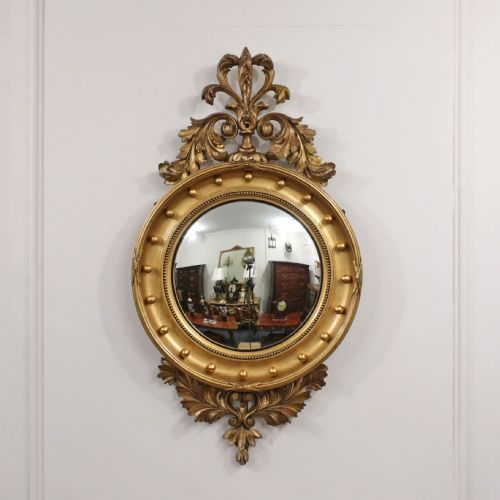
The convex mirror, often called a butler's mirror, curves outward to reflect a wide, distorted panorama of the entire interior space.
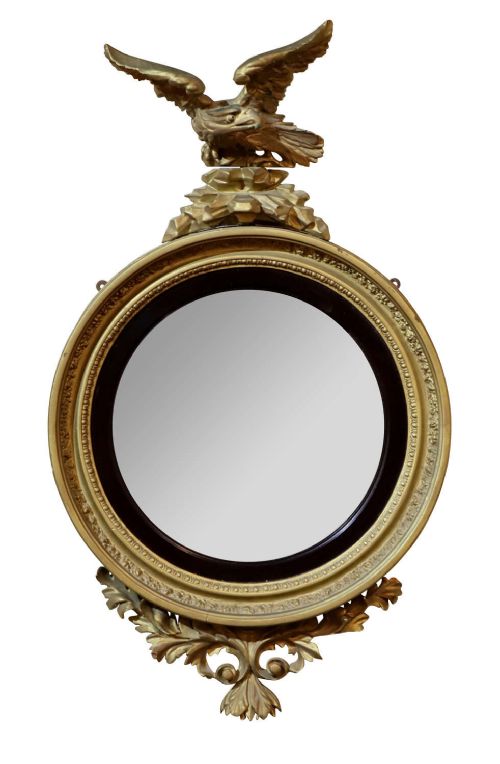
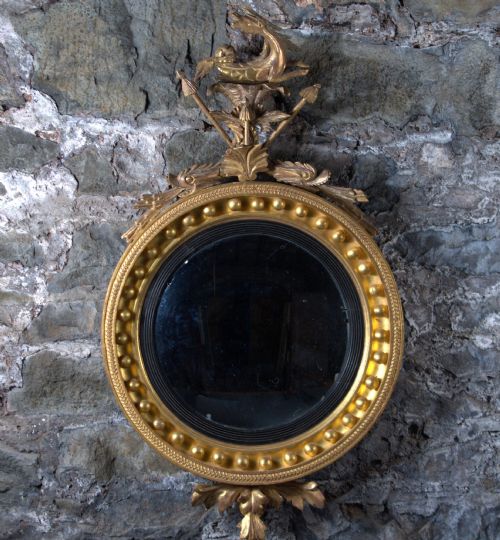
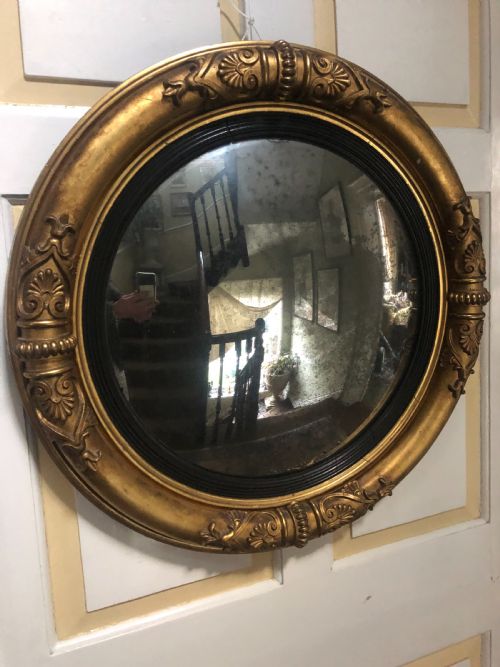
Most pieces you meet on this page date from the early nineteenth century, featuring circular giltwood frames that project presence on a wall.
How they were made
Makers fashioned these frames primarily from giltwood and gesso over a timber base, applying gold leaf to achieve a brilliant metallic sheen.
Convex glass plates required specialised blowing and silvering techniques to create the curved mirror plate.
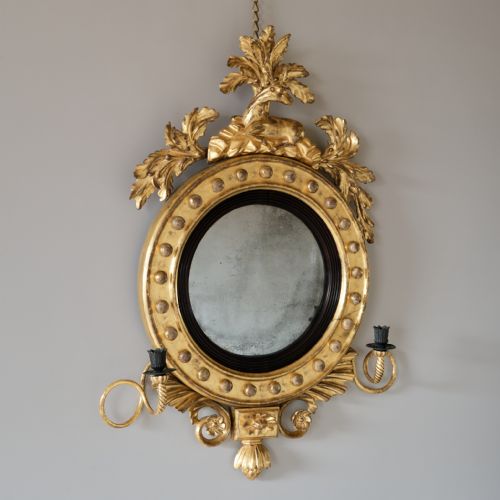
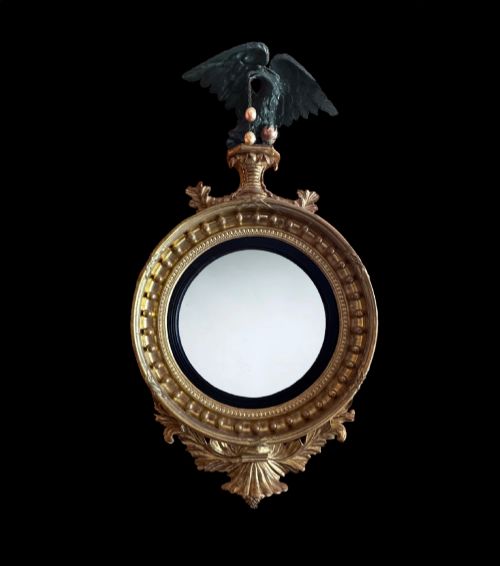
Details such as eagle surmounts, dragons, and ebonised wood inner rings were carved separately and fixed to the main circular frame.
Eagle surmounts peer down from the top of convex mirrors, originally placed there to watch over the household with regal vigilance.
What varies in quality
The crispness of the carved ornamentation, from eagle crests to reeded bezels, separates standard joinery from superior workshop output.
The depth and uniformity of the original gilding dictate the visual authority of the piece when light strikes the surface.
The integrity of the mirror glass itself, whether retaining its early foxing or showing later replacement, influences the historical character.
The Period Round Mirror Glossary
- Convex mirror
- A round mirror with an outward-curving glass plate that captures a panoramic reflection of the room. These were popular in the Regency period for security and decoration.
- Giltwood
- Timber coated with gold leaf over a prepared gesso ground. This finish gives the frames their characteristic warm metallic glow.
- Gesso
- A plaster mixture applied to wood frames before gilding to provide a smooth surface for carving and detail work. It allows for sharp decorative relief.
- Girandole
- A wall mirror fitted with candle sconces attached to the frame. The branches multiply the candlelight within the interior space.
- Foxing
- Age-related spots and discoloration within the mirror plate. Many collectors prize this sign of genuine antiquity.
Period Round Mirror: Frequently Asked Questions
Where should I hang a convex mirror?
These mirrors were traditionally placed in dining rooms or parlours to monitor guests and diffuse light across the space. Hang them at eye level where the curved reflection can take in the widest angle of the room.
Because of their optical distortion, they work best opposite a window or fireplace rather than in narrow hallways where closeness accentuates the bend.
How do I date a Regency round mirror?
Look closely at the framing details, the construction of the backboards, and the style of any carved ornament like eagles or candelabra arms. Regency pieces often incorporate ebonised reeded bezels and heavy gesso moulding.
Comparing the timber types and the weight of the gilding layers helps distinguish genuine early nineteenth-century work from later reproductions.
Why do some round mirrors have convex glass?
Convex glass was designed to reflect a sweeping, panoramic view of an entire apartment without distortion of proportion, albeit with curved edges. Butler's mirrors allowed staff to observe service needs across a dining table.
The optical effect also served a practical purpose in darker historic interiors by gathering and dispersing ambient light from candles and windows.
How do I clean an antique giltwood frame?
Dust the carved surfaces very gently with a soft, dry brush to prevent any damage to the delicate gesso and gold leaf. Avoid commercial cleaning liquids entirely, as moisture strips the historic finish.
Professional restoration is necessary if the gilding flakes or the gesso foundation cracks away from the underlying wood.