
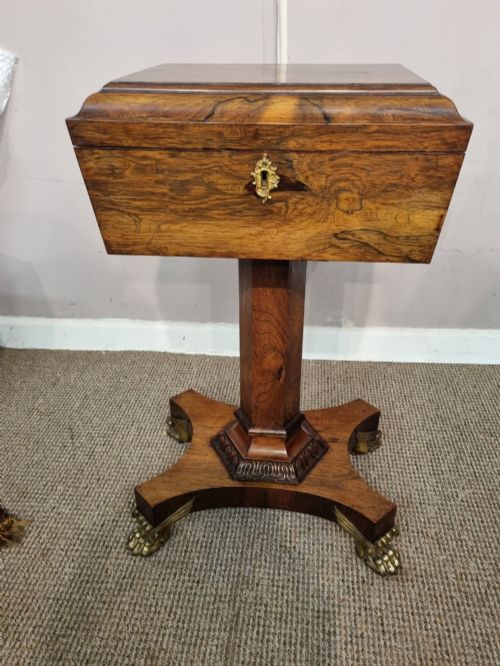
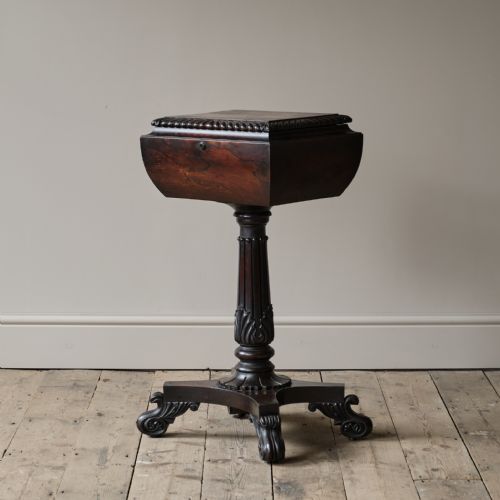


Pedestal Tea Caddy Stand
These pedestal tea caddy stand pieces, known widely as teapoys or tea poys, offer a refined centrepiece for storing precious tea.
Pedestal Tea Caddy Stand
A pedestal tea caddy stand, commonly designated in the trade as a teapoy or tea poy, is a freestanding box designed to hold tea leaves safely away from humidity and light. Most examples encountered on this page date from the Georgian, Regency, William IV, and Victorian periods, spanning the nineteenth century.
These pieces typically combine a lidded storage box with a central pillar and a stable platform base, occasionally taking the form of a sarcophagus shaped box or an occasional table. Alongside standard tea storage, some variations function as work boxes, spirits tables, or jardiniere stands.
The dominant timbers appearing in these listings are rosewood and mahogany, accompanied by burr walnut, burr maple, burr elm, and burr yew. Stylistic influences range from British Regency and William IV designs to Swedish Biedermeier.
Materials and construction
Cabinetmakers constructed these pieces using dense hardwoods such as mahogany and rosewood, frequently applying decorative veneers like flame mahogany, burr maple, and burr elm over sturdy secondary timbers. Solid mahogany also appears among the listings.
Ornamentation relied on skilled cabinetwork techniques including brass inlay, intricate carving upon pillars and feet, and fitted internal compartments for mixing and storing tea.
Some nineteenth century tea containers double as spirits tables, proving that hosts occasionally preferred a stronger brew.
Distinctions in quality
The standard of a pedestal tea caddy stand rests upon the choice of timber and the precision of its grain matching, where highly figured flame mahogany or richly patterned rosewood elevates the piece. The complexity of the internal fittings and the crispness of any brass inlay or carved woodwork further distinguish finer examples.
Structural integrity of the central pillar and the weight of the supporting base govern the balance and presence of the stand. Maker attribution, such as stamping by Gillows, provides a reliable indicator of superior workshop execution.
Gillows
The Pedestal Tea Caddy Stand Glossary
- Sarcophagus
- A box form with a sloping lid and flared or panelled sides, frequently utilised in Regency teapoy design. This shape recalls classical stone sarcophagi adapted for domestic cabinetwork.
- Jardiniere
- A decorative stand or container intended to hold plants or flowers, sometimes shared in form with tea furniture of the Georgian period. These items utilise water-resistant linings or fitted trays.
- Flame mahogany
- A highly figured timber veneer displaying a flickering, flame-like grain pattern prized by Regency cabinetmakers. It requires considerable skill to lay evenly across curved box surfaces.
- Work box
- A compartmented container integrated into tea furniture for sewing and needlework accessories. These interiors feature lidded wells and small partitions.
Pedestal Tea Caddy Stand: Frequently Asked Questions
What is a teapoy?
A teapoy is a lidded container raised on a pillar and base, built to store dried tea leaves securely in a drawing room or parlour. The name derives from Eastern terms for tea combined with the word for foot.
Over the nineteenth century, the form expanded from simple tea storage into a versatile piece incorporating mixing bowls and storage compartments for domestic use.
How were teapoys used?
Teapoys served as secure repositories for expensive tea, which was locked away by the mistress of the house to prevent servants from helping themselves. The internal caddies often featured removable canisters and a central glass mixing bowl.
When tea parties concluded, the leaves were stored back inside the lidded box until the next gathering.
How do I date a teapoy?
Dating relies upon timber choice, carcass construction, and decorative motifs characteristic of periods such as the Regency, William IV, or Victorian eras. Regency examples frequently showcase rosewood with brass inlay, whilst later Victorian pieces often employ heavier oak or walnut.
Carved feet, pillar turnings, and internal box configurations offer additional clues for establishing the decade of manufacture.
Can I use a teapoy as an occasional table?
Many examples function well as decorative accent pieces or bedside tables due to their compact footprints and flat tops. The internal compartments remain useful for storing small modern items.
Care should be taken to protect delicate wood surfaces from moisture or heavy objects.