

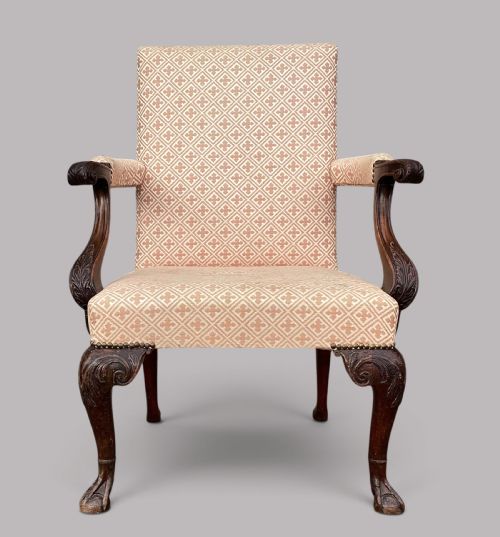
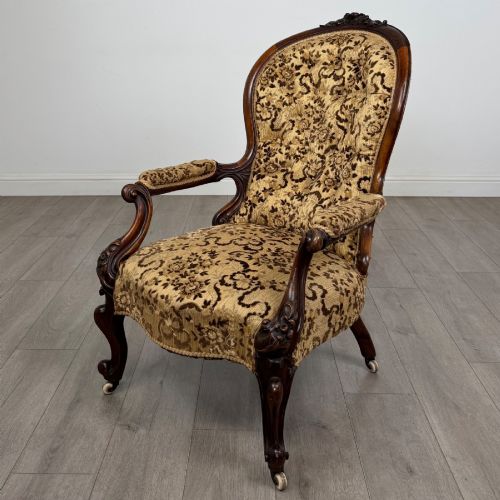
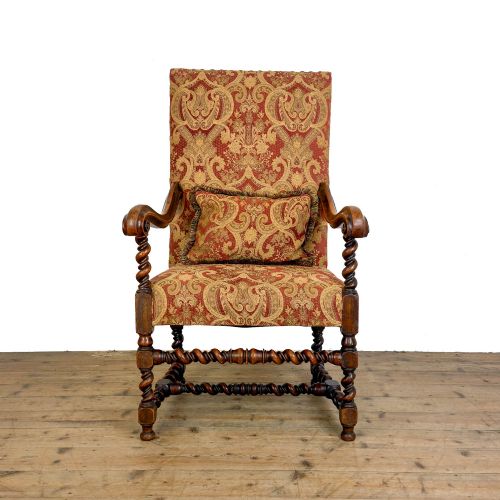


Patterned Fabric Open Armchair
A patterned fabric open armchair brings character to a room through exposed timber frames and textile upholstery, offering comfortable seating with distinct period presence.
Patterned Fabric Open Armchair
When you search for a patterned fabric open armchair, you encounter seating built across several centuries, from George II and Victorian periods to Edwardian and later interpretations. These pieces combine exposed wooden frames in walnut, mahogany, and rosewood with patterned textile covers.
The versions you meet most frequently on this page date from the nineteenth century, including Victorian and William IV examples. They span various stylistic influences, incorporating French Chateau, French Empire, and Carolean Revival details alongside simpler vernacular forms.
The structural layout involves open sides with armrests supported above the seat rail, allowing the upholstered back and seat to display printed, woven, or ticking fabrics. These chairs function equally well as fireside seating, desk chairs, or decorative accents in a sitting room.
Construction and materials
Makers built these frames using solid hardwoods, notably walnut and mahogany, selected for their strength and grain pattern. Carved elements, turned supports, and inlaid details require precise woodworking techniques developed over generations by cabinetmakers.
Upholstery methods evolved from traditional stuffing techniques involving webbing and natural fillings to button-backed springing and hand-tacked textile layers. Fabrics range from printed cottons and historical patterns to heavy velvets and ticking.
Patterned Fabric Open Armchair Retail Price Guide 2026
Typical asking prices for patterned fabric open armchair among the pieces listed under this phrase on Sellingantiques today, from the lower quarter to the upper quarter. They describe what is for sale here now, not the wider market.
Judging quality and craftsmanship
The distinction between standard and exceptional pieces rests upon the crispness of the timber carving and the integrity of the frame construction. Superior examples exhibit harmonious proportions, tight joinery, and carefully selected timbers that display deep natural colour.
Upholstery execution also defines quality, visible in the alignment of fabric patterns across cushions and backrests, as well as the durability of the internal stuffing. Original or sympathetic textile choices enhance the visual cohesion of the piece.
Giles Grendey·Howard and Sons·William Morris
The Patterned Fabric Open Armchair Glossary
- Open armchair
- A seat featuring uncovered wooden arms rather than fully padded upholstered sides. This design highlights the structural framework of the chair.
- Walnut
- A dense, dark hardwood utilised extensively for cabinetmaking and furniture frames during the seventeenth, eighteenth, and nineteenth centuries. It takes a fine polish and allows for delicate carving.
- Mahogany
- A durable, reddish-brown tropical hardwood favoured for high-quality furniture construction from the eighteenth century onward. Its stability makes it suitable for intricate carved details.
- Upholstery
- The padded and textile-covered components of a chair, including seats, backs, and arm pads. It combines internal support materials with decorative outer fabrics.
Patterned Fabric Open Armchair: Frequently Asked Questions
How do I date these chairs?
Dating relies on identifying timber species, construction methods, and stylistic characteristics associated with specific eras like the Georgian or Victorian periods. Walnut and mahogany were used across different centuries, but carving styles often reveal the prevailing aesthetic.
Comparing leg shapes, stretcher placement, and upholstery techniques helps narrow down the decade of manufacture.
Are these chairs comfortable for daily use?
Most of these chairs offer supportive seating designed for parlours, studies, and living spaces. The depth and angle of the seat vary according to the period and specific style.
Modern users often pair them with footstools or position them as reading seats where upright posture is preferred.
How do I care for patterned fabric?
Maintenance depends on the specific textile, whether it is printed cotton, woven wool, or heavy velvet. Regular light vacuuming removes surface dust and prevents fibres from wearing down.
Professional cleaning is recommended for antique or delicate textiles to preserve the integrity of the pattern and the underlying stuffing.