


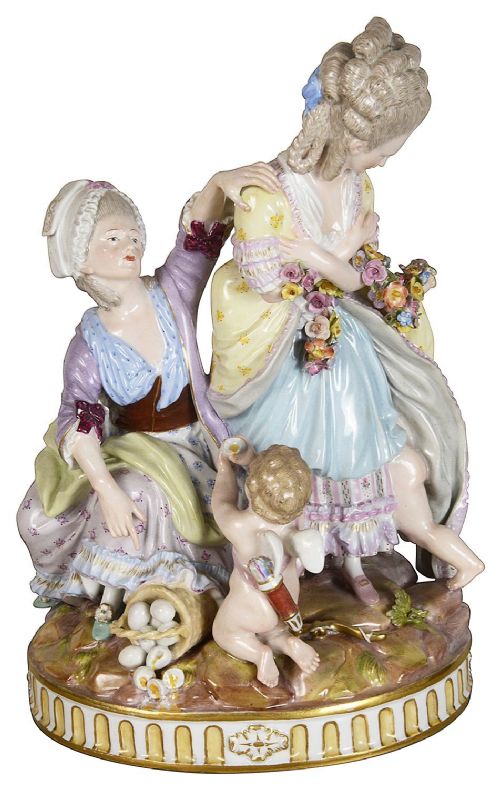


Pastel Porcelain Figures
Pastel porcelain figures bring quiet, historic charm to a room, showing pastoral subjects and delicate modelling in soft, pale tones.
Pastel Porcelain Figures
Pastel porcelain figures comprise figurines, groups, and sculptural pieces modelled as human figures, children, and fisher folk in gentle, muted palettes. You will find examples ranging from mid eighteenth-century English works to nineteenth-century continental pieces from German and French factories.
Objects vary from simple ceramic bisque figures of children to elaborate Meissen groups and French sculptural pairs. Most common are decorative figures and groupings depicting everyday or mythological characters in garden settings.
How they were made
These pieces utilise hard-paste porcelain and bisque porcelain, shaped into intricate forms using moulds and hand-modelling techniques. Bisque pieces remain unglazed to produce a matte, marble-like surface texture, whereas glazed porcelain receives enamel painting.
Painters applied delicate paint washes in pastel hues, sometimes enhanced with gold leaf and gilt highlights to accentuate garment details and floral bases. Firing in kilns set the pigments and glazes, fixing the soft colour schemes seen on the finished sculptures.
Pastoral figures often feature tiny porcelain sheep that manage to look remarkably unconcerned about impending rain.
What varies in quality
Quality rests in the crispness of the modelling and the finesse of the hand-painting across faces, hands, and garments. Superior examples retain fine details in fingers and facial expressions without blurring.
The application of gilding and enamel colours separates standard decorative output from finer workshop productions. Better pieces show careful brushwork in the pastel hues rather than flat, uniform washes.
Meissen·Volkstedt·Vion and Baury·Sitzendorf·Bow
The Pastel Porcelain Figures Glossary
- Bisque porcelain
- Un-glazed ceramic material fired once to produce a matte, porous surface resembling white marble. It is particularly common in nineteenth-century French sculptural figures.
- Hard-paste porcelain
- A durable ceramic composition fired at high temperatures using kaolin and petuntse. It forms the robust body of many continental figures.
- Enamel
- Vitrified glass paste applied to porcelain surfaces as decoration before firing. It provides the soft pastel colours characteristic of these figures.
- Rococo Revival
- A nineteenth-century design style reviving the asymmetrical scrolls, C-curves, and naturalistic flora of the mid eighteenth century. It appears frequently in bases and frames of this period.
- Gold leaf
- Extremely thin sheets of beaten gold applied to porcelain details. It adds metallic highlights to garments and bases.
Pastel Porcelain Figures: Frequently Asked Questions
How do I clean pastel porcelain figures?
Dust these delicate pieces gently with a soft, dry brush to prevent dirt accumulation in crevices and painted areas.
Avoid using water or liquid cleaners, particularly on unglazed bisque surfaces or items with gilt highlights, as moisture can damage old paint layers.
Where were these porcelain figures made?
Production centres span England, Germany, and France, with prominent factories such as Meissen, Sitzendorf, and Volkstedt shaping continental output.
English origins include early factories like Bow, while various French workshops produced the large bisque sculptures and chariot vases found in the period.
How can I tell the period of a figure?
Examine the base style, paste composition, and painting technique to gauge whether a piece belongs to the eighteenth or nineteenth century.
Stylistic markers like Rococo Revival scrolls point towards the Victorian era, while factory marks help confirm earlier eighteenth-century origins.