
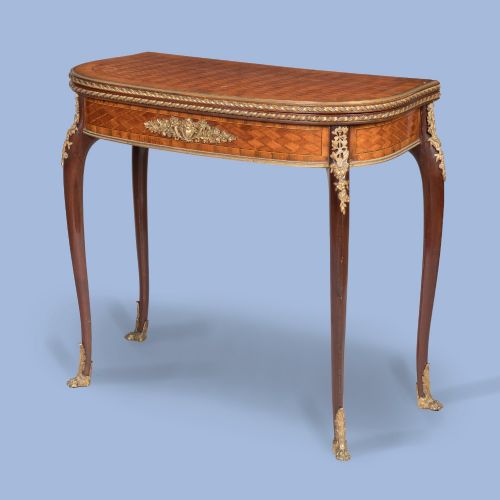


Parquetry Card Table
A parquetry card table brings geometric wood patterns and folding surfaces together, offering a functional centrepiece with period charm.
Parquetry Card Table
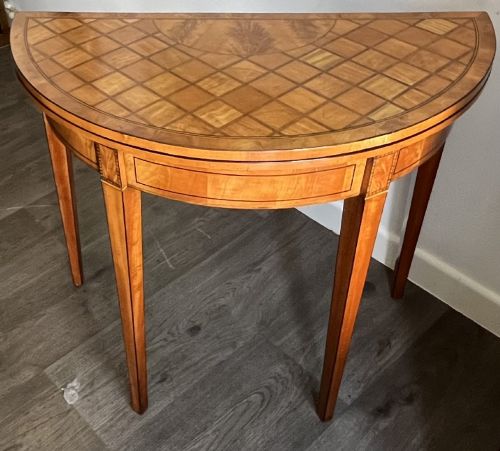
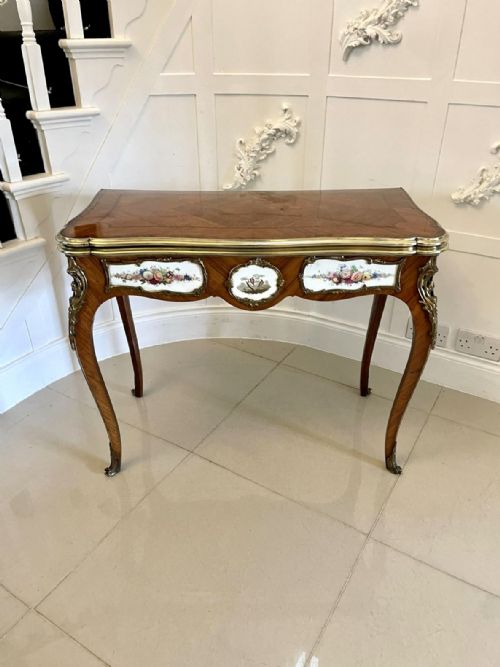
A parquetry card table combines geometric wood veneers with a folding or rotating top designed for gaming and social use. Buyers searching for a parquetry card table typically encounter nineteenth-century French pieces alongside eighteenth-century examples and later revivals.
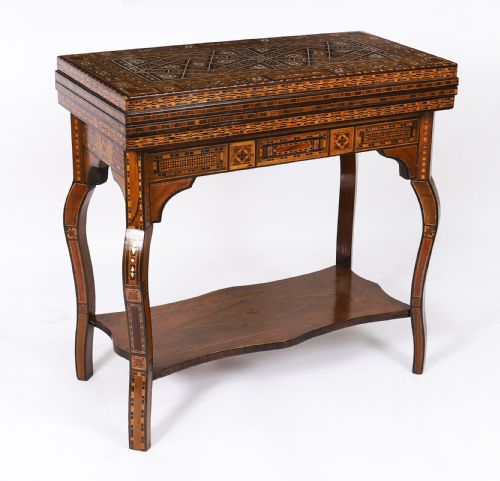
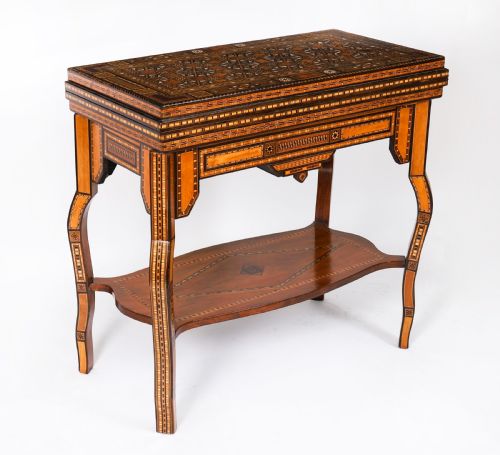
The forms span demi-lune shapes, rectangular console tables, and multi-game surfaces that incorporate chess and backgammon boards. These tables often reflect Louis XV and Louis XVI revivals, bringing intricate marquetry and parquetry patterns into domestic settings.
Geographic origins extend from French workshops to British makers and Levantine or Syrian Ottoman studios. Most pieces available on this page date from the nineteenth century, showcasing walnut, kingwood, and elaborate parquetry tops.
Materials and construction
Craftsmen built these tables using timber frames veneered with kingwood, walnut, satinwood, and fruitwood. Geometric parquetry designs were meticulously cut and fitted to form intricate surface patterns across the folding tops.
Ormolu mounts, gilt bronze details, and occasional applications of bone or mother-of-pearl accentuate the wooden structures. Workshops employed specialised cabinet-making techniques to ensure folding and rotating mechanisms operated smoothly within the veneered frames.
Periods represented span from the 18th century through the 19th century up to the 1930s, encompassing Georgian and revival styles.
Evaluating craftsmanship and execution
Quality rests in the precision of the wood geometry and the crispness of the parquetry alignment across the folding leaves. Superior examples maintain tight veneer joints and structural stability in the legs and pivoting hinges.
The integration of cast or chased ormolu mounts and the choice of dense timbers like kingwood and walnut separate standard production from exceptional cabinet work. Maker attribution and the complexity of multi-game interiors further elevate the standing of individual pieces.
G T Morant·François Linke·Maison Mottheau·Joseph-Emmanuel Zwiener·E Kahn
The Parquetry Card Table Glossary
- Parquetry
- Geometric mosaic woodwork formed by small pieces of veneer arranged in repeating patterns such as cubes or triangles. It differs from pictorial marquetry by relying strictly on geometric repeat.
- Kingwood
- A dense, richly figured timber imported from South America that was favoured by eighteenth- and nineteenth-century cabinet makers. Its dark violet-brown tones and distinctive grain make it ideal for contrasting parquetry.
- Ormolu
- Gilt bronze mounts applied to furniture to protect corners, frame panels, and enhance decorative schemes. The technique involves applying a gold amalgam to bronze before firing.
- Demi-lune
- A half-moon shape characteristic of tables designed to sit flat against a wall when closed and unfold into a full circle or semicircle for play. This form appears frequently in Louis XV and XVI revival pieces.
- Levantine
- Pertaining to the eastern Mediterranean region, denoting tables featuring distinctive regional inlay techniques and multi-game functions. These pieces often combine card, chess, and backgammon surfaces.
Parquetry Card Table: Frequently Asked Questions
How do these tables function?
The top surfaces typically fold out, swivel, or lift to reveal a baize-lined playing area and sometimes hidden compartments for cards and counters. Many incorporate multi-game boards for chess and backgammon beneath the primary folding lid.
Engineering within the frame allows the legs to pivot or pull out to support the opened leaf safely during use.
What periods do these pieces represent?
Examples span from the eighteenth century through the nineteenth century and into the early twentieth century. Nineteenth-century pieces frequently adopt earlier French royal styles such as Louis XV and Louis XVI.
Revival pieces from the late eighteen-hundreds sit alongside genuine eighteenth-century survivors and later twentieth-century interpretations.
Where were these tables made?
Production centres were concentrated primarily in France, particularly Paris, where master cabinet makers produced elaborate parquetry furniture. British workshops also manufactured comparable forms, often influenced by French designs.
Eastern Mediterranean regions contributed Levantine and Syrian Ottoman variations featuring distinct inlay materials and multi-game layouts.
How do I care for parquetry surfaces?
Maintain stable room humidity and avoid placing wooden furniture in direct sunlight to protect delicate veneers and natural timber tones. Regular dusting with a soft, dry cloth preserves the finish without requiring harsh chemical polishes.
Take care when opening folding leaves to avoid straining historic hinges and pivot mechanisms embedded in the wood.