

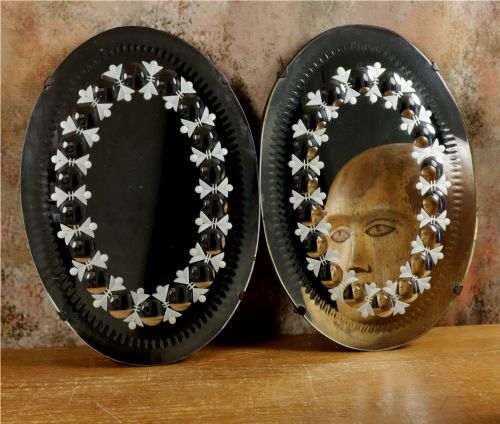
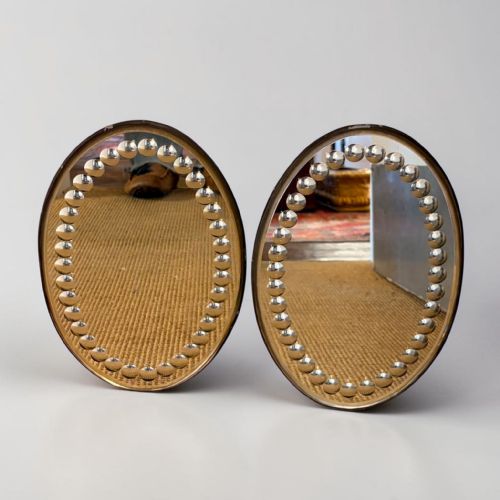


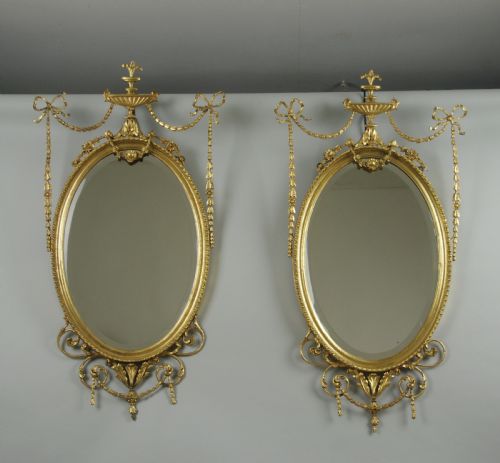


Pair Vintage Oval Mirrors
Pair vintage oval mirrors bring symmetry to a room, offering matching reflective surfaces framed in giltwood, brass, or carved wood.
Pair Vintage Oval Mirrors
When you search for pair vintage oval mirrors, you are looking at matched sets of wall-hanging looking glasses spanning the Victorian, Edwardian, and early twentieth-century periods. These decorative items range from simple painted wooden frames to ornate gilt brass and carved giltwood constructions.
The assortment includes specialised forms such as girandoles alongside standard wall mirrors fitted with original glass plates. Originating mainly from English and French design traditions, these pieces retain their historical character through period fixings and frames.
Materials and construction methods
Frames are constructed from carved wood, gesso, and giltwood, often built up with intricate plaster ornamentation before receiving a gold leaf or metallic finish. Gilt metal and gilt brass examples utilise cast or pressed metal components to achieve decorative detail.
Mirror plates are set within the frames using traditional methods, sometimes featuring bevelled edges to catch the light. Simulated wood finishes and painted surfaces appear alongside carved giltwood, demonstrating a variety of workshop techniques across the different decades.
Pair Vintage Oval Mirrors Retail Price Guide 2026
Typical asking prices for pair vintage oval mirrors among the pieces listed under this phrase on Sellingantiques today, from the lower quarter to the upper quarter. They describe what is for sale here now, not the wider market.
Peach-tinted glass brings a warm glow to the room, proving that past decades understood the flattery of a softly coloured reflection.
Assessing quality in matched pairs
The refinement of the carving and the crispness of the gesso work distinguish finer examples from simpler production. Superior frames retain their original gilding depth and structural integrity without heavy restoration or loss to the ornamental relief.
The quality of the mirror plate itself and the presence of original fittings contribute to the desirability of a set. Matched pairs that have remained together with uniform ageing across both frames hold greater cohesion than assembled sets.
The Pair Vintage Oval Mirrors Glossary
- Giltwood
- Wood that has been covered with a thin layer of gold leaf or gesso preparation. It provides a bright reflective surface that mellows gracefully over the decades.
- Gesso
- A plaster-like material applied to wood frames to create a smooth surface for carving or gilding. It allows for intricate relief ornamentation.
- Bevelled glass
- Mirror plate with an angled edge ground down to a narrower width. This technique refracts light and adds depth to the glass margin.
- Girandole
- A decorative wall mirror featuring attached candle sconces. The candle arms multiply the reflected light within the room.
- Rococo Revival
- A nineteenth-century design style drawing on asymmetrical scrolls, shell motifs, and naturalistic curves. It dominates many Victorian mirror frames.
Pair Vintage Oval Mirrors: Frequently Asked Questions
Where should I hang a pair?
These mirrors work best hung symmetrically on either side of a fireplace, doorway, or large piece of furniture. Placing them opposite a window also helps to bounce natural light around the room.
Ensure the hanging fixings match the weight of the frames and use appropriate wall anchors for security.
How do I date an antique mirror?
Dating relies on examining the construction of the frame, the backing boards, and the characteristics of the glass plate. Victorian and Edwardian pieces often show specific stylistic revivals like Neoclassical or Rococo details.
Original fixings and backboards provide reliable clues to the period of manufacture.
What is the difference between giltwood and gilt brass?
Giltwood consists of a wooden base covered in gold leaf, whereas gilt brass involves a metal substrate treated with a metallic finish. Giltwood frames generally feature hand-carved details or moulded gesso relief.
Gilt brass items offer a different weight and are typically associated with specific twentieth-century manufacturing techniques.
Can I clean the mirror plates safely?
Cleaning requires a soft cloth and a mild glass cleaner applied sparingly to avoid seeping behind the frame edges. Strong chemicals should be kept away from the gilt or painted wooden surfaces.
Older mirror plates may have silvering loss, which is part of their age and should be treated with gentle care.