




Pair of Whatnots
A pair of whatnots brings tiered shelving and display space to a room, offering matched elegance in timber and brass.
Pair of Whatnots
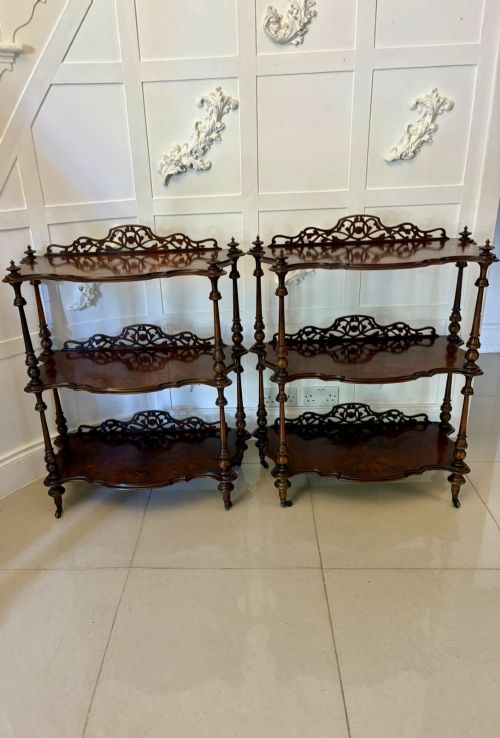
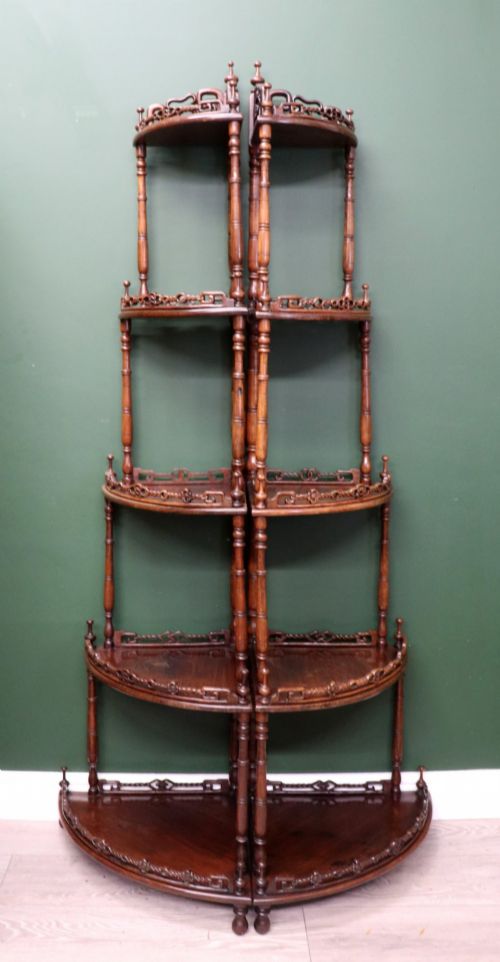
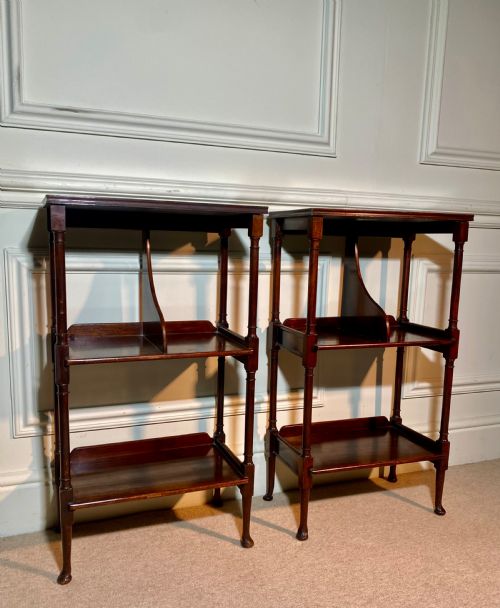
A pair of whatnots comprises matched tiered shelving units designed for displaying small objects, books, and decorative pieces. These multi-shelf pieces appear in forms ranging from corner stands and open bookcases to bedside night stands and etageres.
The selections span the Regency, Victorian, and Edwardian periods, stretching into the early twentieth century. Buyers encounter walnut, mahogany, rosewood, and oak constructions, frequently configured with three tiers for open display.
Materials and construction
Timbers such as mahogany, burr walnut, and rosewood form the structural framework, occasionally accented with boxwood inlay or turned wood supports. Brass components and ormolu add detail and structural strength to the tiers.
Makers utilised traditional joinery to construct multi-tiered shelving and corner units, balancing weight distribution across three or more levels. Surfaces exhibit polished timber grains, sometimes enhanced with birdseye maple or yew-wood veneers.
Pair of Whatnots Retail Price Guide 2026
Typical asking prices for pair of whatnots among the pieces listed under this phrase on Sellingantiques today, from the lower quarter to the upper quarter. They describe what is for sale here now, not the wider market.
Octagonal oak shelves prove that even a humble storage stand wanted to be a geometry lesson.
Distinctions in quality
The choice of timber grain and veneer work separates standard pieces from finer examples, with burr walnut and rosewood demonstrating greater decorative depth. The crispness of turned wood columns and boxwood inlay reveals the maker's hand.
Proportion and matching between the pair dictate desirability, as symmetrical grain patterns and uniform tier heights elevate the ensemble. Structural integrity in the upright supports and shelf joints maintains the balance required for display furniture.
Gillows
The Pair of Whatnots Glossary
- Whatnot
- A piece of furniture consisting of a set of open shelves for displaying small objects or books. They emerged in the eighteenth century and remained popular through the Victorian era.
- Etagere
- A piece of furniture with a series of open shelves for displaying ornaments. The term is often used interchangeably with whatnot.
- Regency
- A British design period spanning the early nineteenth century. It draws inspiration from classical Greek, Roman, and Egyptian motifs.
- Ormolu
- Gilt bronze mounted on furniture or decorative objects. It provides metallic contrast against dark timbers like mahogany and rosewood.
- Burr walnut
- Timber taken from a walnut tree outgrowth, producing intricate swirling patterns. It is highly valued for veneering fine furniture surfaces.
Pair of Whatnots: Frequently Asked Questions
What is a whatnot used for?
A whatnot is designed for displaying small decorative items, ceramics, and books across multiple open shelves. They function effectively in living spaces and bedrooms as auxiliary storage and display surfaces.
Historically, these tiered stands held ornaments that reflected the collector's interests. Today, they serve a similar decorative purpose while adding period character to a room.
How do I date a pair of whatnots?
Dating relies on identifying timber choices, construction techniques, and stylistic markers associated with specific periods. Regency examples often feature rosewood and classical proportions, whilst Victorian pieces frequently utilise burr walnut or mahogany.
Secondary details such as boxwood inlay, turned wood supports, and brass fittings help narrow down the decade of manufacture. Comparing the form to documented archive pieces provides further chronological context.
Are matching pairs common?
True matching pairs of antique whatnots are scarcer than single pieces, as many were produced individually or became separated over time. Finding a matched pair from the same period requires careful comparison of timber, dimensions, and tier counts.
These paired sets often originate from larger reception rooms or libraries where symmetrical placement was desired. They provide balanced visual weight on either side of a fireplace or window.
Where should I place them?
Pairs of whatnots suit placement flanking a fireplace, framing a doorway, or positioned in adjacent corners of a room. Corner shelves and stands make efficient use of unutilised wall junctions.
Bedside versions function as night stands, offering tiered surface space next to a bed. Their open construction keeps rooms feeling spacious while providing ample display capacity.