
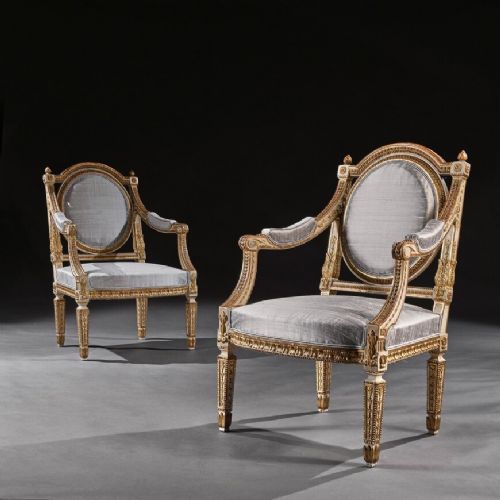
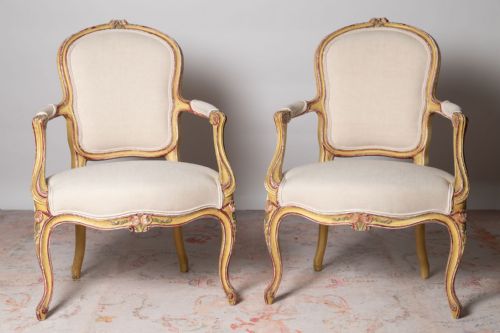
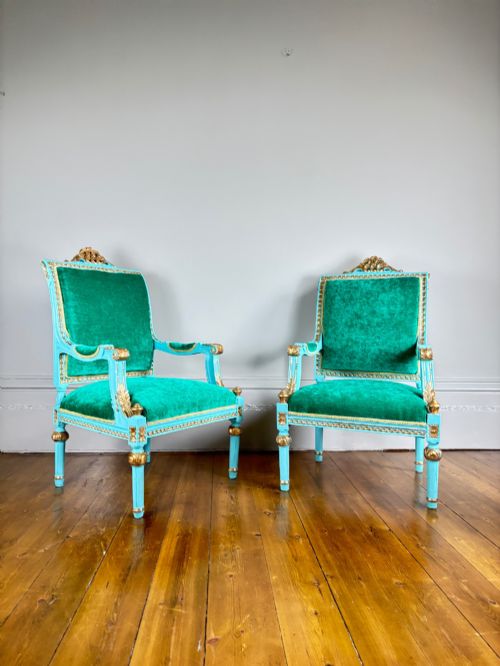
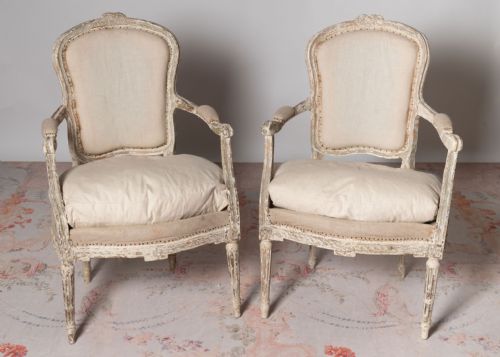


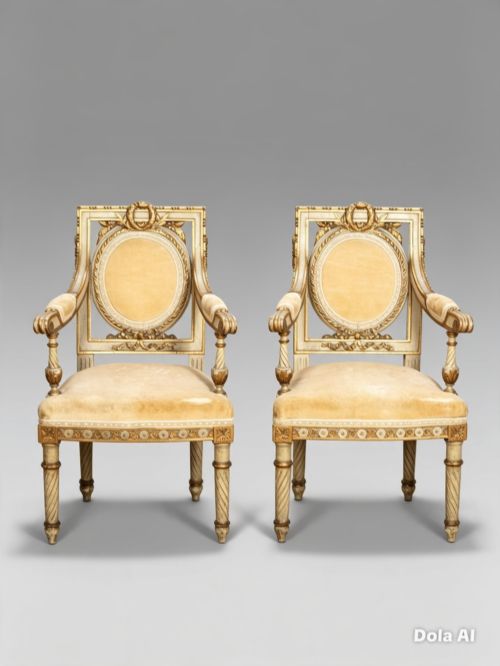


Pair of Painted Fauteuils
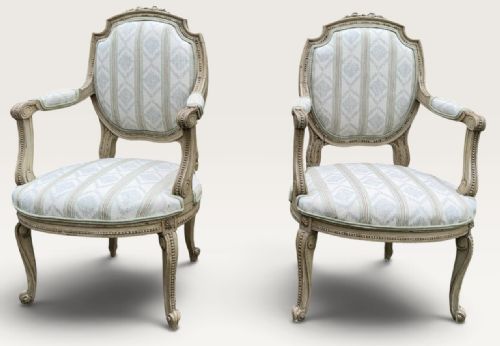
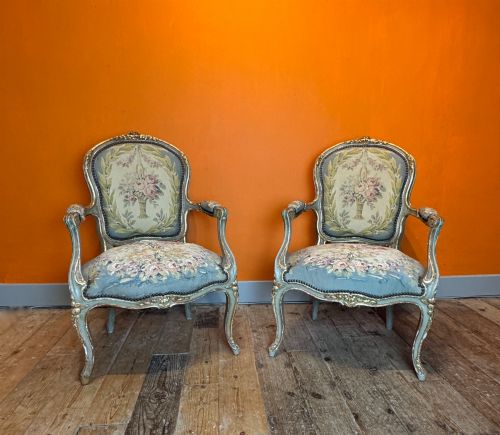
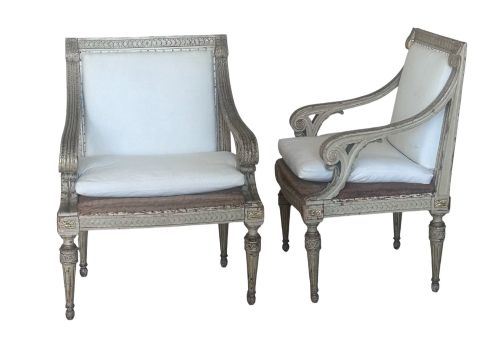
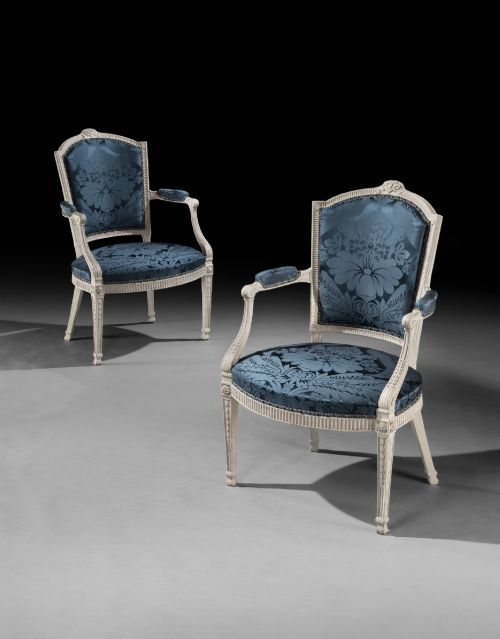
A pair of painted fauteuils brings matched French seating into a room, combining open armchairs with decorated wooden frames.
Pair of Painted Fauteuils
A pair of painted fauteuils represents open-armed seating designed for the salon, originating primarily from French and Italian workshops across the eighteenth, nineteenth, and early twentieth centuries. These armchairs appear in styles ranging from Louis XV and Louis XVI to Neoclassical and provincial designs.
Most examples found here date from the nineteenth and early twentieth centuries, including revival pieces that emulate earlier periods. They arrive as matched pairs, making them suitable for placing opposite a fireplace or flanking a console table.
Materials and construction
Carved wooden frames, typically formed from beech, provide the structural foundation for these chairs. Artisans applied gesso to smooth the wood before finishing the surface with paint, and occasionally added parcel gilt highlights to accentuate the carved details.
Upholstery methods vary from traditional webbing and stuffing covered in tapestry, needlework, linen, or velvet to woven cane panels. Original paint surfaces survive on many frames, showing the patination accumulated over decades of use.
Listings feature beech frames finished with gesso and paint, alongside upholstery in velvet, linen, and needlework.
Evaluating craftsmanship and survival
Quality rests in the crispness of the wood carving and the integrity of the frame construction, where tight joints distinguish finer workshop output from simpler provincial pieces. The survival of original paint surfaces, rather than later repainting, determines the historical coherence of each chair.
The refinement of the upholstery work and the depth of the decorative gesso detailing separate standard salon chairs from high-status decorative seating. Balanced proportions between the open arms, upholstered back, and cabriole or tapered legs define the success of the design.
The Pair of Painted Fauteuils Glossary
- Fauteuil
- An open-armed upholstered armchair with exposed wooden framing, developed in France during the seventeenth century. These chairs feature padded armrests designed to accommodate wide garments.
- Parcel Gilt
- A surface decoration where gold leaf is applied selectively to specific carved details rather than covering the entire object. This technique highlights mouldings and motifs against a painted background.
- Gesso
- A plaster mixture applied to wooden furniture frames to create a smooth surface for painting or gilding. It fills the grain of the wood and accepts fine carved relief work.
- Bergere
- A closed-arm upholstered armchair with solid sides filled with upholstery or cane work. Unlike the open frame of a fauteuil, it offers a more enclosed seat.
- Canework
- Woven cane material used for the backrests and seats of chairs. It provides a lightweight, flexible surface popular in period seating.
Pair of Painted Fauteuils: Frequently Asked Questions
How do I style a pair of painted fauteuils?
Place the armchairs opposite one another around a low table or position them symmetrically against a drawing room wall.
Their decorative painted frames allow them to function as standalone statement pieces or complement existing living space seating.
What is the difference between Louis XV and Louis XVI styles?
Louis XV pieces exhibit curving lines, asymmetry, and cabriole legs reflecting Rococo tastes.
Louis XVI furniture introduces straight tapered legs, geometric symmetry, and neoclassical ornamentation inspired by classical antiquity.
Can these chairs be used daily?
Period armchairs suit regular domestic use provided the underlying wooden frame and joints remain stable.
Upholstery condition dictates comfort, and older textiles may require careful treatment or professional conservation if retained.
How do I identify original paint?
Original paint surfaces show natural wear, fine craquelure, and subtle layers accumulated over generations of use.
Under magnification, older lead-based or oil paints reveal distinct physical depth compared to flat modern emulsion finishes.