
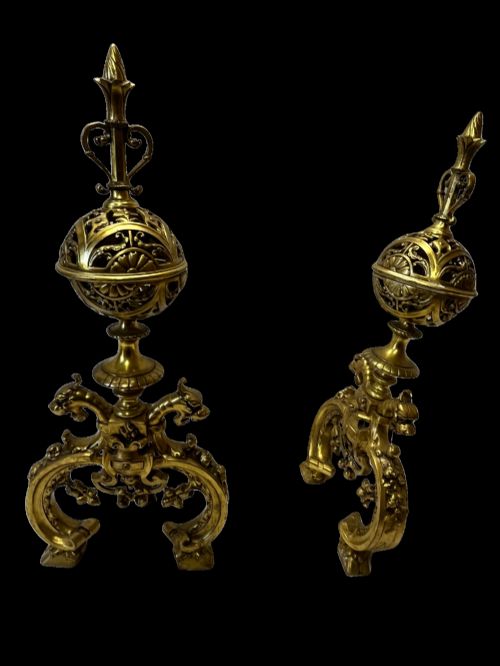


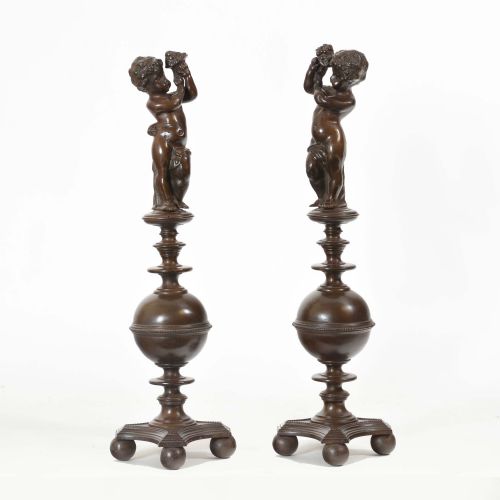


Pair of Bronzed Andirons
These pair of bronzed andirons bring hearthside warmth and French flair, offering heavy metal utility with distinct decorative presence.
Pair of Bronzed Andirons
A pair of bronzed andirons comprises heavy metal supports designed to hold logs within a fireplace opening. The selection here leans heavily towards French Rococo Revival, Renaissance Revival, and Regency styles from the nineteenth century.
Originating largely from French workshops and Italian makers, these pieces showcase classical figural motifs and scrolling ornamentation suited for period hearths.
How they were made
Foundry work combined casting in iron, brass, and bronze with applied ormolu and gilding. Artisans utilised durable metals to withstand intense hearth heat while rendering intricate sculptural details.
Wrought iron and steel provided structural strength for the main billets, whilst bronze and cast brass formed the ornate visible facades and figural elements.
Materials across this selection include bronze, ormolu, wrought iron, and cast brass.
What varies in quality
The crispness of the casting and the depth of the chasing separate standard production from superior examples. Finer pieces display sharper relief in figural work and more secure mercury gilt or ormolu application.
Substantial weight and the use of mixed metals like bronze combined with steel or iron indicate higher grade construction designed for serious hearth use.
The Pair of Bronzed Andirons Glossary
- Andirons
- Supports used in a fireplace to elevate logs for better air circulation and burning. They are also known as fire dogs or chenets.
- Ormolu
- Gilt bronze created by applying a finely ground high-carat gold-mercury amalgam to a bronze object. This technique produces a rich golden finish characteristic of French decorative arts.
- Chenet
- The French term for an andiron, frequently encountered in decorative revival styles. These pieces often feature prominent ornamental fronts.
- Billet bar
- The horizontal iron or steel bar extending backward from the upright front to support the firewood. It bears the brunt of the heat.
- Cast iron
- Iron poured into a mould to form solid, heavy shapes. It provides the utilitarian strength for many nineteenth-century fire accessories.
Pair of Bronzed Andirons: Frequently Asked Questions
How do I clean andirons?
Dust gently with a soft brush to protect patinated bronze or ormolu surfaces. Avoid harsh metal polishes that strip historic finishes.
For iron components, a light application of microcrystalline wax helps prevent further oxidation without altering the surface texture.
Can I use these in an open fire?
Many nineteenth-century pairs built with robust iron and steel billet bars remain entirely suitable for active hearth use. Lighter decorative brass or ormolu variants serve better in non-working fireplaces.
Check the rear bars for structural integrity and heat fatigue before lighting any wood fire.
What is the difference between chenets and andirons?
Chenets is simply the French word for andirons, though the term often implies a more decorative, ornate front standard. Both terms describe the same fundamental fireplace support.
English and Italian pieces are typically called andirons or fire dogs, regardless of elaboration.
How do I date nineteenth-century pairs?
Dating relies on stylistic clues such as Rococo Revival curves or Renaissance Revival cast motifs typical of the eighteen-eighties. Material combinations like bronze mounted on cast iron also point toward this era.
Maker signatures or foundry marks, when present, offer precise attribution.