
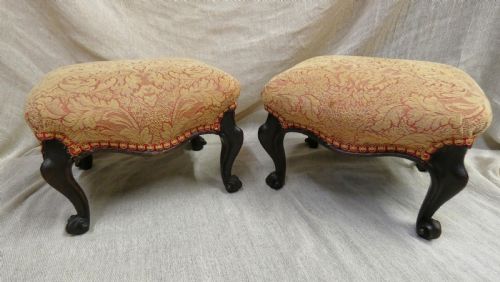


Pair Mahogany Stools
These pair mahogany stools bring solid timber frames and period upholstery together to anchor a room.
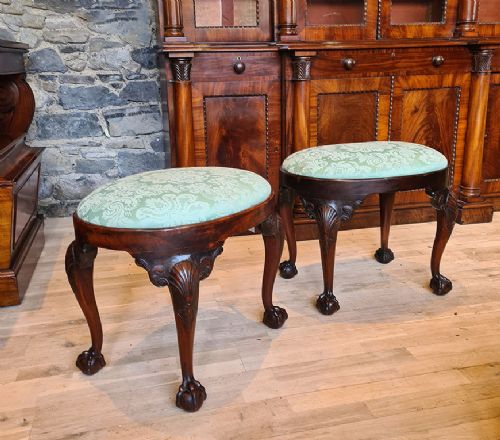
Pair Mahogany Stools
When you search for pair mahogany stools, you encounter seating constructed in dark tropical timber spanning the eighteenth, nineteenth and early twentieth centuries. The selection on this page centres on footstools, long benches, window seats and dressing stools designed to match in identical sets of two.
Victorian and Georgian pieces dominate the available forms, ranging from simple footstools with cabriole legs to elaborate Regency X-frame supports and upholstered long benches. These items served functional roles in drawing rooms and bedrooms, often built to sit before a hearth or beneath a window.
Makers produced these seating pairs in various regional styles including Chippendale, Queen Anne revival, and French influences. The timber frames carry distinct period carving, fluted legs or brass studding, maintaining structural symmetry across both pieces.
How they were made
Cabinetmakers constructed the frames using dense mahogany timber, frequently enhanced with secondary woods, satinwood stringing or ebonised details. Joinery relied on traditional mortise and tenon methods to ensure durability under daily use.
Upholstery techniques applied over the timber frames incorporated horsehair stuffing, webbing and springs secured beneath top layers of leather, silk, velvet, damask or tapestry. Brass-studded trim and fabric borders finished the edges of the padded seats.
Several pairs crossed the channel as luggage stools, proving that even 19th-century travellers packed their bags on fine mahogany frames.
What varies in quality
The degree of hand-carving on the mahogany frame separates standard production from superior examples, with crisp detail on cabriole legs, scroll ends or X-frame supports indicating higher workshop standards. Timber selection also matters, as well-figured grain patterns and rich natural patination elevate a pair above plain or heavily repaired stock.
Upholstery materials and execution dictate the finish of each piece, distinguishing simple drop-in pads from fully buttoned leather or hand-stitched silk and damask coverings. Original matching sets that retain their initial structural integrity and uniform timber colour command greater appreciation than assembled pairs.
J. Kendell & Co.
The Pair Mahogany Stools Glossary
- Mahogany
- A durable, reddish-brown tropical hardwood prized by cabinetmakers for its stability and fine grain. It takes a high polish and resists warping over centuries.
- X-frame
- A structural furniture base formed by intersecting diagonal timbers that create an X shape from the side profile. This ancient form reappeared frequently during the Regency period.
- Stringing
- A narrow inlay of contrasting wood, such as satinwood, inserted into shallow channels on the surface of the mahogany. This technique creates delicate decorative borders.
- Buttoned
- An upholstery method where depressions are formed across the padded surface by pulling cords or threads through to the frame, securing them with fabric-covered buttons.
Pair Mahogany Stools: Frequently Asked Questions
What rooms suit pair mahogany stools?
These low seats function well at the foot of a bed, beside a fireplace, or positioned beneath a long window. Their matched dual format allows them to balance a space when placed symmetrically.
S Smaller footstools slide easily beneath tables or beside armchairs, while longer benches provide substantial seating options for hallways and dressing rooms.
How do I identify Regency period stools?
Regency examples frequently display classical revival motifs, such as sabre legs, fluted turnings, and distinctive X-frame cross supports. The timber tends to have a dark, rich finish reflecting early nineteenth-century taste.
C Maker methods from this era also incorporated brass mounts, ebony stringing, and heavy leather upholstery secured with individual brass studs.
Were these stools used as footrests?
Many smaller examples served strictly as footstools to accompany armchairs and sofas, protecting feet from cold floors. Their padded tops provided comfort during extended periods of sitting.
L Larger variants functioned independently as window seats, luggage stands, or low occasional chairs in country houses and town residences.
How do George III stools differ from Victorian ones?
George III pieces often showcase precise joinery with restrained carving, straight or cabriole legs, and understated upholstery. They reflect eighteenth-century classical proportions and lighter timber framing.
Victorian items generally feature heavier construction, bolder floral or scroll carvings, and more ornate textile choices like velvet, damask, and buttoned leather.