
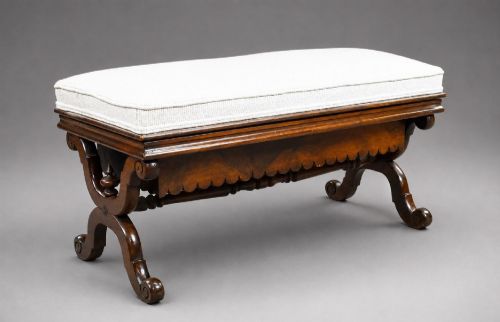
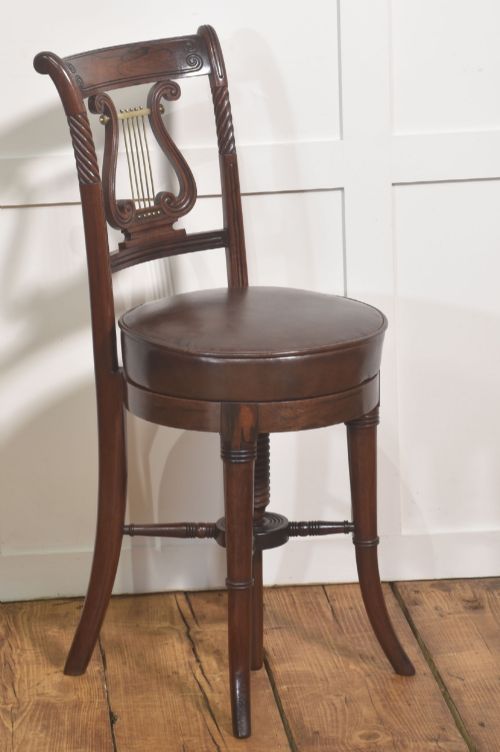


Regency Mahogany Dressing Stools
Regency mahogany dressing stools bring classical balance and compact utility to a room, offering versatile seating that slips easily beneath a vanity or beside a window.
Regency Mahogany Dressing Stools
These pieces are low seats designed for the bedchamber or dressing room, aligning with the domestic refinements of the early nineteenth century. When you search for regency mahogany dressing stools, you encounter forms ranging from simple square seats on turned legs to architectural X-framed models.
The inventory on this page shows pieces spanning the Georgian, Regency, and William IV periods, alongside later Victorian and Edwardian interpretations. Alongside dedicated stools, the selections include adjustable dressing table chairs, piano stools, and compact window seats fulfilling a similar low-profile function.
Makers of this era favoured sturdy timber frames designed to support heavy fabric upholstery, velvet, chenille, or leather. You will find both single examples and matched pairs suited for placement at the foot of a bed or beneath a long mirror.
Assessing quality and proportion
The distinction between standard and superior pieces rests on the weight of the mahogany, the crispness of any turned or carved detail, and the integrity of the frame. Higher-tier examples display thoughtful proportions and substantial timber sections rather than thin, mass-produced mouldings.
Upholstery finish also dictates value, with hand-stitched borders, appropriate period fabrics, and tight springing or webbing reflecting meticulous workshop standards. Simpler pieces remain functional, but superior specimens maintain tighter joinery and more refined classical lines.
Some nineteenth-century makers concealed adjustable mechanisms inside dressing chairs so patrons could alter their height by spinning the seat.
The Regency Mahogany Dressing Stools Glossary
- Mahogany
- A durable, reddish-brown tropical timber prized in British cabinetmaking for its stability and rich grain. It formed the structural backbone for much of the finest nineteenth-century seating.
- X-frame
- A form of cross-legged support inspired by classical Roman curule seats. This architectural geometry provides both strength and visual lightness.
- Chenille
- A fuzzy, tactile textile woven with piled yarn, often utilised for traditional upholstery. It adds warmth and depth to the seat surface.
- Gimp trim
- A narrow woven band used to conceal tacks and finish the edges of upholstered panels. It provides a neat, decorative border to the fabric.
- William IV
- A stylistic period spanning the 1830s characterised by robust classical forms and heavy proportions. Pieces from this era often feature bold turnings and substantial mahogany frames.
Regency Mahogany Dressing Stools: Frequently Asked Questions
Where should I place a dressing stool?
These low seats fit naturally beneath a bedroom vanity table, beside a fireplace, or aligned along a narrow hallway. Their compact dimensions allow them to be tucked away when floor space is at a premium.
They also function effectively as impromptu footstools or as matched pairs positioned beneath a low window seat.
How do I identify a Regency frame?
Look for architectural restraint, classical proportions, and the use of solid mahogany with minimal superfluous ornament. Turned and tapered legs or X-frame profiles are typical hallmarks of the period.
Secondary woods and construction methods beneath the upholstery further confirm the nineteenth-century origin of the piece.
Are these stools suitable for daily use?
Solid mahogany frames and sturdy traditional joinery ensure these seats are entirely practical for everyday sitting. Modern users frequently employ them at contemporary desks or dressing tables.
Checking that the frame remains tight and the webbing secure ensures the piece handles regular weight without issue.
What is the difference between a footstool and a dressing stool?
Dressing stools are generally taller and proportioned for sitting upright before a mirror or table. Footstools sit much lower to the ground, designed specifically to support resting feet.
Many antique pieces bridged these categories, serving dual purposes depending on the room and the owner's needs.