
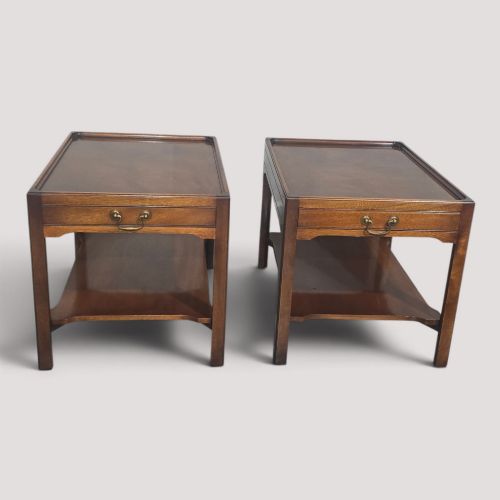
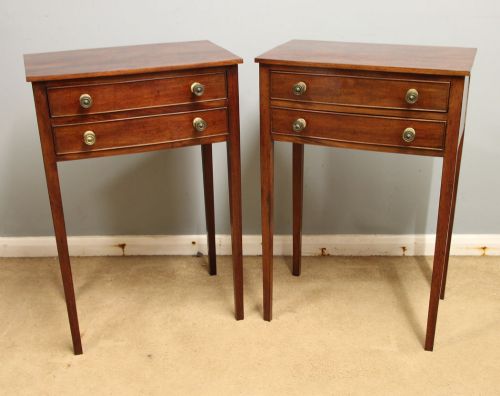
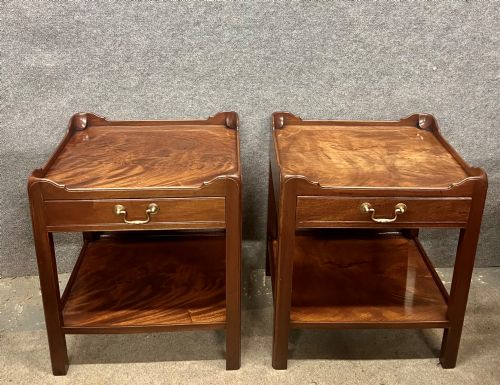
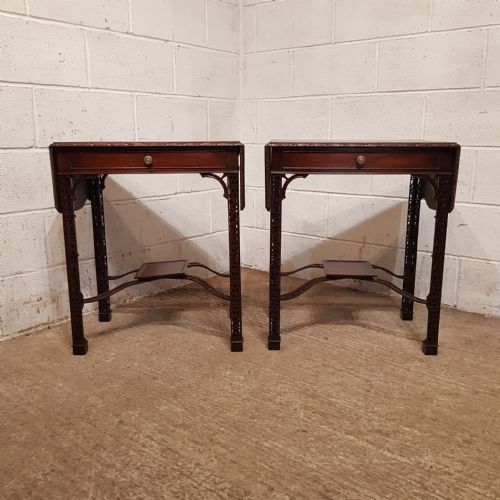
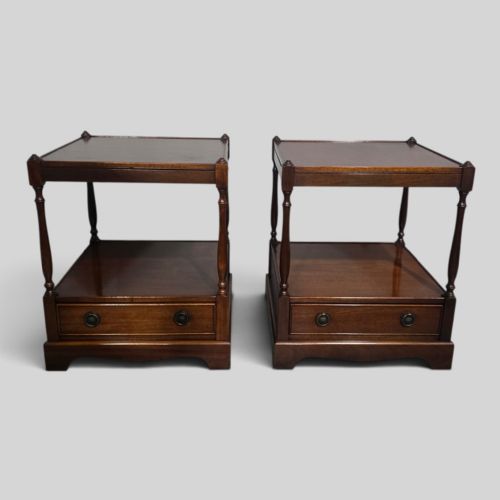
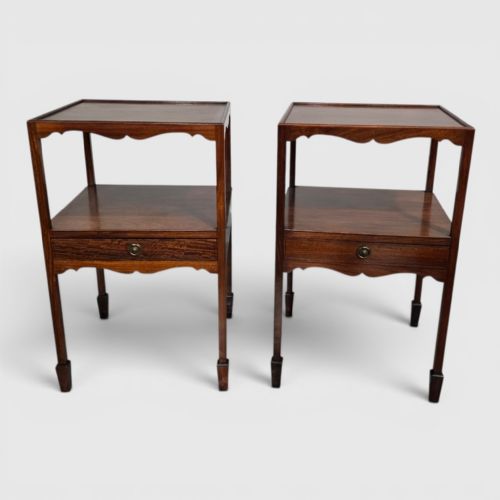
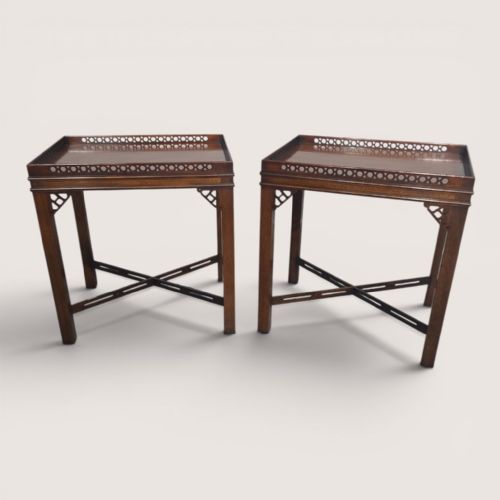
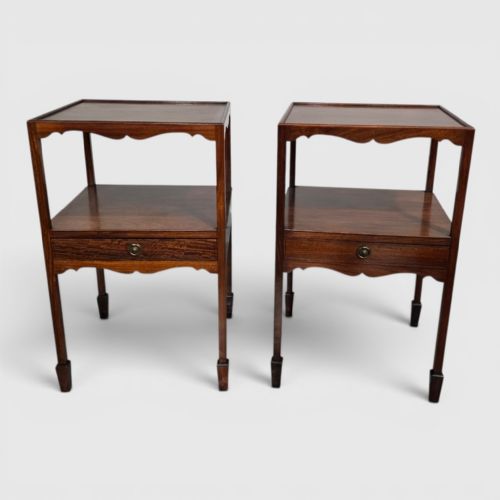

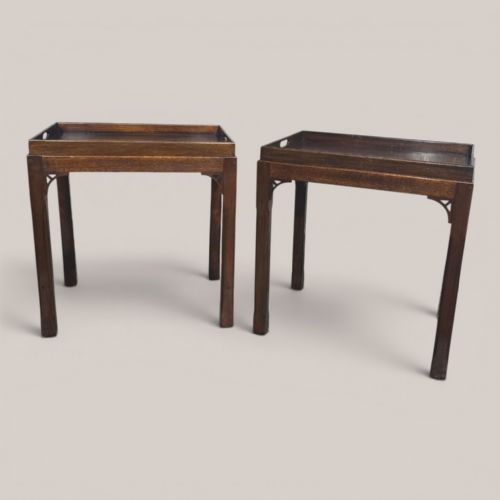


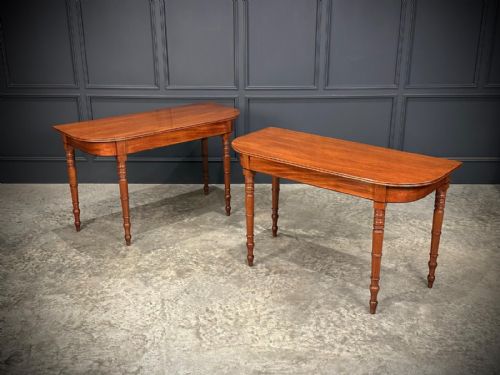


Pair Mahogany End Tables
Pair mahogany end tables unite symmetry with deep timber tones, serving modern rooms as versatile surfaces for lamps, books, and daily use.
Pair Mahogany End Tables
Pair mahogany end tables encompass a wide variety of domestic furniture designed to sit beside seating or beds, including lamp tables, bedside cabinets, and console tables. These pieces span centuries of design, reflecting changing tastes from the architectural rigour of the Georgian period to the lighter decorative styles of the Edwardian era.
The pieces on this page lean heavily towards compact forms suited to flanking a sofa or bed, though larger D-end console tables and occasional tables also appear. They emerge from diverse aesthetic traditions, taking shape as revival pieces, clean-lined Art Deco cabinets, or refined Regency designs.
Buyers seeking this phrase encounter timbers rich in figure, often paired with secondary materials like brass, leather, and satinwood. The matching nature of these items makes them particularly sought after for balancing room layouts with symmetrical surfaces.
How they were made
Makers utilised solid mahogany and carefully selected mahogany veneers applied to secondary woods, yielding surfaces rich in natural figure and depth. Cabinetmakers enhanced these timbers with contrasting stringing in satinwood or incorporated brass mounts, handles, and gallery rails to accentuate the structural lines.
Construction techniques evolved across the periods represented, moving from robust structural joinery in 18th-century workshops to lighter, decorative framing in Edwardian and Art Deco examples. Surfaces frequently received leather inserts for writing tables or high-polish lacquer finishes on oriental-influenced pieces.
Details such as drop leaves, revolving mechanisms, and intricate carved mouldings in the Chippendale style demonstrate the high level of technical skill applied by makers across different centuries.
Pair Mahogany End Tables Retail Price Guide 2026
Typical asking prices for pair mahogany end tables among the pieces listed under this phrase on Sellingantiques today, from the lower quarter to the upper quarter. They describe what is for sale here now, not the wider market.
Listings span from the 18th century through to Art Deco production, uniting Georgian console forms with Edwardian inlaid occasional tables.
What varies in quality
The standard of a pair of mahogany end tables rests heavily on the selection and matching of the timber grain across both pieces. Superior examples display harmonious figuring and deep colour that has matured naturally over time.
Construction integrity defines the upper tier, visible in tight joints, solid drawer linings, and the crispness of carved details such as those found on Chippendale revival pieces. Inferior examples may show heavy-handed restorations, mismatched timber replacement, or crude secondary woods that detract from the unified appearance of the pair.
The Pair Mahogany End Tables Glossary
- D-end
- A table form featuring a semicurved end, allowing pairs to stand individually against a wall or join together to form a larger dining surface.
- Chippendale
- A style originating in the 18th century, characterised by intricate carving, cabriole legs, and scrollwork, often revisited by later makers.
- Demi-lune
- A half-moon shape common in console and occasional tables designed to sit flush against a wall in narrow hallways or reception rooms.
- Inlaid
- The technique of embedding contrasting woods, such as satinwood, into the primary mahogany surface to create geometric or floral patterns.
- Console table
- A table designed to be fixed or placed against a wall, frequently used in pairs to create a balanced entrance or dining room arrangement.
Pair Mahogany End Tables: Frequently Asked Questions
How do I spot a true pair?
True pairs display identical dimensions, matching timber grain patterns, and uniform wear that suggests they were created together in the same workshop. Subtle discrepancies in construction or timber selection usually indicate marriage pieces assembled at a later date.
Examining the underside, drawer construction, and secondary woods helps confirm whether two tables share an identical origin and history.
Where should I place these tables?
These pieces excel when used to flank a sofa, bed, or fireplace, providing symmetrical surfaces for lighting and decorative objects. D-end console variations work well in hallways or paired together to form a larger occasional dining surface.
Their compact footprints allow them to fit easily into smaller spaces while adding warmth and traditional character to a room.
How do I care for mahogany?
Maintain mahogany surfaces by keeping them away from direct sunlight and excessive heat sources that can dry out and fade the timber. Regular dusting with a soft, dry cloth preserves the finish without requiring heavy chemical polishes.
Leather tops found on certain side tables benefit from occasional treatment with appropriate conditioning balms to prevent cracking.
How do I tell the periods apart?
Georgian and Regency pieces lean towards architectural proportion, classical motifs, and solid timber construction with minimal ornamentation. Later Edwardian and revival pieces often incorporate delicate satinwood stringing, lighter frames, and decorative inlay inspired by earlier Sheraton designs.
Art Deco examples abandon historical revivalism entirely in favour of streamlined silhouettes, exotic veneers, and geometric simplicity.