




D End Side Tables
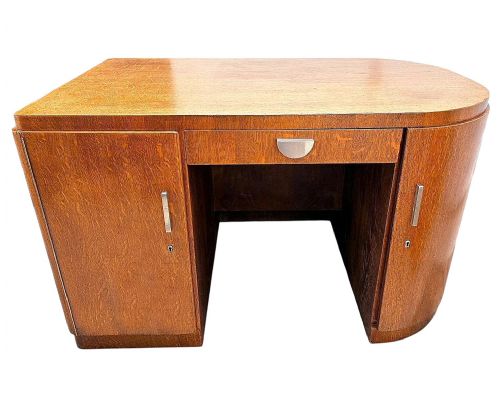
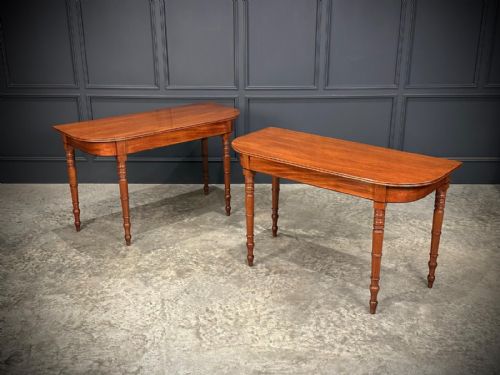
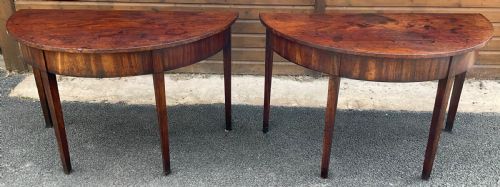
These d end side tables bring structured elegance to a hallway or drawing room, offering flat surfaces and clean architectural lines shaped like a semi-circle.

D End Side Tables
When searching for d end side tables, a buyer encounters pieces designed to sit against a wall or combine with central dining sections to form longer surfaces. The selections span Georgian, Regency, Victorian, and Edwardian periods, reflecting centuries of cabinet-making traditions across England and France.
Most examples appear as matched pairs intended for placement in reception rooms, halls, or as flanking consoles. Forms vary from drop-leaf pembroke items and occasional tables to lamp stands and specialised desks.
Materials and Construction
Makers relied heavily on solid timber and carefully matched veneers, predominantly employing mahogany, oak, and walnut. Brass hardware, gilded mounts, marble tops, and delicate satinwood or chequered inlay provide decorative contrast to the primary wood grains.
Joinery methods range from traditional mortise and tenon frames to turned legs, carved pedestals, and faux bamboo detailing. The structural integrity depends on stable timber selection and precise hand-carving or ebonising techniques.
Current listings feature hardwood, oak, mahogany, and walnut, spanning periods from the eighteenth century through the Edwardian era.
Evaluating the Pieces
The distinction between ordinary and superior pieces rests on the depth of figure in the timber and the crispness of any applied carving or inlay. Finer examples display harmonious grain matching across the semi-circular tops and original brass or wooden fittings.
Proportion and stability define the upper tier of these tables. Well-balanced frames with tight joints and clean lines command greater appreciation than heavily restored or clumsily proportioned alternatives.
Trevor Page & Co·Liberty & Co·William Birch
The D End Side Tables Glossary
- D end
- A table with one curved, semi-circular end shaped like the letter D, often designed to stand against a wall or join with central leaves.
- Console
- A side table supported by wall brackets or decorative legs, typically positioned in hallways or below mirrors.
- Pembroke
- A rectangular table with hinged drop leaves on two opposing sides, supported by folding brackets.
- Satinwood
- A lustrous, yellowish timber native to India and Sri Lanka, frequently utilised for fine stringing and marquetry inlay.
- Faux bamboo
- Wood turned and carved to imitate the segmented stalks of natural bamboo, popular during the nineteenth century.
D End Side Tables: Frequently Asked Questions
How were d end side tables used?
These tables served primarily in dining rooms and entrance halls as serving surfaces or console displays. When built as modular sections, they could separate or reconfigure to accommodate gatherings.
Pairs often stood symmetrically against a wall beneath a mirror or painting, offering a stable surface for lighting and decorative objects.
How do I identify a Georgian d end table?
Georgian pieces typically exhibit rich mahogany surfaces with minimal, elegant carving such as subtle edge moulding or tapered legs. Construction relies on dense, heavy timbers and hand-cut joinery consistent with eighteenth-century workshops.
Proportions remain understated and functional, focusing on the natural grain of the wood rather than excessive ornamentation.
Are these tables usually found in pairs?
Many surviving examples originate as matched pairs designed to frame a fireplace, doorway, or large window. Splitting or uniting these sets occurred frequently over time as domestic interiors changed.
Finding a matched pair remains common in archives, particularly among Regency and Georgian console configurations.
What is the difference between an Edwardian and a Victorian version?
Victorian iterations tend to feature heavier proportions, darker finishes, and robust carving in oak or rosewood. Edwardian examples often introduce lighter woods like satinwood, inlaid details, and more delicate, slender legs.
Both periods embraced historical revivals, yet Edwardian pieces lean toward brighter tones and refined simplicity.