

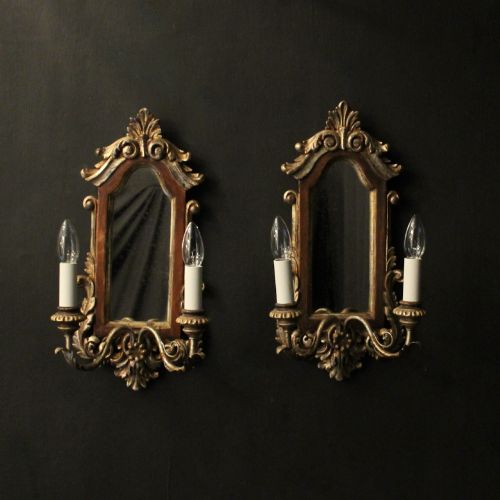
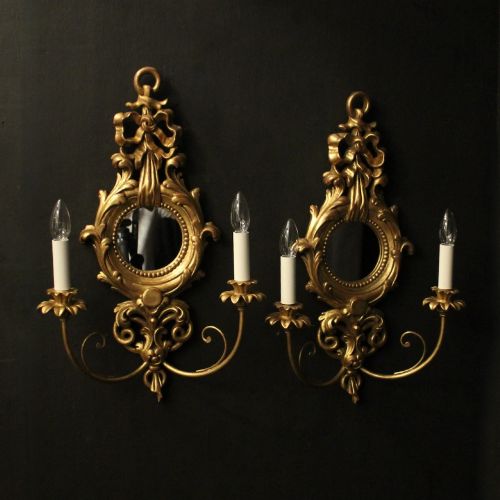
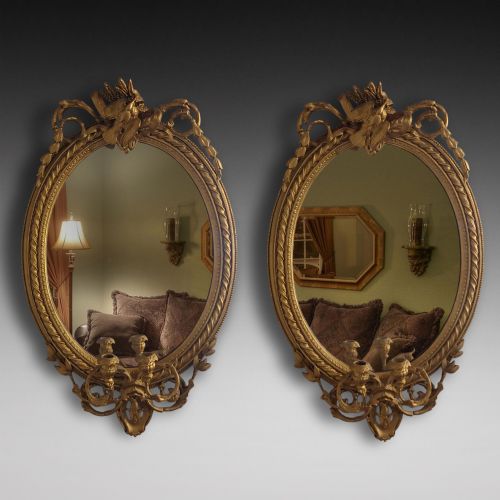


Pair Gilt Girandole Mirrors
These pair gilt girandole mirrors bring candlelight and reflected depth to a room through matching frames.
Pair Gilt Girandole Mirrors
A pair gilt girandole mirrors combines a reflective looking glass with integrated candle sconces, designed to multiply ambient light in a room. These pieces appear across eighteenth, nineteenth, and early twentieth century periods, reflecting diverse revivals from Rococo to Neoclassical and Regency styles.
The forms span from grand oval pier mirrors with ornate crestings to twin-arm wall lights and carved console-matching frames. French, Italian, and English origins dominate the selection, showing regional interpretations of gilt surface treatments.
Buyers encounter everything from simple gilded wood frames to complex composition mouldings fitted with multiple candle arms. The consistent thread across these objects remains the pairing of reflective glass with functional lighting brackets.
Materials and construction
Construction relies on timber frames shaped with gesso or carved directly before receiving a layer of gold leaf or gilt paint. Many examples incorporate cast bronze, brass, or ormolu elements, particularly where candle arms attach to the main structure.
Mirrored glass plates sit within the rebated frames, sometimes exhibiting convex curves or bevelled edges depending on the period. Giltwood surfaces often combine water gilding with oil gilding techniques to achieve varied sheens across the carved details.
Pair Gilt Girandole Mirrors Retail Price Guide 2026
Typical asking prices for pair gilt girandole mirrors among the pieces listed under this phrase on Sellingantiques today, from the lower quarter to the upper quarter. They describe what is for sale here now, not the wider market.
Listings feature items from the eighteenth century through to the 1930s, utilising materials including giltwood, gesso, brass, and bronze.
Assessing quality and execution
Quality rests in the crispness of the hand-carved or moulded ornament and the depth of the gilding applied over the gesso ground. Superior examples display sharply defined acanthus leaves, figurative crestings, and well-integrated armatures for the candles.
The integrity of the original mirrored glass plate and the stability of the joining points where candle branches meet the frame indicate superior workshop execution. Finer pieces maintain harmonious proportions between the reflective surface and the surrounding decorative woodwork.
The Pair Gilt Girandole Mirrors Glossary
- Girandole
- A wall mirror fitted with branching candle sconces or holders designed to reflect candlelight into the interior. These fixtures became popular in formal reception rooms during the eighteenth and nineteenth centuries.
- Gesso
- A plaster-like mixture applied to wood frames to create a smooth surface for carving and subsequent gilding. This material allows artisans to achieve sharp relief details before applying gold leaf.
- Ormolu
- Finely chased and gilt bronze mounted to furniture and decorative objects. The technique involves applying a gold amalgam to a copper alloy base and heating it.
- Pier glass
- A tall mirror designed to hang on the wall space between windows. These mirrors frequently appear paired with console tables placed underneath.
- Rococo revival
- A nineteenth century design movement that reinterprets eighteenth century asymmetrical scrolls, natural motifs, and C-scrolls. This style heavily influences many nineteenth century decorative mirror frames.
Pair Gilt Girandole Mirrors: Frequently Asked Questions
How do I hang a pair safely?
Weight distribution requires sturdy wall fixings secured directly into studs or masonry rather than relying solely on plasterboard. Professional mirror hangers utilise brackets that support the lower frame while securing the top safely against the wall.
Matching pairs demand careful alignment at identical heights to maintain visual symmetry in a room. Measuring from floor level to the centre point of each glass plate ensures correct placement.
Can I burn real candles?
Original metal sconces and drip pans accommodate traditional wax candles, though care prevents dripping hot wax onto delicate gilt surfaces. Using modern dripless candles or appropriate height extinguishers protects the surrounding antique frame from heat damage.
Many owners choose unlit display to preserve fragile antique metalwork and prevent smoke residue from settling on the gilding. Electric conversion remains an alternative seen on certain period lighting fixtures.
How do I clean the glass?
Cleaning requires a soft microfibre cloth dampened slightly with distilled water rather than harsh commercial chemical sprays. Spraying liquid directly onto the glass risks seeping behind the plate and damaging the silvered backing or the internal frame structure.
Gentle wiping prevents abrasion to antique glass surfaces that may show age spots or original foxing. The surrounding gilt frame must remain completely dry during any maintenance procedure.
What rooms suit these mirrors?
Dining rooms and hallways benefit particularly from the reflective qualities and integrated candle arms that amplify evening lighting. Placing them above mantlepieces or console tables creates a traditional focal point within formal living spaces.
Matching pairs offer balanced symmetry when positioned on opposite sides of a fireplace, doorway, or architectural window pier. The proportion of the wall space dictates whether smaller oval designs or large rectangular frames work best.