
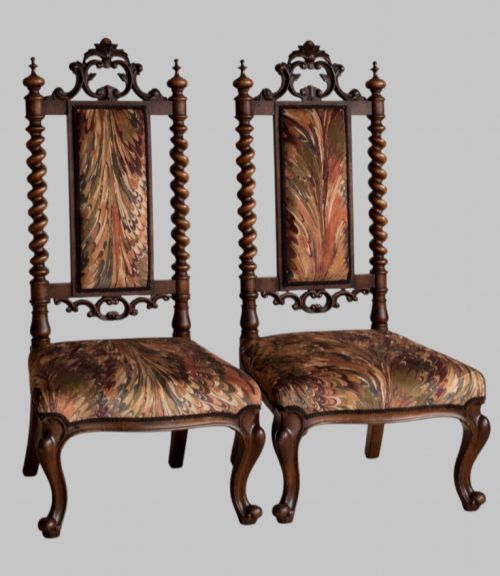


Pair Barley Twist Chairs
These pair barley twist chairs bring robust timber frames and spiralled turns into rooms that need weight and traditional craft.
Pair Barley Twist Chairs
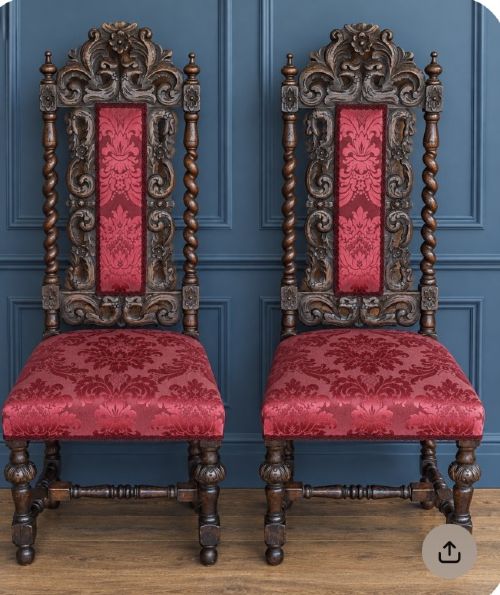
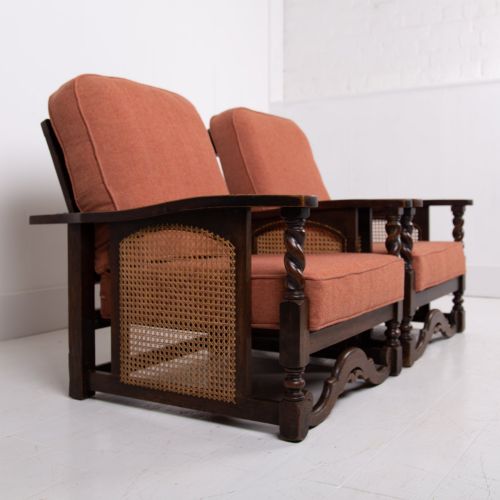
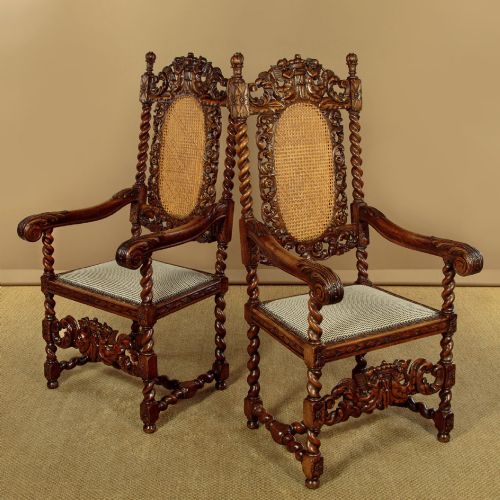
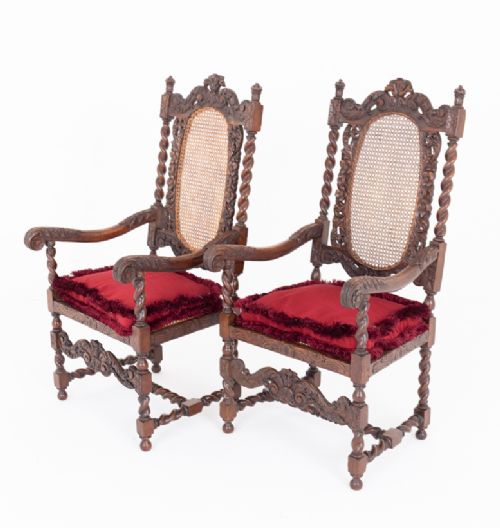
When you search for pair barley twist chairs, you are looking at matched sets of seating defined by their spiralled wooden structural members. These chairs appear primarily in oak and walnut, spanning periods from the nineteenth century through the early decades of the twentieth century. The forms range widely across the evidence, taking shape as armchairs, side chairs, hall chairs, dining chairs, carvers, and throne chairs.
The dominant aesthetic draws heavily on historical revivals, with Jacobean, Gothic, Renaissance, and Louis XIII influences frequently shaping the carved details. You will encounter upholstered seats alongside cane, rattan, leather, and tapestry panels. These seating pairs serve equally well around a dining table, flanking a fireplace, or positioned in a hallway.
What varies in quality
The standard of carving distinguishes exceptional examples from simpler production, particularly where foliage, figures, or Green Man motifs show crisp depth and confident chisel work. Timber selection also dictates grade, with dense, well-figured oak and rich walnut carrying greater presence than plainer secondary woods.
Structural integrity of the turned supports and joints determines longevity, especially under the daily weight applied to armchairs and carvers. The quality of secondary materials - whether finely woven cane, heavy leather, or supportive upholstery webbing - further separates standard utility seating from finer parlor and drawing room pieces.
Revival designs span Jacobean, Gothic, Renaissance, and Louis XIII styles, reflecting enduring Victorian and Edwardian interest in historical furniture forms.
The Pair Barley Twist Chairs Glossary
- Barley twist
- A turned wooden furniture leg or support shaped in a continuous spiral resembling a stalk of barley. This decorative turning became popular during the seventeenth century and saw revivals through the Victorian and Edwardian eras.
- Carver armchair
- A wooden chair with arms, traditionally placed at the head of a dining table or used as a desk chair. In these listings, they appear alongside side chairs and larger throne formats.
- Bergere
- An enclosed upholstered armchair with a wooden frame where the sides and back are typically filled with cane or rattan work. Examples in the evidence combine this airy weave with oak framing.
- Cromwellian style
- A plain, sturdy style of English furniture dating from the mid-seventeenth century, characterised by straight lines, leather upholstery, and brass studs. Later revivals recreate this austere aesthetic in oak.
- H stretcher
- A horizontal wooden brace connecting the legs of a chair in the shape of the letter H to provide structural stability. This underframing supports the weight of heavy oak and walnut frames.
Pair Barley Twist Chairs: Frequently Asked Questions
What periods do these chairs come from?
The pieces span the nineteenth and early twentieth centuries, encompassing Victorian, Edwardian, and various revival eras. Many items reflect historical design periods like the seventeenth century while being manufactured later.
Dates recorded across the inventory stretch from the mid-nineteenth century through the 1930s, showing consistent production of spiralled wooden seating over many decades.
Which woods were used for these frames?
Oak is the predominant timber found across the listings, ranging from bleached oak to dark carved variations. Walnut also appears frequently in armchairs and hall seating.
Additional materials include ebonised wood and occasional papier-mâché, providing diverse finishes depending on the specific revival style of the piece.
How are the seats finished?
Seating surfaces vary widely between solid wood, woven cane, rattan, and upholstered pads. Many armchairs feature textile, leather, tapestry, or velvet coverings.
Some examples include loose cushions or newly added upholstery, while others retain traditional drop-in seats or woven cane panels supported by wooden frames.
Where should I place a pair in my home?
These matching chairs work well in dining spaces, hallways, libraries, and living rooms. Hall chairs and side chairs suit narrow spaces or flanking a console table.
Larger armchairs, throne chairs, and carvers fit comfortably beside fireplaces, in reading corners, or paired opposite one another to create a balanced seating arrangement.
How do I identify a revival style?
Revival styles draw on specific historical periods, incorporating design elements like Jacobean carving, Gothic arches, or Louis XIII framing. Makers replicated these earlier aesthetics using nineteenth and twentieth-century manufacturing techniques.
Examining the turning of the spiral legs alongside the specific motifs on the backrest helps determine which historical period inspired the maker.