
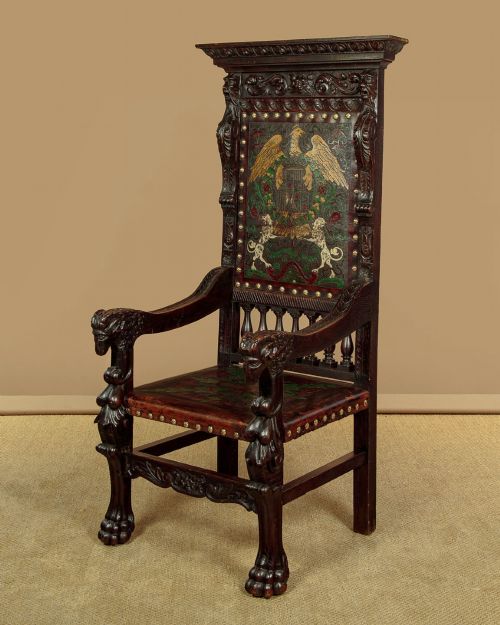


Edwardian Oak Throne Chair
An Edwardian oak throne chair stands with high dignity, bringing robust timber framing and commanding presence to a room.
Edwardian Oak Throne Chair
An edwardian oak throne chair is a substantial armchair built to command a room, drawing on revivalist aesthetics from the gothic, jacobean and renaissance traditions. These heavy seating pieces often feature high backs, carved panels and robust armrests suited for hallways and principal chambers.
The versions most commonly met on this page date from the edwardian era and the late nineteenth century, constructed primarily in solid oak. They appear alongside related armchairs and carver chairs built in the same revivalist tastes.
Makers of the period utilised classical orders and ecclesiastical motifs, creating imposing seats with leather panels, tapestry fabric or velvet upholstery. Buyers seek them for their architectural weight and historic character.
How they were made
Joiners built these chairs using solid oak timbers, often featuring carved ornamentation, barley twist turnings and panel detailing. Structural joints relied on traditional woodworking methods to support the considerable weight of the timber frame.
Upholstery materials included brass studding, leather, tapestry fabric and velvet. Craftsmen secured these coverings over padding to create buttoned panels and decorative seats that complemented the carved woodwork.
Revival styles dominate the inventory, with gothic, jacobean and renaissance influences appearing frequently across the armchairs.
What varies in quality
The distinction between standard workshop production and finer examples lies in the depth and execution of the carved ornamentation. Crisp relief work on the oak frame and well-proportioned architectural details indicate higher craftsmanship.
Material selection also dictates the grade of the piece, particularly the quality of the timber grain and the durability of the leather or tapestry upholstery. Heavy golden oak frames with intact classical motifs represent the more substantial end of the range.
A.W.N. Pugin
The Edwardian Oak Throne Chair Glossary
- Throne chair
- A large, imposing armchair designed with a high back and prominent arms to resemble a seat of authority. These pieces often incorporate architectural carvings.
- Barley twist
- A type of turning shaped like a spiral rope, frequently found on the legs and uprights of edwardian and jacobean revival furniture. It adds texture to the oak frame.
- Gothic revival
- An architectural and decorative style drawing on medieval forms, featuring pointed arches, tracery and heavy timber construction. It heavily influences many of these armchairs.
- Ecclesiastical taste
- A design style mimicking church furnishings, characterised by serious proportions, dark oak and solemn decorative motifs. Such chairs were often used in halls and studies.
Edwardian Oak Throne Chair: Frequently Asked Questions
Where were these chairs used?
These imposing seats were traditionally placed in grand entrance halls, libraries or studies where their architectural presence could be fully appreciated. They served both as functional seating and as decorative statements.
In modern interiors, they function well as standalone statement pieces in living spaces or hallways.
How do I identify the period?
Dating relies on examining the construction methods, timber patination and decorative motifs present on the oak frame. Edwardian and late nineteenth-century examples often combine revival styles like gothic or jacobean with solid brass hardware.
Carving styles and upholstery types, such as buttoned leather or tapestry fabric, also provide clues to the exact era of manufacture.
What woods were used?
Oak is the primary timber found across these pieces, selected for its strength, durability and suitability for deep carving. Golden oak and dark oak finishes are both common.
Secondary materials support the structure, while the main visual impact relies on the heavy oak grain.