
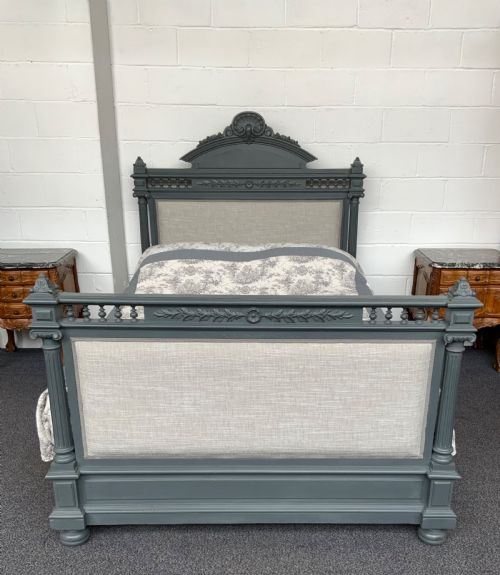
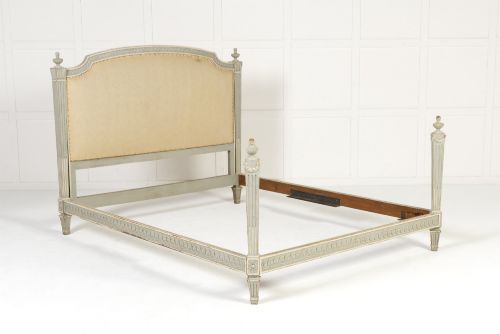
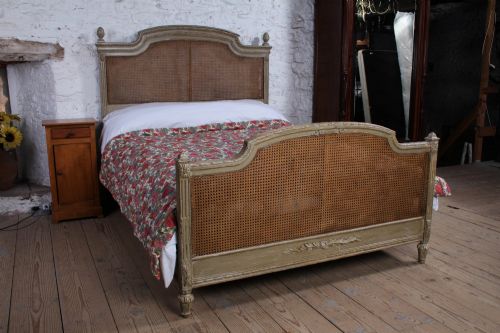


Painted Wooden Headboard
A painted wooden headboard brings colour and classical proportion to a bedroom, drawing the eye instantly.
Painted Wooden Headboard
A painted wooden headboard forms the architectural focus of a sleeping space, drawing on continental designs and British cabinet-making traditions. When you search for a painted wooden headboard, you encounter robust domestic frames alongside grand continental bedsteads.
The selection here encompasses items originating across the nineteenth and twentieth centuries, spanning Victorian, Edwardian, and Regency periods. Pieces range from straightforward double and king-size beds to upholstered variants, caned models, and standalone panels.
French styles dominate the selection, heavily influenced by Louis XV, Louis XVI, and Empire aesthetics. Alongside these sit distinct Dutch-style bedsteads, Spanish panels, and satinwood pieces bearing the hallmarks of major London makers.
How they were made
Makers utilised solid timbers, applying layers of paint directly to the wooden surface often complemented by parcel gilt highlights or carved relief details. Structural frames frequently incorporate woven cane panels or sections prepared for fabric upholstery.
Metal embellishments in brass appear alongside natural materials like linen and leather to accent the timber framework. Surface decoration ranges from simple hand-applied paint finishes to intricate satinwood schemes.
Joinery techniques combine traditional cabinet construction with integrated iron or brass fittings designed to secure large headboards and footboards to side rails.
Listings feature items spanning the nineteenth century through the Edwardian period, alongside twentieth-century French provincial designs.
What varies in quality
Quality rests primarily in the crispness of the carved wooden ornament and the finesse of the painted finish. Superior examples display hand-carved details that retain sharp definition beneath layers of historic or refreshed paint.
The integrity of the structural timber dictates longevity, with dense hardwoods providing greater stability than softer alternatives. Integrated elements like hand-woven cane panels or original brass mounts further elevate a piece.
Provenance and execution distinguish standard domestic frames from works produced by prominent retail furnishers or specialised cabinet makers.
Maple and Co·Harrods
The Painted Wooden Headboard Glossary
- Caned
- A technique where split rattan is woven into an open mesh pattern to form airy panels within a wooden bed frame. This method lightens the visual weight of large headboards.
- Parcel gilt
- A decorative treatment where thin sheets of gold leaf are applied selectively to raised carved details over a painted wooden base. It catches ambient light in a room.
- Satinwood
- A durable exotic hardwood known for its natural golden sheen and smooth grain, frequently utilised in high-end late Victorian bedroom furniture. It accepts paint finishes exceptionally well.
- Louis XVI Style
- A neoclassical design vocabulary characterised by straight tapered legs, symmetrical proportions, and classical architectural motifs such as fluting and ribbon twists. It heavily influences continental painted beds.
- Bedstead
- A complete framework of a bed comprising the headboard, footboard, and side rails, designed to support a mattress base. Many antique examples accommodate modern mattress sizes with minor adaptations.
Painted Wooden Headboard: Frequently Asked Questions
Will an antique bed fit a modern mattress?
Many nineteenth and twentieth-century frames differ slightly from contemporary standard sizing. Careful measurement of the interior rails ensures correct alignment.
Custom mattress makers or subtle internal adaptors easily resolve minor discrepancies without altering the visible exterior woodwork.
How do I care for a painted wooden finish?
Gentle dusting with a dry, soft cloth prevents the accumulation of particulate matter on delicate painted surfaces. Avoid harsh chemical cleaners that might degrade historic paint layers.
Keeping the piece away from direct sunlight and excessive moisture preserves both the timber substrate and the decorative coating.
Are upholstered sections original?
Upholstery fabric on antique beds frequently undergoes renewal to suit contemporary tastes and hygiene standards. Frames often feature newly applied textiles while retaining their underlying period structure.
Checking the method of attachment reveals whether the padding adheres to traditional stuffing techniques or modern equivalents.
How do I distinguish Louis XV from Louis XVI style?
Louis XV furniture favours asymmetrical curves, undulating cabriole legs, and organic rococo motifs. The overall aesthetic feels fluid and dynamic.
Louis XVI design marks a return to classical straight lines, symmetry, and geometric shapes, displaying rectangular headboards and fluted columns.