
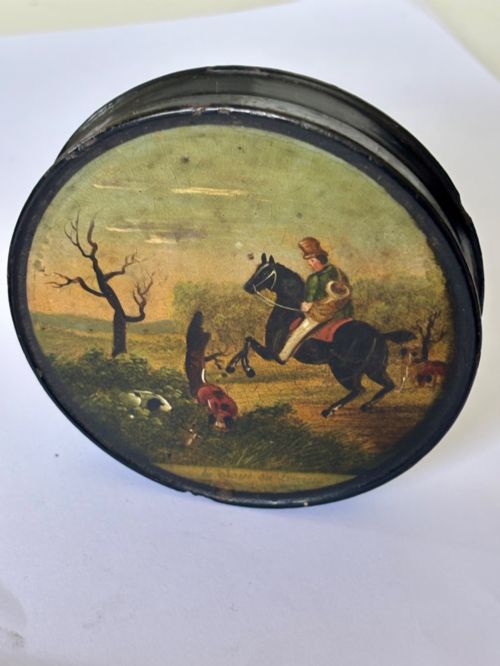
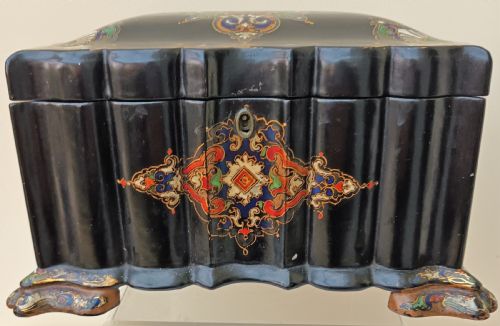


Painted Papier Mache Box
A painted papier mache box brings miniature portraiture, lacquered finishes and intricate gilding straight to the desk or pocket.
Understanding painted papier mache box pieces
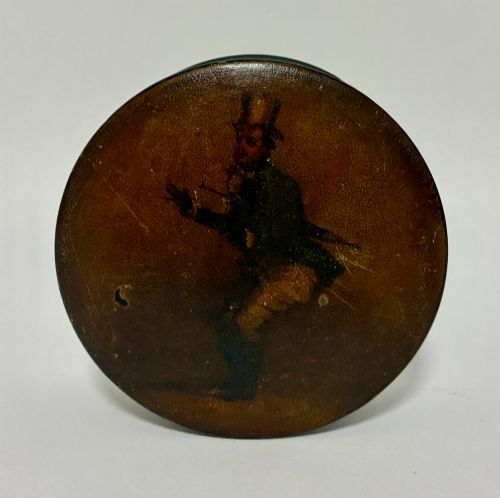
When you search for a painted papier mache box, you encounter a remarkably diverse assortment of personal and desktop containers made from compressed paper pulp and finished with hard varnishes. These objects range from tiny pocket snuff boxes and cigarette cases to much larger stationary boxes, tea caddies, writing desks, and card boxes.
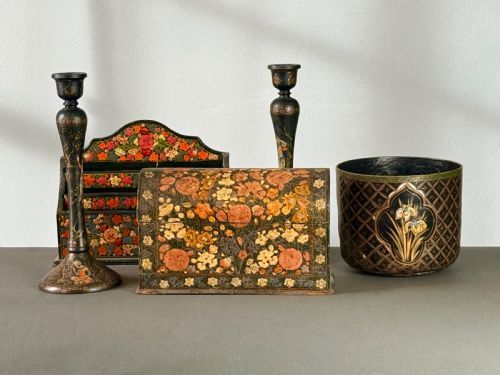
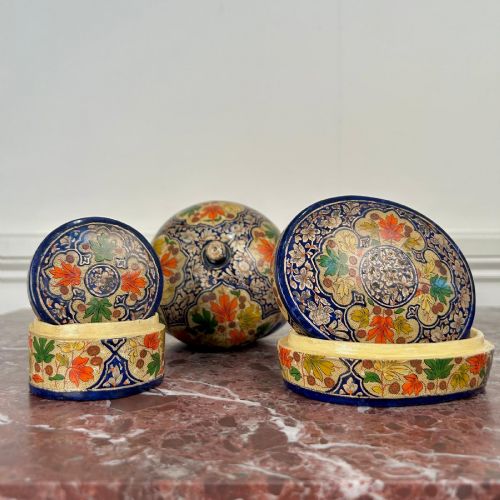
The pieces appearing here span the nineteenth century and the year nineteen hundred, drawing together English Victorian production, Russian lacquer work, German workshops, French Empire design, Biedermeier simplicity, and Indo-Persian traditions. English Victorian examples frequently feature floral motifs, topographical scenes such as Tintern Abbey, or canine studies, while continental and eastern pieces lean towards hunting scenes, figurative portraiture, and elaborate gilded patterns.
Forms vary according to their original domestic purpose, including specialised containers for gloves, trinkets, scent bottles, and games. Table snuff boxes and larger lap desks represent the most common survival of these fragile containers, often retaining their original fitted interiors of velvet, silk, or pale wood.
Materials and construction
The foundation of every painted papier mache box relies on layers of paper pulp, sometimes reinforced with cloth, bonded together with glue or paste and pressed into rigid moulds or built up on wooden cores before drying into a remarkably tough board. This solid base was then sanded smooth and sealed with successive coats of dark lacquer or oil paint.
Makers applied oil paint directly onto the dark prepared surfaces, frequently incorporating delicate details in gold leaf and setting iridescent pieces of mother-of-pearl into the damp varnish to catch the light. Final protective clear lacquer layers were polished to a high sheen, sealing the polychrome pigments and metallic foils beneath a glassy surface.
Retail Price Guide 2026
Typical UK retail prices for painted papier mache box, calculated from the Sellingantiques database of over a million retail prices indexed since 2003. This retail price guide relies exclusively on Sellingantiques data; no external sources or auction records are used, so the figures do not describe the wider market.
Some nineteenth-century German snuff boxes featured concealed erotic paintings hidden beneath sliding interior lids for private amusement.
Distinguishing finer examples
Quality in a painted papier mache box rests primarily on the crispness and ambition of the hand-painted decoration, where minute brushwork, accurate human figures, and well-rendered animals elevate a standard container to a work of art. The integration of shimmering mother-of-pearl inlay and the clever use of raised gold leaf further separate standard production pieces from masterworks.
The structural integrity of the paper base and the preservation of the original glossy lacquer finish dictate the grade of survival. Superior pieces retain their crisp moulded edges, tightly fitting lids, and undamaged internal compartments lined in silk or velvet, without extensive overpainting or clouding to the clear varnishes.
Vishnyakov Workshop·Stobwasser
The Painted Papier Mache Box Glossary
- Papier-mache
- A composite material made from paper pulp or layers of paper mixed with glue, resin, and sometimes chalk, then moulded and dried into a hard substance. It provides a lightweight yet durable base for decorative lacquer and paint.
- Lacquer
- A clear or coloured varnish applied in multiple coats and polished to a hard, glossy, and durable finish. It protects the delicate paintwork underneath and deepens the visual depth of the surface.
- Mother-of-Pearl
- The iridescent inner layer of mollusc shells, cut into thin plates and embedded directly into the wet lacquer or paint surface. It creates shimmering highlights on buildings, clothing, and natural motifs.
- Gold Leaf
- Gold beaten into extremely thin sheets and applied to the painted surface as an accent or border. It reflects ambient light and highlights specific details of the design.
- Stobwasser
- A famous German manufacturer known for producing high-quality lacquered papier mache snuff boxes with detailed miniature paintings. Their pieces often served as the benchmark for European box-making.
Frequently Asked Questions
What were painted papier mache boxes used for?
These containers served practical domestic functions to store small personal items safely out of sight. Common contents included loose tobacco, snuff, cigarettes, stationery, calling cards, jewellery, and sewing accessories.
Larger versions functioned as desk companions, holding inkwells and writing paper, while pocket-sized pieces sat easily in a waistcoat or purse for daily use.
How do I care for a painted papier mache box?
Keep the piece away from direct sunlight, excessive heat, and high humidity to prevent the lacquer from cracking or warping the paper base. Dust gently with a dry, soft cloth and avoid all liquid cleaners, commercial polishes, or abrasive materials.
If the box includes a hinged lid or delicate clasp, handle the mechanism with care to avoid straining the original pins and fitted edges.
How can I tell the period of a box?
Dating relies on a combination of painting style, the subject matter depicted, and the construction of the interior fittings. Georgian and early nineteenth-century pieces often feature tighter, neoclassical or hunting scenes, while mid-Victorian examples frequently display floral sprays, mother-of-pearl architecture, or specific historic landmarks.
Examining the interior paper lining, hinge type, and handwriting on any accompanying signatures or date inscriptions helps narrow down the decade of manufacture.
Are all papier mache boxes English?
While English workshops in Birmingham and London produced vast quantities of Victorian stationary and tea boxes, production was widespread across Europe and Asia. German centres, notably Brunswick, excelled in precision snuff boxes.
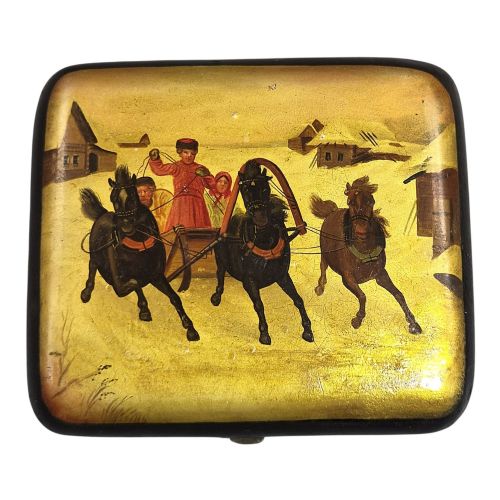
Russian workshops created distinct lacquered pieces featuring troika scenes, and Kashmiri artisans produced intricate painted papier mache items with characteristic patterns.