



Painted Enamel Glass Vase
These painted enamel glass vases bring together vibrant colours and detailed brushwork across Victorian, Bohemian and Art Nouveau periods.
Painted Enamel Glass Vase
A painted enamel glass vase combines translucent or opaque glass vessels with hand-painted vitreous enamel decoration, spanning the nineteenth and early twentieth centuries. When searching for a painted enamel glass vase, collectors frequently encounter Victorian pieces, including ruby and cranberry glass, alongside continental Bohemian and Art Nouveau examples.
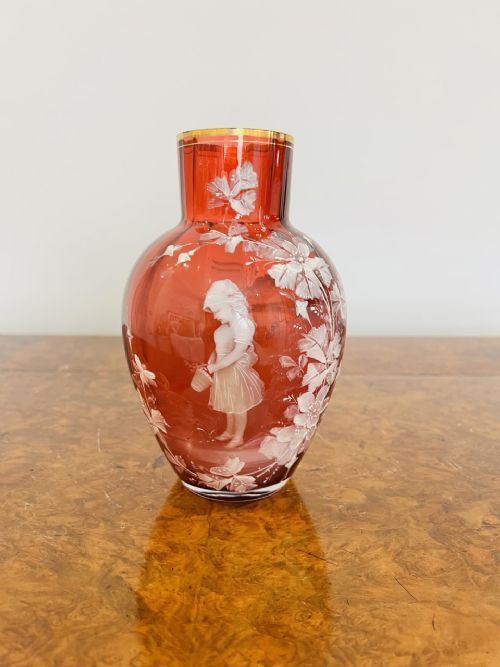
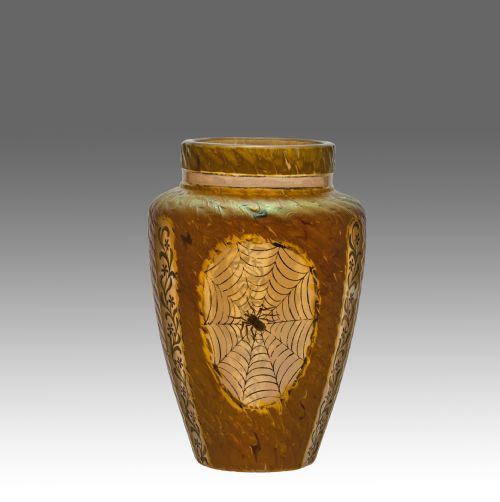
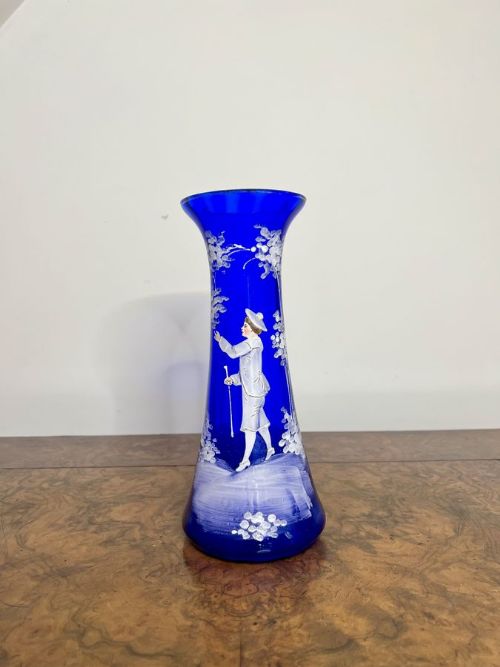
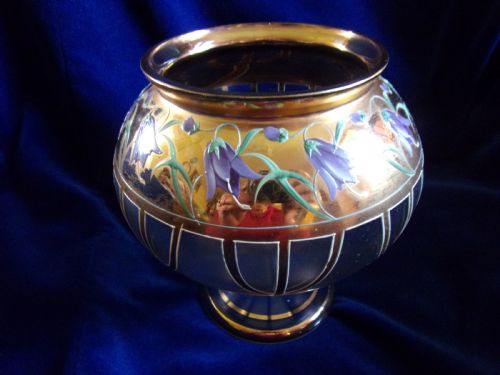
The selection ranges from small bulb vases and mantle lustres to large decorative garniture sets and table centrepieces. Victorian examples often feature white silhouette figures or floral scenes, while later Art Nouveau and turn-of-the-century pieces display naturalistic landscapes and gilded details.
Originating largely from English, Bohemian and French workshops, these items demonstrate a distinct shift from mid-Victorian opaline glass towards flowing, nature-inspired motifs of the 1900s. The forms vary from straightforward cylindrical shapes to elaborate overlay glass and panelled vessels.
How they were made
Glassmakers shaped vessels using hand-blowing techniques, often utilising coloured glass formulas such as cranberry, ruby, green and opaline glass. Lead crystal and crystal overlay methods added depth, allowing craftsmen to cut through contrasting layers to reveal underlying hues.
Decoration relied on opaque enamel paints applied directly to the glass surface, frequently accented with gold leaf and gilding. Artisans then fired the pieces at lower temperatures to fuse the enamel permanently to the glass body.
Listings feature Victorian, Edwardian, and early twentieth-century periods alongside glass types including opaline, cranberry, ruby, and lead crystal.
What varies in quality
Quality rests upon the crispness of the enamel work and the complexity of the glass body itself, such as multi-layered overlay or heavy lead crystal. Finer pieces display precise brushwork in floral or figural scenes rather than simplified, uniform stenciling.
The weight of the glass, the richness of underlying colours like deep cranberry or emerald green, and the subtlety of applied gold leaf distinguish standard production wares from exceptional studio pieces.
Kralik Glass·Moser·Legras·Daum·Harrach
The Painted Enamel Glass Vase Glossary
- Cranberry glass
- A rich pinkish-red glass coloured with gold chloride, widely utilised in Victorian tableware and decorative vases. This distinctive colour forms the background for many enamelled floral designs.
- Opaline glass
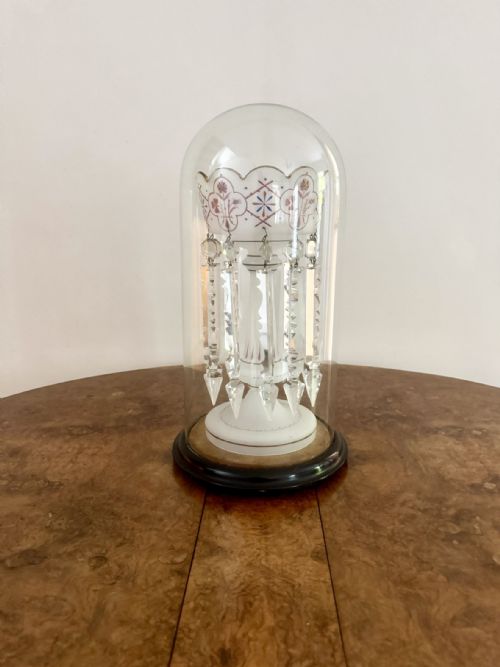
- An opaque or translucent pale glass developed in France and popular throughout the nineteenth century. It provides a smooth, milky canvas for detailed hand-painted enamel decoration.
- Mantle lustres
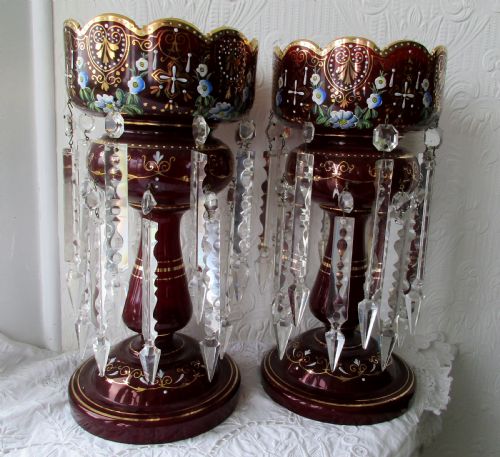
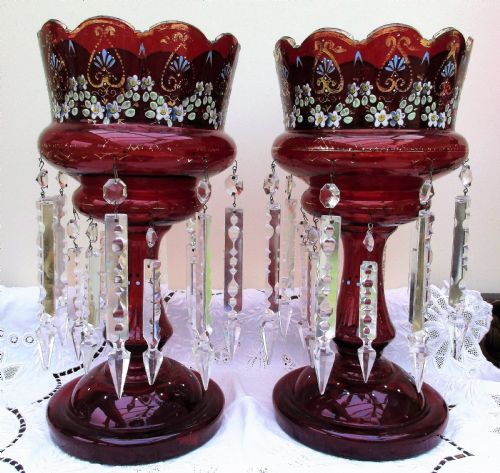
- Decorative glass vases fitted with dangling crystal prisms around the rim, typically produced in pairs for nineteenth-century mantelpieces. They frequently feature enamel and gilt highlights.
- Enamel
- A powdered glass mixture suspended in a medium that hardens when fired, used to paint permanent designs onto glass surfaces. It sits in raised, tactile strokes above the vessel walls.
- Overlay glass
- A technique involving two or more distinct layers of glass fused together before blowing or shaping. Craftsmen cut away sections of the outer layer to expose the contrasting colour beneath.
Painted Enamel Glass Vase: Frequently Asked Questions
How do I identify Mary Gregory glass?
Mary Gregory pieces are characterised by white enamel silhouettes depicting Victorian children playing amidst foliage or natural settings. The glass itself frequently appears in cranberry, blue, or green.
While named after a specific American decorator, most pieces bearing this style are actually Victorian English or Bohemian productions created for the export market.
What is Bohemian overlay glass?
Bohemian overlay glass consists of a base glass body encased in one or more contrasting outer layers of coloured glass. Artisans cut intricate windows through the top layer to reveal the different shade underneath.
These cut-away sections are then typically embellished with painted enamel flowers or gilt scrollwork.
Where were mantle lustres placed?
Mantle lustres stood on nineteenth-century drawing-room mantelpieces, often flanked by clocks or other decorative garniture pieces. Their hanging crystal prisms caught the flickering light of oil lamps and candles.
They served as ornamental centrepieces rather than functional vessels for holding large flower arrangements.
How do I date a piece?
Dating relies on combining the glass colour, manufacturing technique, and decorative style visible on the vessel. Mid-nineteenth-century items often feature simple opaline or ruby glass bodies with modest floral enamelling.
Turn-of-the-century works shift towards organic Art Nouveau forms, naturalistic winter landscapes, and iridescent finishes associated with makers like Kralik and Legras.