
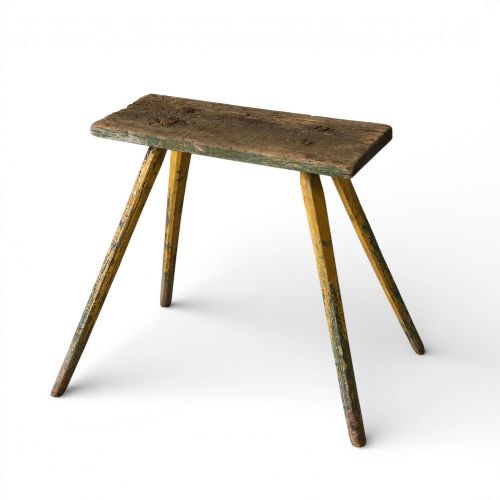
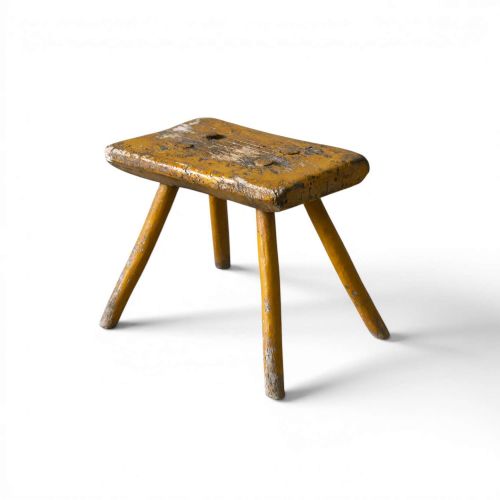
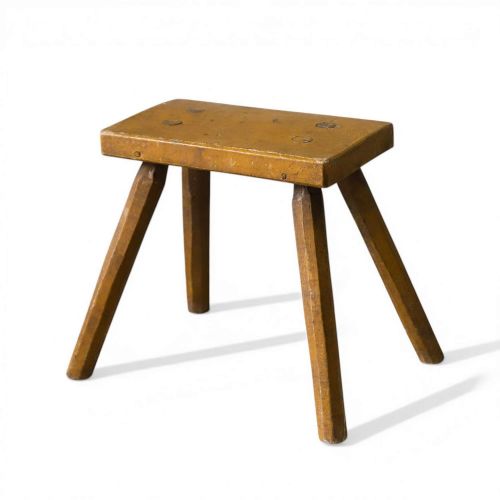
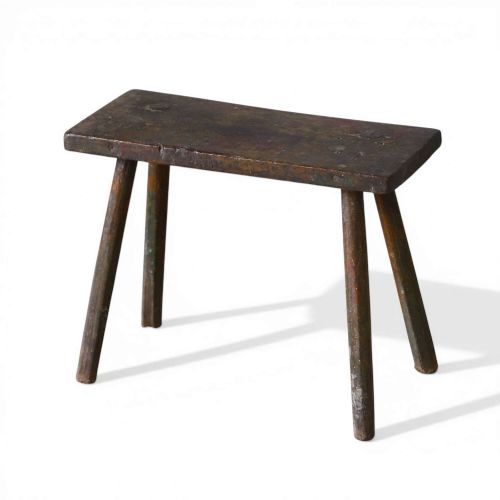
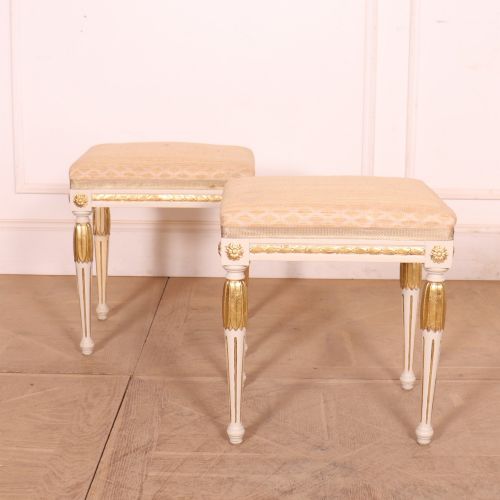


Painted Country Footstool
These painted country footstools bring practical rustic charm and centuries of character into a room.
Painted Country Footstool
When you search for a painted country footstool, you encounter humble seating forms shaped by daily rural life across Europe. These pieces span the nineteenth century up to nineteen thirty, taking the shape of milking stools and low benches.
The versions most frequently met on this page originate from Sweden, France, and Eastern Europe. They arrive as individual seats or matched pairs, constructed for utilitarian tasks and retained for their decorative presence.
How They Were Made
Maker construction relies on timber, pine, and wood shaped into simple tripod or four-legged forms. Surfaces receive layers of paint, including ochre, yellow, green, and gold leaf applications.
Some examples incorporate fabric and linen elements alongside carved details influenced by Gustavian and Louis XV styles. Original paint finishes survive directly on the aged wood.
Styles represented on this page include Gustavian, French Country, Rustic Farmhouse, Folk Art, and Louis XV Revival.
What Varies in Quality
Quality rests in the survival of original paint surfaces and the integrity of the underlying timber. Untouched ochre, green, or yellow pigments hold more interest than later decorative overpainting.
Proportion and structural balance separate standard utilitarian examples from finer pieces bearing deliberate carved details. Pairs matching in scale and pigment command stronger visual presence than isolated items.
The Painted Country Footstool Glossary
- Gustavian
- A Swedish aesthetic reflecting local interpretations of French neoclassical design. It prioritises restrained carving and pale painted finishes.
- Milking stool
- A low, stable seat traditionally utilised during dairy work. These pieces typically feature three legs to remain steady on uneven farm floors.
- Ochre
- An earthy natural pigment utilised to achieve yellow, brown, or red tones in historic paint finishes. It remains durable across centuries.
- Tripod
- A three-legged structural arrangement common in country stools. This configuration ensures the seat does not wobble on irregular surfaces.
- Original paint
- Pigment applied during the initial period of manufacture rather than during later restoration. Collectors prize untouched layers for historical authenticity.
Painted Country Footstool: Frequently Asked Questions
How were they used historically?
Historic owners utilised them for close seating during farm chores such as milking livestock. Their low height provided stability and reduced fatigue during repetitive daily labour.
Beyond agricultural work, households kept them near hearths or used them to reach low storage areas. Their portability allowed owners to move them easily around the room as needed.
How do I live with one?
Place a low country stool beside a fireside chair or use it to support a stack of books. Their compact proportions fit effortlessly into small corners or empty hallway spaces.
Protect the historic painted surface by keeping the timber away from direct heat sources and excessive moisture. Treat the old wood gently to preserve the original pigment layers.
How can I tell periods apart?
Nineteenth-century examples frequently show heavy wear on the wooden feet and patinated surfaces from prolonged practical use. Earlier pieces often display simpler, heavier joinery dictated by regional tool traditions.
Items from the nineteen thirties lean towards lighter construction methods and smoother painted finishes. Stylistic cues like French country or Gustavian carving help narrow down geographic origins.