
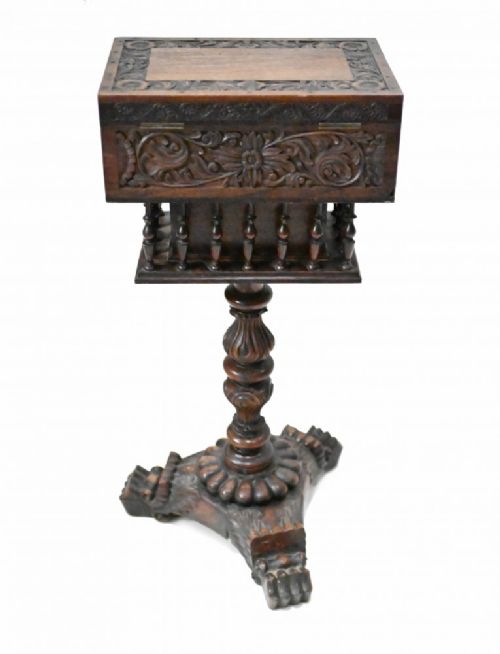
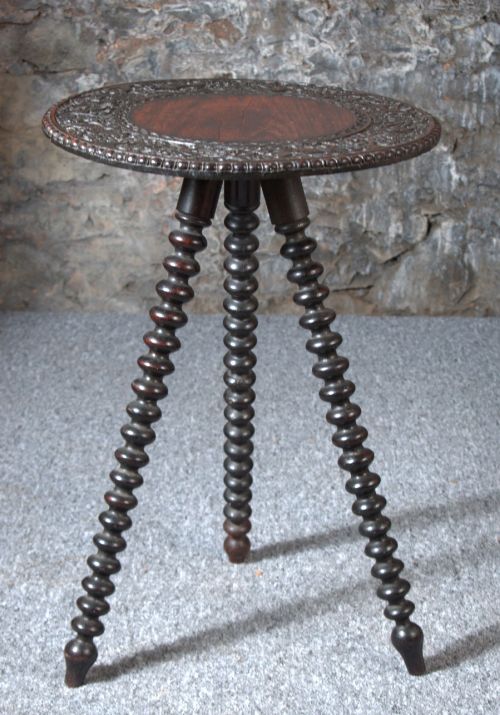


Padouk Side Table
These padouk side tables bring dense tropical timber and intricate regional carving into domestic spaces.
Padouk Side Table
A padouk side table represents a distinct intersection of colonial trade, native craftsmanship and domestic utility across the eighteenth and nineteenth centuries. These pieces serve as functional surfaces while displaying intricate woodwork derived from Anglo-Indian, Chinese and Burmese traditions.
The versions most commonly met on this page span the Victorian era, alongside earlier George III examples and late nineteenth-century export pieces. Forms range from compact circular tilt-top occasional tables to console tables, plant stands and specialised carved tripod bases.
Makers often utilised regional motifs, incorporating deep relief carving, elephant figures and pedestal designs suited to both colonial outposts and European drawing rooms. The resulting furniture combines robust tropical timber construction with ornamental detail unique to its origin.
How they were made
Makers constructed these tables primarily from padouk, a dense tropical hardwood celebrated for its durability and rich reddish-brown tone. Artisans frequently paired this primary timber with secondary hardwoods or incorporated decorative elements such as inset marble tops and brass fittings.
The ornamentation relies on heavy hand-carving executed in relief, showing deep floral patterns, animal motifs and geometric borders. Joinery and turning techniques varied according to whether the piece originated in British colonial workshops or Qing dynasty export centres.
Several nineteenth-century Burmese and Anglo-Indian tables incorporate carved elephant motifs directly into their pedestal supports.
What varies in quality
Quality in these tables rests heavily on the depth and crispness of the hand-carving across the frieze and pedestal. Superior examples exhibit precise tool work that retains sharp edges and balanced proportions, whereas lesser pieces show softer, shallower detailing.
The selection and treatment of the padouk timber also differentiate the grade of a table. Well-chosen boards display a rich, uniform grain and colour, while the structural integrity of the tilt-top mechanisms or pedestal joints dictates long-term stability.
The Padouk Side Table Glossary
- Padouk
- A heavy, durable tropical hardwood native to Asia and Africa, prized for its deep reddish hue and stability in furniture construction. It darkens gracefully with age when exposed to light.
- Tilt-top table
- A table featuring a mechanism that allows the circular or oval top to pivot vertically into a space-saving position when not in use. This form became popular for occasional use in nineteenth-century interiors.
- Anglo-Indian
- A style of furniture produced during the British colonial period in India, combining European furniture forms with traditional Indian carving techniques and native timbers. The results often blend classical proportions with dense foliate ornamentation.
- Chinese Export
- Goods manufactured in China specifically for Western markets, often adapting local materials and motifs to suit European room layouts. These pieces frequently utilise dense Asian hardwoods like padouk.
- Console table
- A table designed to stand against a wall, traditionally supported by wall brackets or front legs. In nineteenth-century contexts, these often served decorative display functions in hallways and reception rooms.
Padouk Side Table: Frequently Asked Questions
What is a padouk side table?
A padouk side table is a piece of furniture fashioned from dense tropical timber, often featuring intricate regional carving from nineteenth-century workshops. These surfaces were built to serve functional roles in domestic interiors while showcasing elaborate decorative motifs.
Examples on this page frequently originate from Anglo-Indian, Burmese or Chinese export traditions, encompassing forms like occasional tables, plant stands and console tables.
How do I care for padouk wood?
Padouk timber benefits from minimal intervention, requiring simple dusting with a dry cloth and protection from direct sunlight. Avoiding excessive moisture helps preserve the natural finish and deep colour of the hardwood.
Applying occasional natural wax can nourish the surface without building up residue. Maintaining stable indoor humidity prevents movement in the timber and joints.
Are tilt-top tables stable?
Tilt-top tables rely on a central catch and block mechanism that secures the surface in a horizontal position during use. When the mechanism is well adjusted, the top remains firm and reliable for holding lamps or decorative objects.
Collectors should check that the original peg or latch functions correctly. This ensures the table transitions safely between its display position and its stored vertical state.
Where were these tables made?
These tables were produced across various regions influenced by international trade and colonial presence during the eighteenth and nineteenth centuries. Workshops in the Bombay region, Burma and Chinese treaty ports generated much of this export furniture.
Local artisans adapted indigenous carving styles to suit the domestic tastes of European buyers. This cross-cultural exchange produced the distinctive fusion seen in Anglo-Indian and Chinese export pieces.