
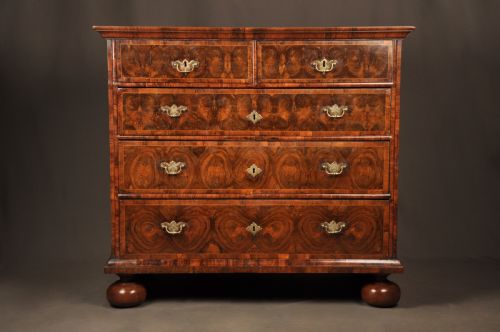



Oyster Veneered Drawers
Oyster veneered drawers are richly patterned timber pieces offering deep historical character that collectors prize for their intricate cross-grain circular motifs.
Oyster Veneered Drawers
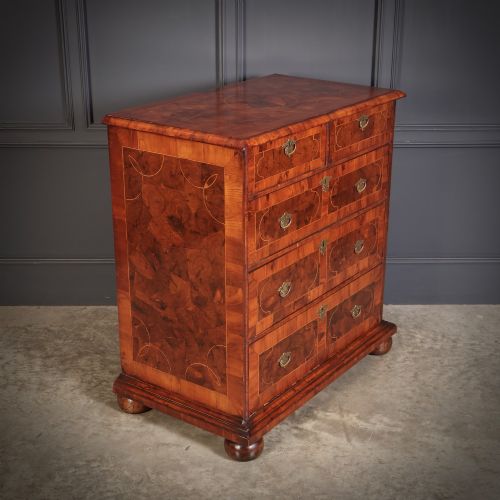
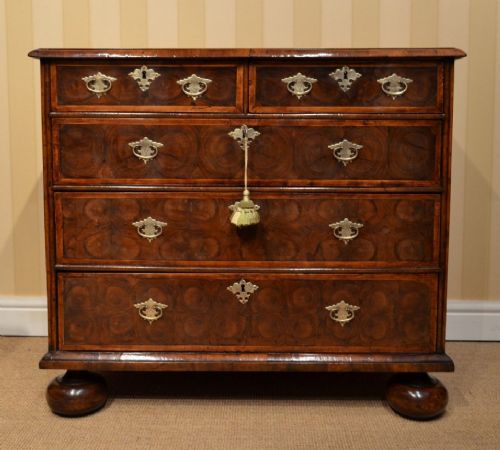
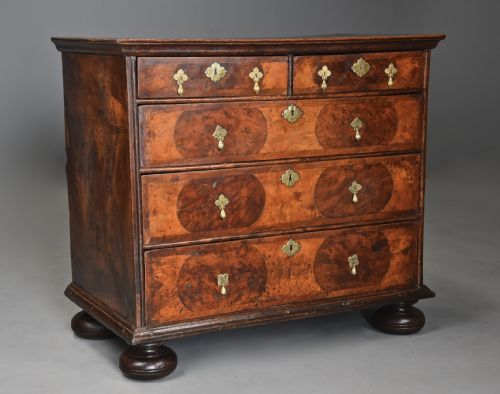
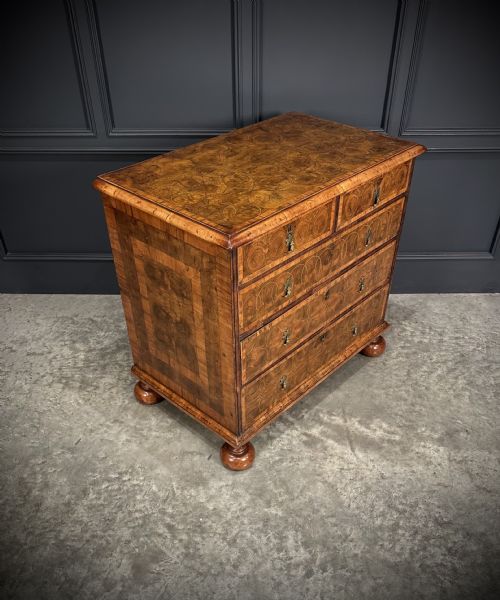
When you search for oyster veneered drawers, you encounter timber surfaces sliced across small branches to create circular and oval patterns resembling oyster shells. These pieces predominantly date from the seventeenth century and the William and Mary period, spanning chest of drawers and chest on stand forms. Walnut and laburnum are the common timbers, often accented with olivewood and yew.
The chests appear in various formats, ranging from compact examples on stands to larger multi-drawer configurations. Later revivals from the twentieth century also surface, though the seventeenth-century originals form the core of what you will handle. These items embody the peak of late-seventeenth-century cabinet making.
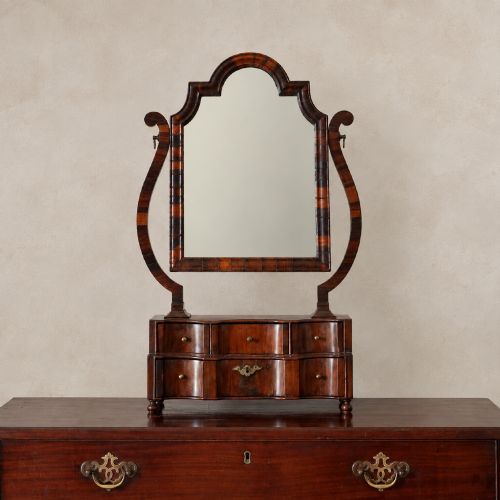
Alongside standard chests, you find specialised forms such as toilet mirrors and chests on stands utilising similar circular slicing techniques. The aesthetic relies entirely on the natural growth rings of the timber rather than applied carving.
Materials and construction
Cabinet makers produced oyster veneers by cutting small branches or roots obliquely across the grain to generate small roundels. These sections were laid down on secondary woods like oak or pine to form dense geometric patterns across the drawer fronts and top surfaces.
Makers combined walnut, laburnum, olivewood, and yew, frequently utilising boxwood stringing and marquetry details to frame the individual roundels. Brass handles and escutcheons completed the construction, anchored securely to the heavy timber carcass.
Every single branch cut creates a fingerprint of tree rings that no cabinet maker could ever duplicate twice.
Judging the work
Quality rests primarily on the tightness of the timber's growth rings and the precision of the cutting. Finer examples display minimal gaps between the roundels and maintain an even thickness across the entire veneered surface.
The choice of secondary woods and the complexity of the cross-banding also separate standard items from superior pieces. Original surfaces with deep patination hold more integrity than heavily restored examples.
The Oyster Veneered Drawers Glossary
- Oyster veneer
- Slices of small branches or roots cut across the grain to reveal circular growth rings. This technique was highly favoured in late seventeenth-century cabinet making.
- Cross-banding
- Border strips of veneer laid perpendicular to the main grain of the furniture. It frames the central panels and provides structural definition.
- Chest on stand
- A case of drawers raised on a separate frame with legs. This form elevates the primary storage section.
- Marquetry
- Decorative patterns formed by fitting together small pieces of various woods. It often embellishes the top surfaces and drawer fronts.
- Escutcheon
- A protective plate surrounding a keyhole, commonly made from brass on these pieces. It prevents the timber from wearing around the lock.
Oyster Veneered Drawers: Frequently Asked Questions
How do I date an oyster veneered chest?
You look at the construction methods, secondary woods like oak, and the framing styles typical of the late seventeenth century. William and Mary period pieces usually exhibit specific handle configurations and dovetailing techniques.
Changes in timber choice and the presence of later revivals also help determine whether a piece originates in the 1600s or the twentieth century.
What woods were used for oyster veneers?
Walnut and laburnum are the most frequently encountered timbers used to create the characteristic circular oyster patterns. Olivewood, yew, and boxwood also appear in the evidence.
Cabinet makers selected these woods for their contrasting grain patterns and rich natural colour variations.
How should I care for oyster veneer?
You keep these pieces away from direct sunlight and sudden temperature shifts to protect the thin timber roundels from lifting. Gentle dusting with a dry cloth maintains the surface.
Avoid excessive polishing or moisture which can damage the historic patinated finish on the walnut and laburnum.
What is a chest on stand?
A chest on stand combines a primary drawer section sitting atop an elevated wooden frame with legs. This form lifts the storage unit off the floor.
Such pieces often date from the late seventeenth century and incorporate elaborate cross-banding and oyster veneering across the entire elevation.