
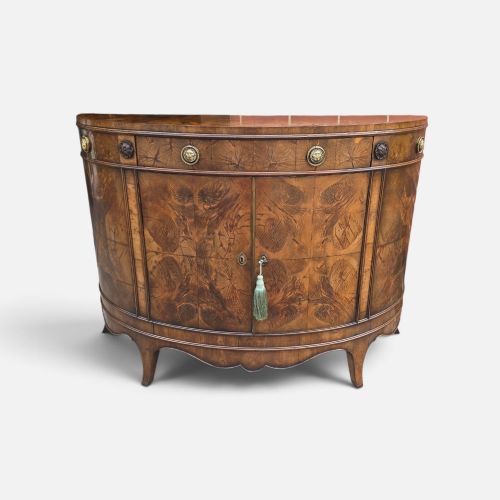


Brown Oyster Veneer Cabinet
These brown oyster veneer cabinets are striking pieces defined by circular cross-grain wooden roundels, offering exceptional historical character for any interior.
Brown Oyster Veneer Cabinet
A brown oyster veneer cabinet represents a sophisticated category of antique furniture primarily originating from the seventeenth century and the William and Mary period, alongside later revival pieces. When exploring this selection, buyers encounter cabinets on stands, chests of drawers, side cabinets, and writing cabinets.
The defining characteristic of these brown oyster veneer cabinet items is the circular pattern formed by slicing small branches diagonally. Examples range from seventeenth-century walnut and olive wood creations to early twentieth-century interpretations.
How they were made
Cabinetmakers constructed these pieces using dense hardwoods like walnut, olive wood, laburnum, and yew wood, often accented with boxwood stringing or marquetry. Branches were cut transversely to produce small elliptical or circular discs, which were then laid flat in intricate geometric arrangements across the surfaces.
Master artisans supported these elaborate veneered facades with robust secondary timbers such as oak, securing the delicate patterns with traditional animal glues. Brass hardware, including drop handles and escutcheons, completed the construction on stands or chest bases.
Listings feature seventeenth-century William and Mary pieces alongside early twentieth-century revivals, utilising walnut, olive wood, laburnum, and kingwood.
What varies in quality
Quality in these items hinges on the precision of the veneer work and the complexity of the geometric layout. Dense, uniform roundels that cover entire surfaces with minimal disruption denote superior craftsmanship compared to sparse or poorly aligned patterns.
The choice of primary timber and secondary wood also dictates the grade of the piece. Olive wood, kingwood, and burr walnut examples from the seventeenth century represent high-end production, whilst early twentieth-century revivals vary according to the fidelity of their period construction methods.
The Brown Oyster Veneer Cabinet Glossary
- Oyster veneer
- A method of cutting branch wood transversely to create small, oval-shaped roundels resembling oyster shells. This technique creates a distinctive repeating pattern across the furniture surface.
- Cabinet on stand
- A form comprising a main storage body raised upon legs connected by stretchers. This elevated design was particularly popular during the late seventeenth century.
- Marquetry
- The art of applying pieces of veneer to a structure to form decorative patterns and pictures. It frequently accompanies oyster veneering on high-status seventeenth-century pieces.
- Escritoire
- A writing cabinet featuring a fall-front panel that conceals internal drawers and pigeonholes. These items combine practical desk space with decorative veneered exteriors.
- Stringing
- Thin inlay lines of a contrasting timber, such as boxwood, used to outline panels and drawers. It provides a sharp visual border for the circular veneer motifs.
Brown Oyster Veneer Cabinet: Frequently Asked Questions
What is an oyster veneer cabinet?
An oyster veneer cabinet is a piece of furniture decorated with circular wood slices cut from small branches. These pieces date predominantly from the seventeenth century or later revival periods.
They showcase intricate grain patterns arranged closely together across drawers, doors, and tops to create a rich decorative surface.
How were these cabinets used?
These cabinets served as high-status storage furniture for valuable items, documents, and textiles. Versions with stands and drop-fronts also functioned as writing desks for correspondence.
Their elevated designs and striking wooden facades made them focal points in formal rooms during the Baroque era.
How do I live with one?
Living with these antique cabinets involves placing them away from direct sunlight and sudden temperature shifts to protect the delicate veneer. Regular polishing with appropriate wax maintains the timber's finish.
Their compact forms and rich brown tones allow them to integrate successfully into both traditional and contemporary interiors.
How do I tell periods apart?
Seventeenth-century examples display authentic period construction techniques, hand-cut dovetails, and primary timbers like olive wood, walnut, or kingwood. William and Mary pieces often feature specific stand designs with shaped stretchers.
Twentieth-century revival pieces, such as those from the nineteen-tens and twenties, show more uniform internal timbers and machine-assisted precision whilst imitating earlier styles.