


Oyster Veneer Tallboy
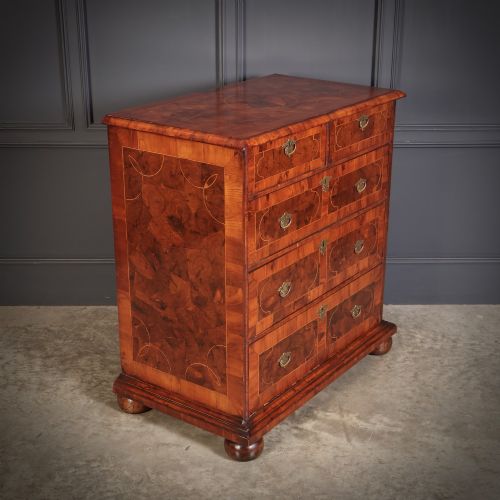
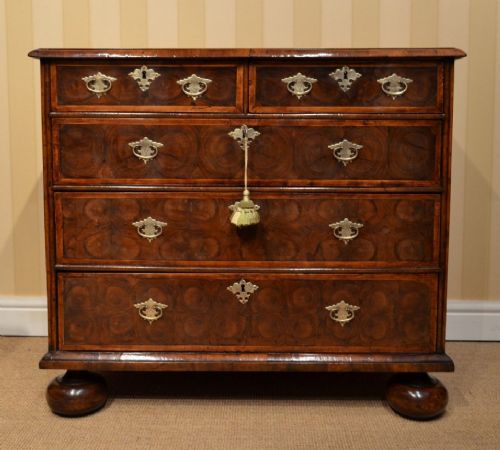
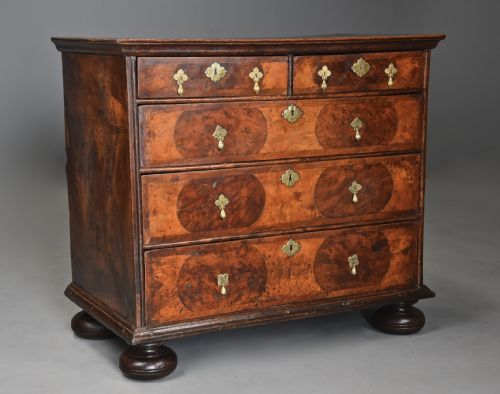
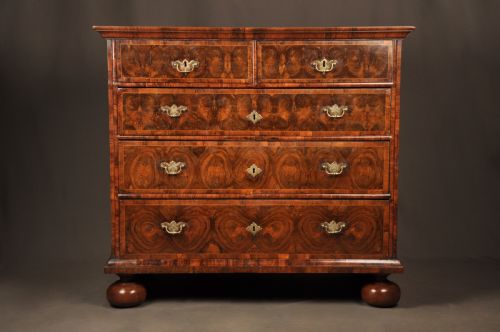
An oyster veneer tallboy brings together small cross-cut circles of timber and rich cabinetry to anchor a room.
Oyster Veneer Tallboy
An oyster veneer tallboy involves pieces formed from transverse sections of branch wood arranged to display concentric growth rings. These items appear across seventeenth century, eighteenth century, and early twentieth century periods, anchored primarily in William and Mary and George I styles.
The primary forms include chests of drawers and chests on stand, constructed using timber varieties such as walnut, yew, olive, laburnum, and oak. Buyers encounter formats ranging from standard chest configurations to elevated chest on stand designs.
Originating during periods of intricate cabinet work, these pieces demonstrate historic woodworking methods scaled to domestic storage. The aesthetic relies on repeating circular patterns across drawer fronts and top panels.
How they were made
Cabinet makers sliced small branches or boughs across the grain to produce thin oval discs of timber known as oysters. These were laid down in geometric patterns, often complemented by contrasting stringing in boxwood.
The carcase construction frequently employed oak or pine as a sturdy foundation, veneered over with walnut, olive, laburnum, or yew. Brass hardware such as drop handles and escutcheons completed the construction.
Early cabinet makers occasionally used fruitwood branches just to see how many tiny wooden eyes they could pack into a single drawer front.
What varies in quality
The rhythm and alignment of the circular veneer patterns dictate the visual success of the piece, separating methodical work from careless arrangement. Precision in cutting the timber cross-sections ensures tighter joints and a more unified surface.
The selection of secondary timbers and the retention of original brasses or patinated surfaces influence the character of the object. George I and William and Mary iterations often display distinct refinements in proportion and stand design.
The Oyster Veneer Tallboy Glossary
- Oyster veneer
- A method of cutting branches diagonally or transversely to create circular or oval wooden motifs resembling oyster shells. This technique flourished in the late seventeenth century.
- Chest on stand
- A form comprising an upper chest section raised upon a distinct table-like base with legs. These structures often feature additional drawer space in the lower stand.
- Stringing
- Fine inlay lines of contrasting wood, such as boxwood, embedded into the surface to frame panels or drawer edges. It defines the geometric borders of the veneer work.
- William and Mary
- A stylistic period spanning the late seventeenth and early turn of the century, characterised by Dutch influences and rich marquetry. Furniture from this era often utilises walnut and exotic veneers.
- Patina
- The surface sheen and mellowing developed by wood over centuries of handling and exposure to light. It is a key indicator of age and historical continuity.
Oyster Veneer Tallboy: Frequently Asked Questions
What is an oyster veneer?
Oyster veneer is formed by slicing small tree branches across the grain to create circular or elliptical wooden discs. These slices are arranged closely together to cover furniture surfaces in repeating patterns.
The resulting surface resembles the shell of an oyster, giving the technique its traditional name. Cabinet makers used walnut, olive, and laburnum in this manner during the seventeenth century.
How do I date a piece?
Dating relies on examining the construction methods, timber choices, and overall form of the furniture. Seventeenth century and William and Mary examples typically feature specific base designs and native hardwoods.
Later revivals from the early twentieth century employ similar techniques but can often be identified through secondary woods and modern finishing traces. Comparing the hardware style and drawer construction also aids in attribution.
Where were they placed?
These items functioned as primary storage furniture within principal rooms of domestic residences. Their decorative patterned surfaces meant they were meant to be seen rather than hidden away.
Chest on stand variants offered elevated storage while adding architectural height to bedchambers or parlours. The compact drawer arrangements held linens, documents, or personal valuables.
How do I care for the wood?
Maintaining veneer work requires stable environmental conditions away from direct heat sources and strong sunlight. Sudden humidity shifts can cause the thin circular timber sections to lift or crack.
Applying a traditional wax polish periodically helps nourish the historic timber and preserve the surface sheen. Gentle dusting with a dry cloth prevents abrasive particles from dulling the finish.