
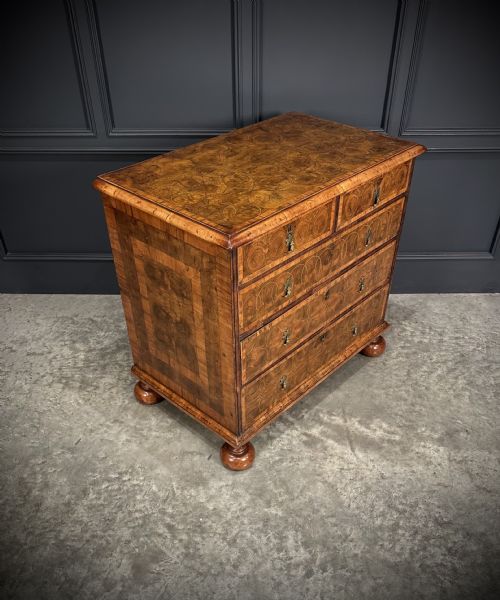


Walnut Oyster Chest Drawers
Walnut oyster chest drawers bring tactile warmth and intricate grain patterns into a room, offering practical storage with distinct period character.
Walnut Oyster Chest Drawers
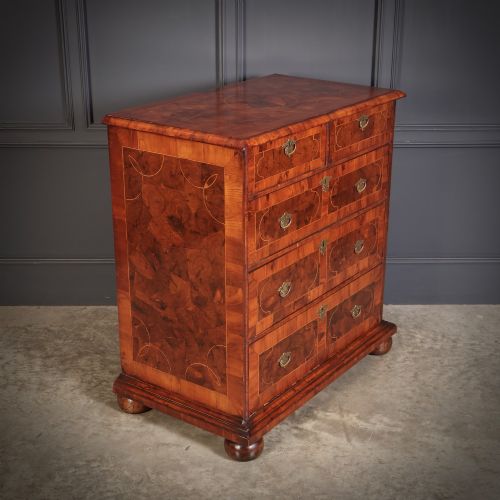
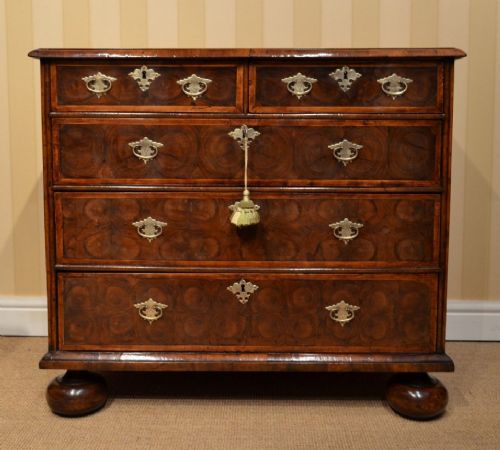
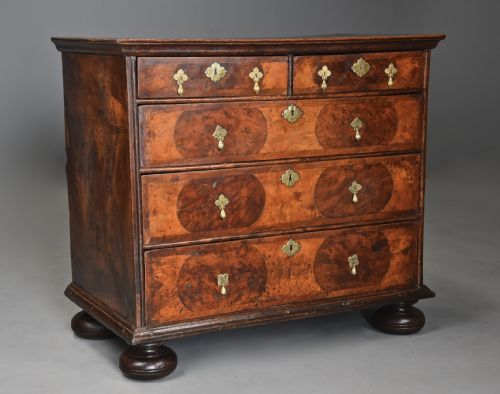
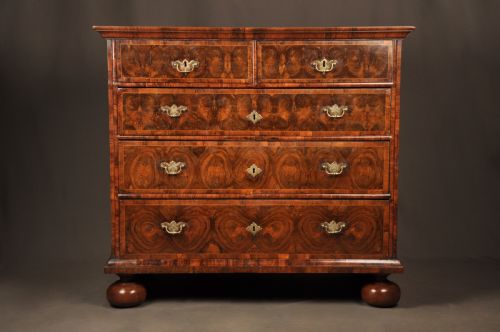
When you search for walnut oyster chest drawers, you are looking at sophisticated storage pieces primarily dating from the seventeenth century and the Georgian period. These items span standard chest of drawers formats as well as elevated chest on stand designs.
The version you are most likely to meet on this page originates from the William and Mary era. Such pieces combine small circular or elliptical wood sections with structured drawer configurations.
The corpus includes variants incorporating olive, yew, laburnum, and fruitwood alongside primary walnut timbers. Several examples feature inlaid details and cross-banded borders that frame the patterned drawer fronts.
Assessing quality in oyster veneered furniture
Quality rests heavily on the tightness and consistency of the transverse cutting across the timber branches. Closely fitted veneer patterns without excessive filler or mismatched timber segments represent superior craftsmanship.
The integrity of the underlying carcase construction and the retention of original or period-appropriate support structures, such as stands and feet, determine the overall integrity of the piece.
Branch sections were sliced thin like carrots to make those hypnotic wooden rings.
The Walnut Oyster Chest Drawers Glossary
- Oyster veneer
- Transverse slices of small branches arranged to resemble oyster shells. This technique creates complex circular and oval patterns across furniture surfaces.
- Chest on stand
- A storage chest elevated on a separate frame with legs. This form lifts the main drawer body higher off the floor.
- Cross-banding
- Border strips of wood veneer laid perpendicular to the grain of the surrounding surface. It frames the central panels on drawer fronts.
- Marquetry
- Elaborate decorative inlay using various woods to create pictorial designs. It appears on selected seventeenthand eighteenth-century examples.
Walnut Oyster Chest Drawers: Frequently Asked Questions
How do I care for oyster veneer?
Keep these pieces away from direct sunlight and consistent heat sources to prevent the thin circular veneers from lifting.
Apply a microcrystalline wax periodically to nourish the wood and maintain a gentle protective sheen without building up heavy residues.
Are these chests suitable for daily use?
The drawers provide practical storage for lighter items of clothing or linens when handled with reasonable care.
Avoid overloading the drawers, as historic runner systems and secondary timbers require gentle treatment compared to modern cabinetry.
What defines William and Mary style?
This late seventeenth-century aesthetic emphasises geometric drawer arrangements, oyster veneering, and applied mouldings.
Pieces from this period frequently rest on distinctive stands or turned bun feet that reflect Dutch design influences.
How do I distinguish seventeenth-century pieces?
Examine the secondary timbers inside the drawers, such as oak or deal, which match the construction methods of the 1680s and 1690s.
Look for hand-cut dovetails and subtle irregularities in the timber preparation that indicate manual workshop production.