


Oyster Veneer Dresser
An oyster veneer dresser brings together seventeenth-century geometry and remarkable timber work in a single piece.
Oyster Veneer Dresser
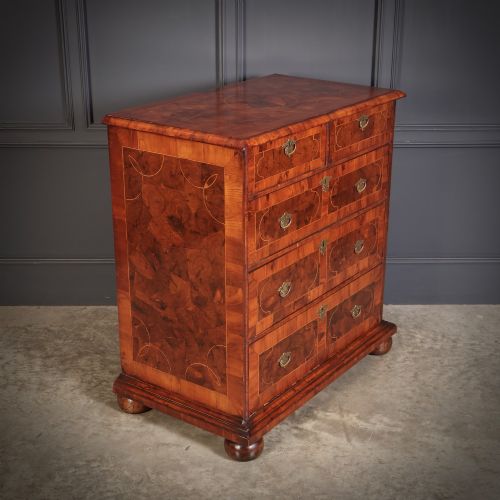
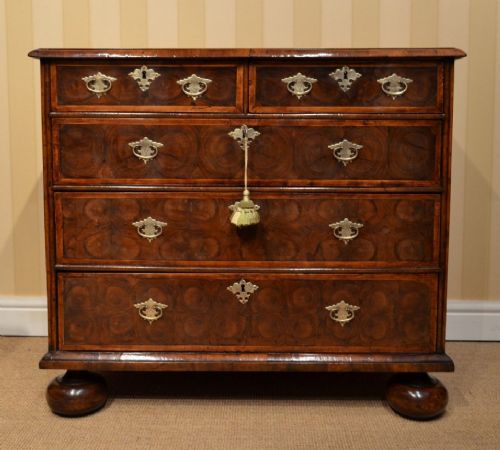
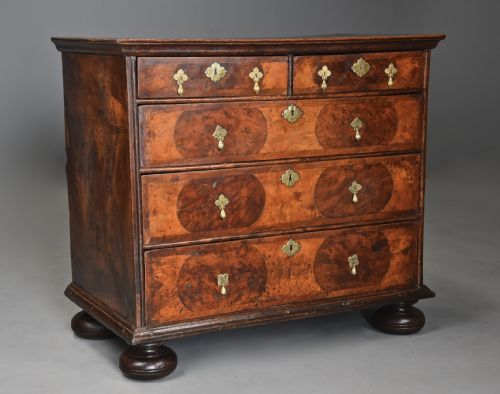
When you search for an oyster veneer dresser, you encounter seventeenth-century chests of drawers and chests on stand featuring distinctive circular wood sections. The pieces listed now originate from the seventeenth and eighteenth centuries, including William and Mary period examples.
Most items on this page take the form of chests of drawers or chests on stand rather than standard kitchen dressers, though earlier archive records include dresser bases with oyster veneered fronts. The predominant styles span Jacobean and William and Mary aesthetics.
Makers constructed these surfaces using careful cross-cut branch sections arranged to create mesmerizing geometric patterns. Buyers look for these specific forms to secure early English case furniture with strong visual movement.
Materials and construction
Craftsmen sliced small branches diagonally to produce circular and oval disks of walnut, olivewood, laburnum, yew, maple, and boxwood. They laid these delicate wooden rings onto oak or walnut carcases to form intricate patterned veneers.
Workshops frequently combined oyster veneer with contrasting stringing, marquetry, and banding in boxwood or walnut. Cabinetmakers mounted the drawers with brass hardware, completing pieces that showcase seventeenth-century timber manipulation.
Current listings feature walnut, olivewood, yew, maple, and laburnum deployed across seventeenth-century chests and chests on stand.
Distinctions in quality
Quality rests primarily on the preservation of the delicate circular veneer patterns and the choice of secondary timbers like olivewood and laburnum. Superior examples maintain crisp geometric alignment across the drawer fronts and top surfaces without major disruption to the timber rounds.
The sophistication of the underlying structure also separates standard chests from finer pieces on stands with integrated marquetry work. Strong patination on the walnut and olive surfaces indicates age and careful historical maintenance.
The Oyster Veneer Dresser Glossary
- Oyster veneer
- A method of cutting thin cross-sections from small tree branches to produce circular or oval motifs. This technique creates a characteristic rippled pattern across furniture fronts.
- Chest on stand
- A tall case of drawers raised on a separate base with legs. This form lifts the main body off the floor for a lighter visual presence.
- Marquetry
- The art of applying pieces of veneer to a structure to form decorative patterns and pictures. Craftsmen utilised contrasting woods to build elaborate floral or geometric designs.
Oyster Veneer Dresser: Frequently Asked Questions
What is an oyster veneer?
Oyster veneer is formed by slicing small tree branches transversely rather than lengthwise. This creates small, rounded disks of wood showing annual growth rings.
Cabinetmakers arranged these disks closely together to cover large surfaces with striking circular patterns.
How do I date these pieces?
Dating relies on timber choices, construction methods, and stylistic cues like William and Mary proportions. Most items belong to the late seventeenth century and early eighteenth century.
Examining the drawer linings and internal oak construction helps confirm the period.
Are these practical for daily use?
These historical chests provide functional drawer storage suitable for modern homes. Careful placement away from direct heat sources protects the delicate seventeenth-century timber veneers.
Treating the surfaces gently ensures the intricate patterns remain secure.
What woods were used?
Workshops utilised walnut, olivewood, laburnum, yew, maple, and boxwood for the decorative surface veneers. Oak and softwoods typically served as the primary carcase and drawer lining materials.
Contrasting timber species provided natural colour variation within the geometric designs.