
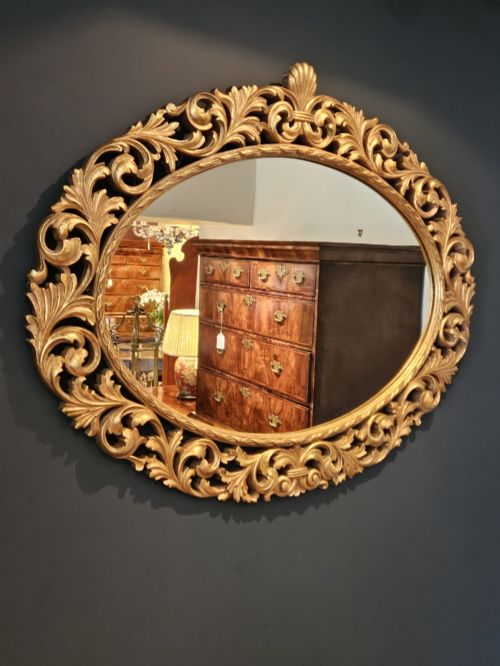


Oversized Wall Mirror
An oversized wall mirror delivers immediate scale and light to a room, anchoring a space with period presence.
Oversized Wall Mirror
An oversized wall mirror functions as a dominant architectural feature, filling large expanses of wall with reflected light and traditional form. When you search for an oversized wall mirror, you encounter substantial pieces designed to alter the perceived proportions of a room.
The pieces listed here span the nineteenth century up to nineteen twenty, taking forms such as overmantel mirrors, pier mirrors, and large oval or floor mirrors. French and English influences dominate, appearing through styles like Rococo, French Empire, Victorian, and French Provincial.
You are most likely to meet substantial giltwood or carved wooden frames, often finished with paint or gesso. These mirrors reflect both country house and urban interiors, utilising considerable dimensions to dominate a mantelpiece or floor space.
How they were made
Makers constructed these frames from timber, often utilising carved wood or layered gesso to build up intricate relief work before applying gilding or paint. This combination of wood and gesso allowed craftsmen to achieve deep architectural mouldings and decorative motifs.
Surfaces received finishes of gold leaf or applied paint, protecting the underlying timber while creating the luminous quality seen in French Chateau and Victorian examples. The heavy glass plates were then fitted securely into the substantial rebated frames.
Materials across these listings include glass, giltwood, gesso, timber, and paint.
What varies in quality
Quality rests in the depth and crispness of the carved timber and gesso ornament, where skilled hand-carving separates superior frames from simpler commercial output. Finer examples display precise detailing in their Rococo scrolls or architectural pilasters without heavy softening of the edges.
The integrity of the original gilt or painted surface dictates the visual strength of the piece, with well-preserved patination commanding greater appreciation. Furthermore, the weight and proportion of the timber frame must properly support the large glass plate.
The Oversized Wall Mirror Glossary
- Giltwood
- Wood that has been coated with fine gold leaf or gold powder. This finish gives the frame its characteristic metallic sheen and brightens reflected interior light.
- Gesso
- A plaster mixture applied to wood frames as a base for gilding or painting. It allows craftsmen to carve intricate relief details smoothly.
- Overmantel mirror
- A large mirror specifically designed to hang above a fireplace mantel. These pieces often feature horizontal or vertical proportions suited to architectural chimney breasts.
- Pier mirror
- A tall mirror designed to hang on the narrow wall space between windows. They frequently match the vertical height of the surrounding architecture.
- Patina
- The surface appearance altered by age, wear, and use. It reveals the genuine history of the painted or gilt wooden finish.
Oversized Wall Mirror: Frequently Asked Questions
Where should I hang an oversized wall mirror?
These large mirrors suit prominent positions such as above a drawing room fireplace or against a main hallway wall. Their scale demands a wall capable of bearing both physical weight and visual presence.
Positioning them opposite a window maximises the reflection of natural light deep into the room. Ensure the wall fixings match the substantial timber and glass weight of the specific frame.
How do I identify a French Empire mirror?
French Empire pieces display classical architectural restraint, often incorporating bold symmetry and formal ornamentation. They reflect the neoclassical tastes popular during the early nineteenth century.
Look for structured frames that avoid excessive scrollwork in favour of cleaner, monumental lines. These mirrors often served as tall pier glasses between large windows.
What is a bistro mirror?
Bistro mirrors originate from commercial French hospitality interiors of the mid nineteenth century. They provided functional reflection while brightening public dining spaces.
These pieces typically feature simpler painted wood frames rather than heavy gold leaf. Their robust construction suited busy interior environments.
How do I care for antique giltwood?
Giltwood surfaces require gentle dusting with a soft, dry brush to prevent the loss of fragile gold leaf. Avoid liquid cleaners or chemical agents that can strip the historic finish.
Keep the mirrors away from direct moisture and extreme temperature fluctuations to protect the underlying gesso and wood. Proper environmental stability preserves the original patination.