
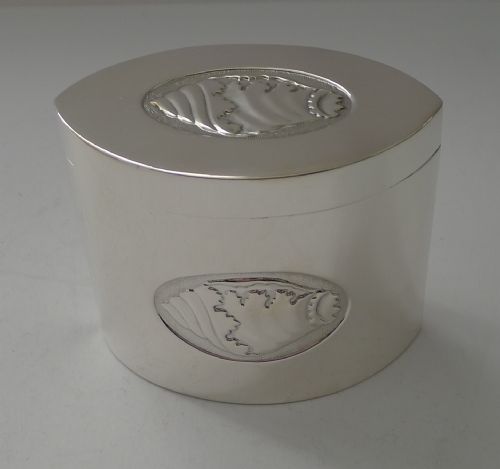
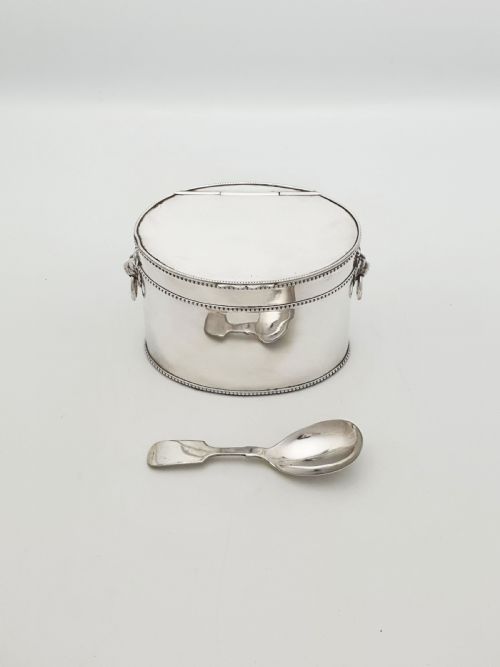


Oval Silver Tea Caddy
An oval silver tea caddy brings domestic refinement to the table, offering a curved form that collectors prize for its graceful Georgian and Victorian proportions.
What an oval silver tea caddy is
An oval silver tea caddy provides a secure vessel for storing valuable dry leaves, utilising a soft curvilinear footprint instead of rigid corners. The examples found here span the Victorian, Edwardian, and George V periods, showing how silversmiths adapted the shape over decades.
Most pieces meet the eye as compact boxes featuring pull-off lids or hinged tops designed to keep loose leaves fresh. Buyers encounter plain bodies alongside fluted and embossed variations that reflect changing decorative tastes from eighteen eighty onwards.
The form evolved from earlier cylindrical or square containers to give tea tables a softer aesthetic line. Whether dating from nineteen hundred or nineteen twenty-four, each oval silver tea caddy displays the characteristic proportions of its era.
How they were made
Silversmiths formed these vessels using sterling silver and silver plate, shaping sheets of metal by hand or utilising pressing techniques. Bodies often incorporate embossed decoration or half-fluting to catch the light across the curved surfaces.
Details such as lion mask handles and fitted spoons demonstrate the intricate metalwork applied to domestic items. Lids were carefully engineered to fit snugly over the mouths, ensuring the contents remained sealed against damp air.
What varies in quality
Quality separates simple production pieces from work bearing distinct hallmarks of superior craftsmanship. The crispness of embossed patterns and the weight of the sterling silver dictate the standing of individual vessels.
Makers who added cast elements like lion mask handles or dished tops elevated standard containers into works of distinction. Heavier gauge metal ensures the curved walls maintain their structural integrity over generations of use.
Thomas Shepherd
The Oval Silver Tea Caddy Glossary
- Sterling silver
- A standard alloy consisting of ninety-two point five percent silver by mass, with the remainder composed of copper. This composition provides the durability required for functional household objects.
- Hallmark
- An official stamp applied by an assay office to indicate the purity of the metal, the maker, and the year of production. British silver typically carries a leopard head or anchor alongside the date letter.
- Pull-off lid
- A snug cover that lifts directly upwards without hinges, commonly found on earlier tea caddies. It relies on precise fitting to stay secure.
- Half fluted
- A decorative technique where vertical channels or grooves cover the lower portion of the caddy body. This design element adds texture and visual depth to the curved surface.
- Lion mask
- A cast sculptural ornament depicting a lion's face, often used where drop rings or handles attach to the sides. It brings classical sculptural detail to the piece.
Frequently Asked Questions
What is an oval silver tea caddy?
An oval silver tea caddy is a small lidded container designed to hold loose tea leaves safely on the dining table or sideboard.
The curved shape distinguishes it from square or rectangular boxes, offering a softer profile that became popular during the eighteenth century and persisted through the Victorian and Edwardian eras.
How do I date a silver tea caddy?
Dating relies on reading the assay office hallmarks stamped directly onto the metal surface, which indicate the exact year of production.
Stylistic clues such as embossed floral motifs, half-fluting, or lion mask handles also point toward specific periods like the Victorian age or the reign of George V.
Were these caddies used for black or green tea?
Tea caddies held both black and green tea leaves when tea was an expensive commodity kept under lock and key by the head of the household.
Many period caddies featured internal dividers or companion canisters to separate different varieties within the same box.
How should I clean my silver tea caddy?
Cleaning requires a soft microfiber cloth and a gentle silver polish formulated to lift tarnish without removing the thin layer of precious metal.
Avoid harsh abrasive pads or liquid dips that can strip away the fine hallmarks and soften the crisp details of embossed decoration.