


Oval Inlaid Armoire
An oval inlaid armoire brings presence to a room, offering generous storage through timber work and decorative marquetry.
Oval Inlaid Armoire
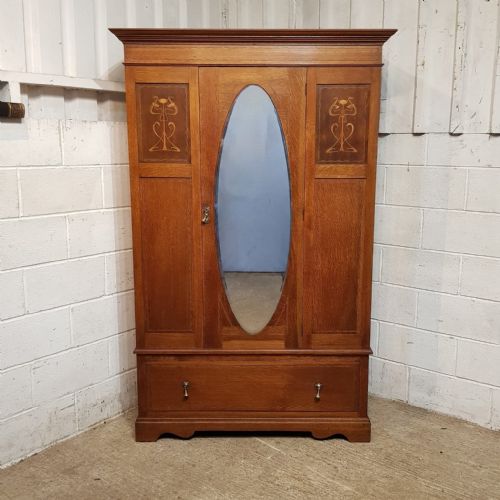
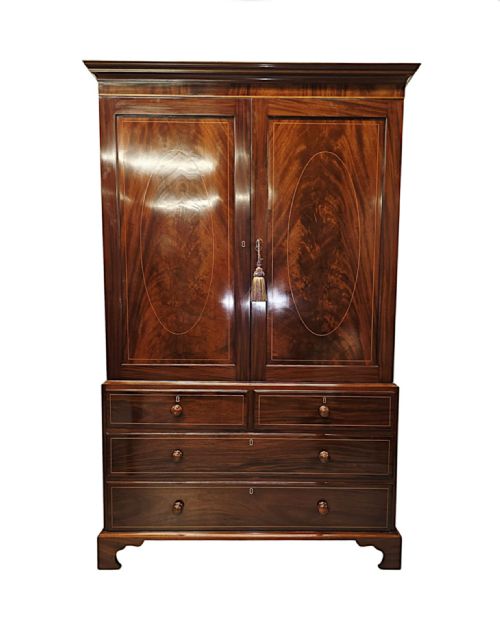
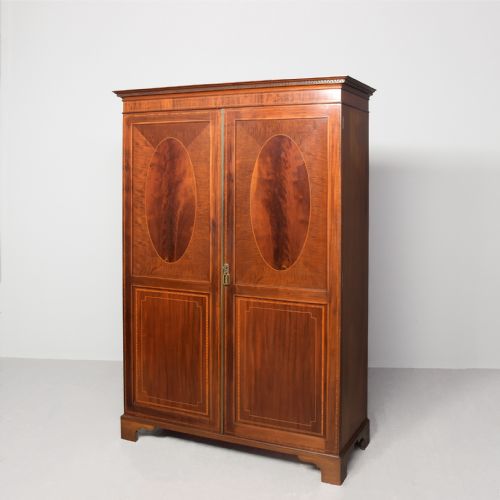
When you search for an oval inlaid armoire, you encounter substantial storage furniture primarily described across the listings as linen presses, gentlemen's press cupboards, and wardrobes. These pieces emerge predominantly from the Georgian period through the nineteenth century, extending into Edwardian and Arts and Crafts examples around nineteen hundred.
The materials recorded in the inventory point towards mahogany, flame mahogany veneer, walnut, and oak, frequently enhanced with contrasting satinwood and boxwood inlay. Forms vary from traditional two-door cupboards to pieces featuring swan-neck pediments, bow fronts, and channel island origins.
Most examples combine upper storage with lower chest sections, reflecting their original purpose as comprehensive clothes and linen repositories. The selection balances formal Georgian proportion with later regional and Edwardian interpretations.
How they were made
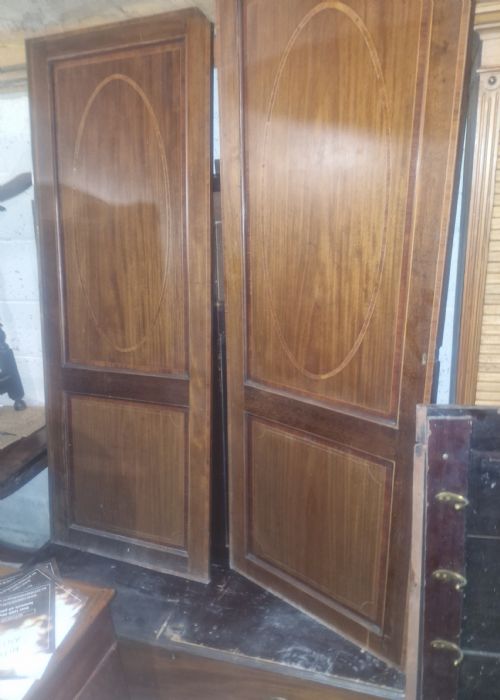
Cabinet makers utilised solid timber and veneers, applying flame mahogany veneer over foundational woods to create dramatic grain patterns across large surfaces. Boxwood and satinwood were then inlaid into the primary timber to form geometric borders and decorative bands.
Brass hardware, including escutcheons and handles, was incorporated to secure doors and drawers, while glass occasionally appears in related configurations. Joinery techniques ensured structural stability for tall carcasses housing multiple internal sliding trays or hanging space.
Several pieces originate from the Channel Islands, hinting at distinct regional tastes in maritime cabinet making.
What varies in quality
The standard of timber selection and the precision of the inlay work largely determine the distinction between pieces. Superior examples exhibit carefully matched veneer grains and crisply executed boxwood banding that remains uniform across the doors and cornice.
Structural integrity and the retention of original brass fittings also define the tier of craftsmanship, alongside the finesse of secondary details such as swan-neck pediments and panel proportions.
The Oval Inlaid Armoire Glossary
- Linen Press
- A large cabinet comprising upper shelving or sliding trays enclosed by doors, positioned above a base of drawers. This form was traditionally utilised for storing folded garments and household linens.
- Flame Mahogany Veneer
- A thin slice of mahogany cut from the branch junction where the grain pattern resembles flickering flames. Cabinet makers applied this to prominent surfaces for decorative impact.
- Satinwood
- A durable, yellowish wood sourced from tropical trees, valued for its lustrous sheen. It frequently appears as contrasting inlay or banding on dark carcases.
- Swan-Neck Pediment
- A broken arch top moulding curving upwards and inwards like the neck of a swan, often terminating in a scroll or patera. This architectural feature crowns formal case furniture.
- Boxwood Inlay
- Narrow strips or motifs of pale boxwood embedded flush into the surface of a darker wood. This technique creates sharp linear contrast and geometric decoration.
Oval Inlaid Armoire: Frequently Asked Questions
How are linen presses different from wardrobes?
Linen presses traditionally contain sliding trays behind the upper doors for storing folded garments, whereas wardrobes are designed primarily for hanging clothes.
Over time, many interiors adapted these presses for modern hanging needs by removing internal trays.
Where should I place an armoire?
These large storage pieces require a wall with adequate depth and ceiling height to accommodate their substantial cornices and door swings.
Bedrooms and spacious hallways suit their scale best, providing both a functional focal point and substantial storage capacity.
How do I identify a Georgian piece?
Georgian furniture often displays formal proportions, architectural mouldings, and restrained use of mahogany, satinwood, and boxwood inlay.
Details such as bracket feet, swan-neck pediments, and hand-cut dovetail joints further indicate eighteenth-century construction.
How should I care for mahogany surfaces?
Maintain the timber by keeping the piece away from direct sunlight and steady heat sources that can dry out the wood and veneer.
Apply natural beeswax periodically to nourish the grain and preserve the lustre of the polished surface.