


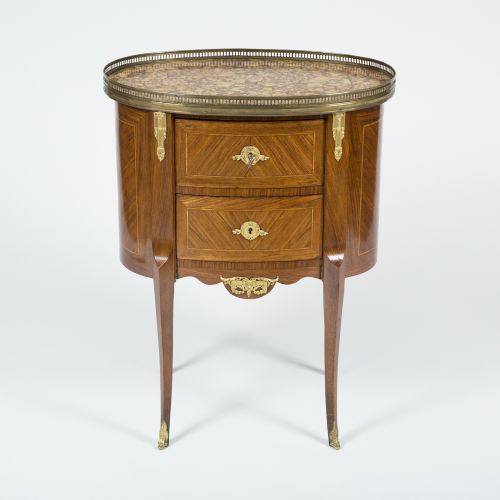

Oval French Bedside Table
An oval french bedside table brings continental refinement to the bedroom, offering curved surfaces and fitted marble tops designed for daily use.
Oval French Bedside Table
An oval french bedside table serves as a compact storage piece or lamp stand beside the bed, originating primarily from the nineteenth and early twentieth centuries. These diminutive items appear in forms such as bedside cabinets, commodes, and tables en chiffonière, carrying stylistic influences from the Louis XV and Louis XVI revivals.
Makers working in this tradition adopted varied timber selections alongside painted finishes, creating pieces suited for boudoirs and bedrooms alike. The inventory includes single items and matched pairs, showing how makers adapted the oval footprint to save space while retaining decorative presence.
How they were made
Cabinetmakers constructed the carcase using timbers like mahogany, kingwood, tulipwood, and walnut, often applying intricate parquetry or marquetry patterns across curved surfaces. Tops frequently feature inset marble slabs, including breche d'alep varieties, surrounded by cast brass or ormolu galleries.
Metal mounts such as ormolu sabot and trims accentuate the serpentine or oval outlines typical of French revival furniture. Cane inserts and painted wooden finishes appear across different examples, demonstrating a range of workshop techniques from the nineteenth and early twentieth centuries.
Some nineteenth-century makers cleverly shaped the tiny drawers inside these oval tables to follow the tight curve of the wooden frame.
What varies in quality
Quality depends upon the precision of the marquetry work and the selection of fine veneers, where crisp geometrical or floral patterns elevate the piece. The choice of marble top, the weight of the ormolu mounts, and the smoothness of curved drawer construction distinguish superior examples from simpler painted or plain timber versions.
The integration of original bronze or brass mounts and the refinement of the leg profile separate standard production items from workshop pieces associated with notable makers. Proportions remain balanced across better examples, ensuring the delicate curve of the oval top matches the taper of the supports.
François Linke·Charles Topino
The Oval French Bedside Table Glossary
- Marquetry
- Decorative veneer applied to furniture in pictorial or patterned designs. This technique utilises contrasting wood grains to create intricate surface imagery.
- Ormolu
- Gilded bronze mounts applied to furniture for decoration and edge protection. Makers cast these metal elements to complement the curves of the wooden structure.
- Parquetry
- Geometric mosaic woodwork used for repeating patterns on tabletops and cabinet doors. It involves precise cutting of small wood blocks.
- Table en chiffonnière
- A small French occasional table or tall narrow chest designed for sewing or miscellaneous items. These pieces often feature multiple small drawers and an oval top.
- Breche d'alep
- A type of quarried marble featuring brecciated patterns of brown, cream, and grey. It frequently forms the inset top of French marble-top tables.
Oval French Bedside Table: Frequently Asked Questions
What is an oval french bedside table used for?
These pieces function as bedside stands for lamps, books, and small personal items, while providing enclosed storage within cabinets or drawers.
Their curved oval shape allows them to fit smoothly into bedroom corners and beside lower bed frames without sharp edges.
How do I identify a louis xv style table?
Louis XV style pieces display asymmetrical curves, cabriole legs, and floral marquetry that reflect mid-eighteenth-century French design tastes.
Nineteenth-century revival examples adopt these flowing contours alongside ormolu mounts and shaped marble tops.
Are marble tops original to these tables?
Many nineteenth-century French tables were constructed specifically to house fitted marble slabs, which provided a durable surface for washing and placing items.
Inspect the underside of the marble and the supporting wooden rebate to check that the stone matches the age of the base.
How should I care for inlaid wood?
Keep inlaid furniture away from direct sunlight and heat sources to prevent the veneers from drying out and lifting over time.
Apply a microcrystalline wax occasionally to nourish the timber and protect the polished surface from moisture.