


Oval Back Carver Chairs
Oval back carver chairs bring neoclassical elegance to a dining table or library, offering sturdy arm support paired with a distinctive curved silhouette.
Oval Back Carver Chairs
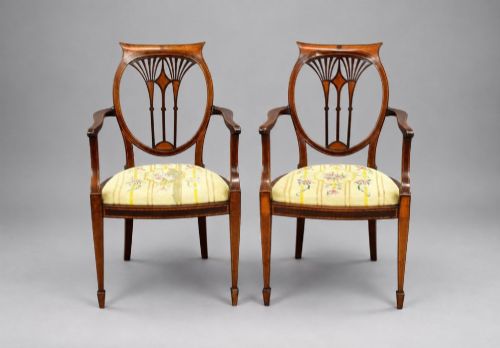
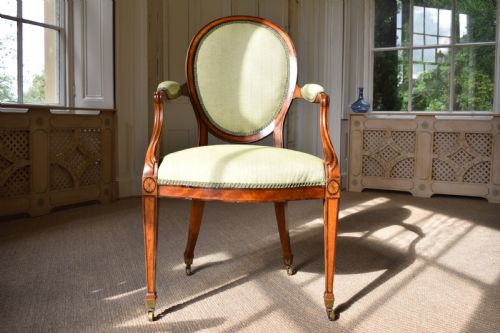
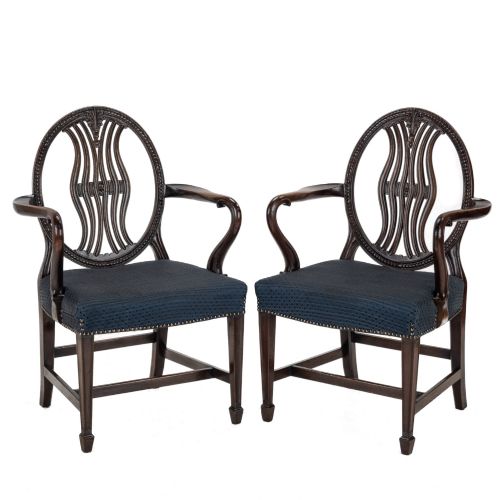
Oval back carver chairs are dining armchairs and open armchairs defined by their rounded backrests, emerging across periods from the 18th century through to the 20th century. When exploring oval back carver chairs, a buyer encounters pieces drawing on George III, Sheraton, Hepplewhite, and Louis XVI styles, alongside Edwardian and later revivals.
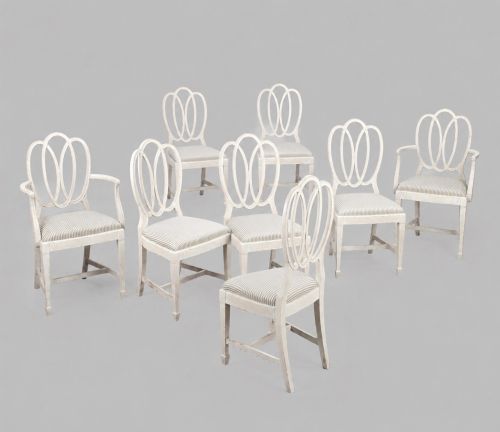
The selection ranges from single open armchairs to matched pairs and larger suites, often utilised as host chairs at the head of a dining table. Mahogany and satinwood predominate, alongside painted finishes, giltwood, and walnut frames paired with fabric or damask upholstery.
Materials and construction
Cabinetmakers constructed these frames primarily in mahogany, satinwood, and walnut, frequently incorporating intricate wood inlays to accent the classical proportions. Skilled artisans also utilised paint and giltwood finishes to achieve the refined surface decoration seen in Louis XVI and neoclassical designs.
Frames support various upholstery options, including silk damask, traditional fabric, and red damask, secured to open armchairs and elbow chairs. Joinery techniques ensure structural integrity for seating, while hand-carved details define the transitional edges between the frame and the armrests.
Some larger suites offer up to forty-two matching chairs, ensuring nobody ever misses out on a seat at the feast.
Assessing craftsmanship and finish
The distinction between standard production and superior craftsmanship lies in the crispness of the wood carving and the precision of the inlay work. Finer examples display balanced proportions in the curved backrest and seamless integration of the arm supports into the main frame.
Surface preservation significantly influences character, with original painted or giltwood finishes and well-maintained timber patination holding greater visual integrity. The harmony between the framing materials and the chosen upholstery fabric completes the overall standard of the piece.
The Oval Back Carver Chairs Glossary
- Carver chair
- A dining chair featuring arms, traditionally placed at the head of a table or used as an occasional seat. These pieces provide additional side support through integrated armrests.
- Open armchair
- An armchair constructed without upholstered panels on the sides, exposing the wooden frame and supports. This form highlights the carved details of the mahogany or satinwood structure.
- Giltwood
- Timber coated with a thin layer of gold leaf or gilt finish to create a lustrous decorative surface. This technique appears frequently on pieces influenced by French styles.
- Damask upholstery
- A reversible figured fabric traditionally woven with patterns visible on both sides. It provides a formal textile finish suited to period dining chairs.
- Satinwood
- A durable, light-coloured exotic timber valued for its smooth grain and used extensively in refined neoclassical cabinetmaking.
Oval Back Carver Chairs: Frequently Asked Questions
Where should I place oval back carver chairs?
These armchairs serve effectively as host seating at either end of a dining table or as accent pieces in a study or library.
Their distinctive curved profiles also complement bedroom settings or reception rooms where an occasional seat is required.
How do I identify a Hepplewhite style oval back chair?
Hepplewhite style designs typically feature graceful, shield-shaped or oval open backs supported by slender tapered legs.
Look for delicate neoclassical inlays and balanced proportions that reflect 18th-century English furniture traditions.
What is the difference between an armchair and a carver?
In traditional usage, a carver refers specifically to an armchair designed to match a set of dining chairs, often positioned at the table ends.
While structurally similar to standard armchairs, carvers are proportioned to fit comfortably beneath a dining table alongside side chairs.
Are these chairs suitable for daily use?
Period and revival armchairs constructed from solid mahogany or walnut provide robust structural frames capable of regular seating.
Ensuring the joinery remains tight and the upholstery is well-maintained will keep the chairs functional for everyday dining or living spaces.