
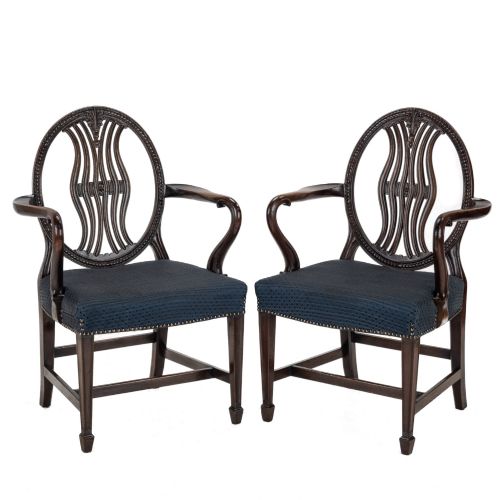


Hepplewhite Revival Armchairs
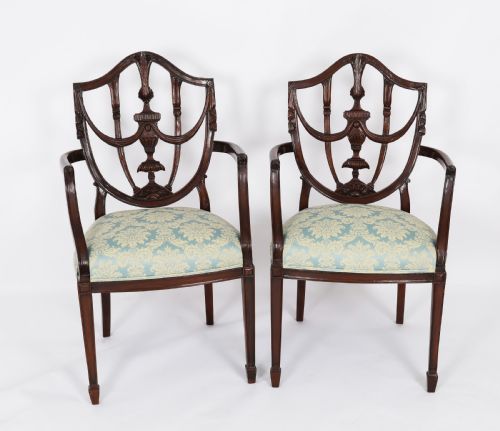
These hepplewhite revival armchairs bring eighteenth-century elegance into twentieth-century rooms with their characteristic shield backs and carved mahogany frames.
Hepplewhite Revival Armchairs
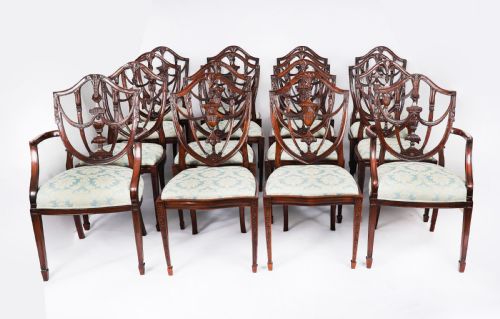
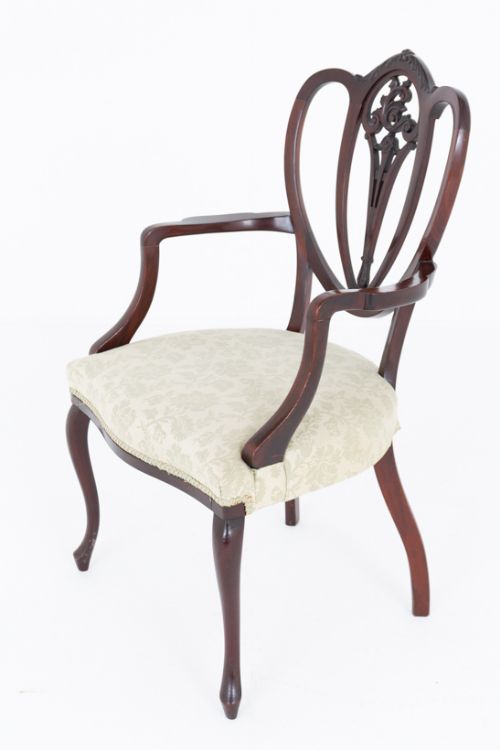
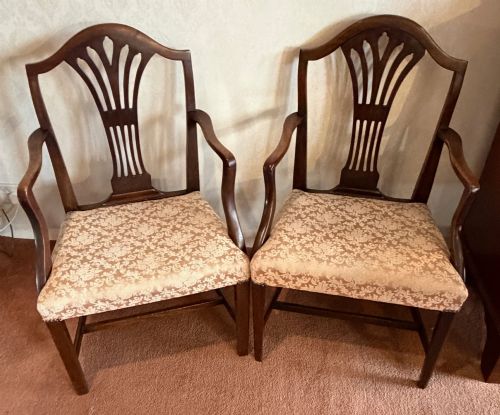
When you search for hepplewhite revival armchairs, you encounter seating built during the nineteenth and twentieth centuries that echoes the lighter forms of the georgian period. The pieces on this page include single open armchairs, carvers, and larger dining chair sets.
Most examples date from around nineteen hundred, the edwardian era, and the nineteen thirties, though some late nineteenth century pairs also appear. They span styles described as hepplewhite revival, federal revival, and georgian revival.
How they were made
Makers constructed these chairs primarily from mahogany, shaping the wood to form the distinctive shield backs and curved arms associated with the design. Ebonised finishes and decorative painted details also occur on select nineteenth century examples.
Upholstery forms a central part of the construction, utilising fabrics, velvet, leather, and traditional padding materials. Brass accents occasionally appear as structural or decorative elements within the suites.
Listings on this page span the nineteenth century, nineteen hundred, the edwardian era, nineteen twenty, and nineteen thirty, using mahogany, velvet, leather, and brass.
What varies in quality
The standard of carving on the shield backs and arms dictates much of the distinction between ordinary production and finer workshop output. Crisp detail in the pierced splats separates superior examples from plainer alternatives.
The integrity of the mahogany framing and the quality of the original or period upholstery materials further define the character of each suite or individual chair.
The Hepplewhite Revival Armchairs Glossary
- Shield back
- A chair back shaped like a heraldic shield, typically featuring a curved top rail and a pierced central splat. This silhouette defines the classic hepplewhite aesthetic.
- Carver
- An armchair, frequently designed as part of a dining set to sit at the head of the table. These pieces feature open arms attached to the main seat frame.
- Splat
- The vertical central strip of wood within a chair back, often carved or pierced in revival pieces. In these chairs, the splat connects the seat to the shield frame.
- Federal revival
- A decorative style popular in the twentieth century that reinterprets eighteenth-century neoclassical motifs. It shares many characteristics with hepplewhite revival furniture.
- Ebonised
- Wood finished with a dark stain or black paint to imitate ebony. This treatment appears on selected nineteenth-century open-arm chairs.
Hepplewhite Revival Armchairs: Frequently Asked Questions
What are hepplewhite revival armchairs?
These pieces are nineteenth and twentieth-century seating designs that copy the lighter, neoclassical shapes popularized by george hepplewhite in the eighteenth century. They are typically identified by their curved shield backs and open wooden arms.
Such chairs were produced as single library seats, carvers for dining tables, or in large sets spanning up to sixteen pieces. They bridge historical design with later manufacturing methods.
How do you date these armchairs?
Dating relies on timber characteristics, construction joints, and stylistic markers recorded across the nineteenth and twentieth centuries. Edwardian and nineteen-thirties examples often show cleaner machine-finished internal framing compared to earlier work.
Makers working in the nineteenth century utilised denser mahogany and hand-cut joinery. Reference to period markers helps distinguish original eighteenth-century work from these later revivals.
Are these chairs suitable for daily dining?
Many examples on this page form parts of large dining chair sets, making them practical for regular use around a table. Their sturdy mahogany frames support daily sitting when structurally sound.
Upholstery materials such as leather, velvet, and standard fabric can be maintained or replaced to suit modern household requirements. Open armchairs work well as desk or occasional seating.
How do revival pieces differ from original antiques?
Revival furniture was manufactured during the victorian, edwardian, and later twentieth-century periods to satisfy a renewed taste for historical design. These items adopt eighteenth-century forms but use the tools and timber stocks of their own time of manufacture.
Examining the underside, finish wear, and secondary woods clarifies whether a piece belongs to the georgian period or the subsequent revival eras.