




Outdoor Terracotta Urn
An outdoor terracotta urn brings classical presence to a garden, offering weathered warmth through clay shapes that hold plants or stand alone.
Outdoor Terracotta Urn
When you search for an outdoor terracotta urn, you encounter sturdy garden vessels spanning the Georgian, Victorian, and early twentieth centuries. These range from substantial campana shapes and large oil jars to strawberry planters and urns paired with stone plinths.
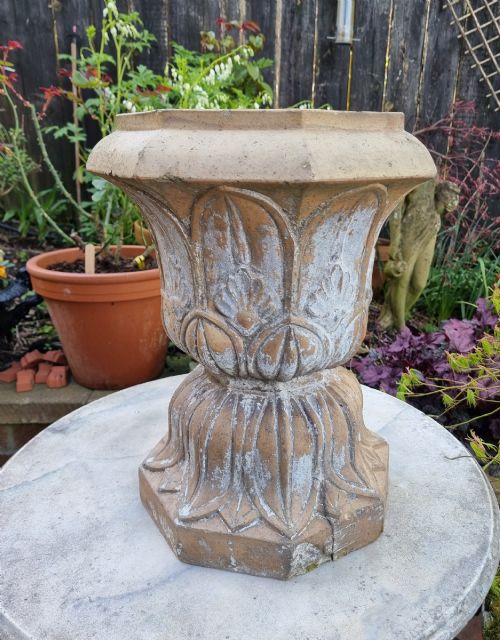
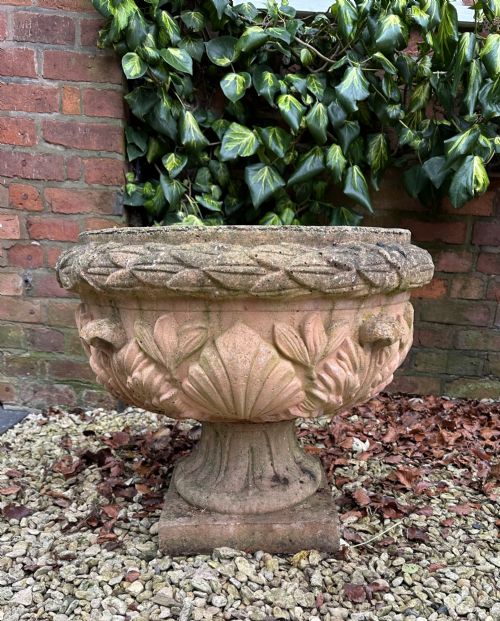
The versions most commonly met on this page are nineteenth-century pieces alongside early twentieth-century examples. Many show direct neoclassical influence or rustic Mediterranean character, often shaped with handles, carved heads, or scroll details.
Makers and origins vary across the selection, including Scottish pieces, Italian designs, and English works echoing the Compton Pottery style. Alongside classic terracotta and clay, the listings encompass salt-glazed stoneware and occasional cast iron alternatives.
Materials and construction methods
These outdoor terracotta urn forms rely on moulded or turned clay and earthenware fired to create sturdy garden vessels. Some examples utilise salt-glazed stoneware for enhanced durability against weathering.
Surface finishes recorded in the evidence include historic lime wash and paint, alongside natural patination accumulated over decades outdoors. Details such as carved heads on handles and faux bois textures are shaped directly into the body or applied during forming.
Listings feature nineteenth-century and early twentieth-century examples, including Victorian neoclassical designs and rustic Mediterranean oil jars.
Assessing quality in garden vessels
Quality rests in the crispness of the modelling, from classical foliage to carved handles, and the harmonious proportion of body to foot. Better examples display confident throwing or moulding where the weight and wall thickness feel entirely suited to the scale.
Surface character distinguishes individual pieces, as genuine weathering, lime wash remnants, and deep patination provide visual depth that cannot be forced. The integrity of the clay body and the survival of matching pairs further elevate certain pieces above standard garden ware.
The Outdoor Terracotta Urn Glossary
- Campana urn
- A bell-shaped garden vessel with an everted rim and a tapering lower body set on a pedestal base. This classic neoclassical form appeared frequently in nineteenth-century gardens.
- Salt-glazed stoneware
- A dense ceramic material fired at high temperatures with salt thrown into the kiln to produce a vitreous, glossy coating. It offers high resistance to frost and moisture.
- Faux bois
- An artistic imitation of wood grain or tree bark applied to materials like terracotta or concrete. In garden pieces, this technique creates rustic planters that mimic natural logs.
- Plinth
- A heavy architectural base or pedestal supporting an urn or statue. These elevate garden vessels to create focal points within a landscape layout.
Outdoor Terracotta Urn: Frequently Asked Questions
Are these urns frost resistant for winter?
Clay and terracotta possess porous qualities that absorb moisture, making them vulnerable to cracking if freezing water expands within the body. Many period pieces survive because they were sheltered during harsh weather or placed in well-drained positions.
Salt-glazed stoneware vessels generally handle outdoor elements more robustly due to their vitrified surfaces. Gardeners often line terracotta pots or empty them during freezing months to protect the antique material.
How do I date an antique terracotta urn?
Dating relies on stylistic clues, manufacturing techniques, and material traits recorded across different eras. Georgian and Victorian examples often feature neoclassical proportions and hand-finished details like carved handles.
Twentieth-century pieces, including those reflecting Arts and Crafts or Compton Pottery traditions, show distinct clay textures and simpler moulding methods. Surface patination, old paint layers, and lime wash remnants also provide clues to age.
How should I clean an aged terracotta surface?
Historic surfaces often carry decades of moss, lichen, and lime wash that contribute to their visual character. Gentle brushing with water usually suffices to remove loose dirt without disturbing the patina.
Harsh chemical cleaners and pressure washers should be avoided because they strip away the weathered crust and erode the soft terracotta beneath. Preserving the historic skin maintains both the appearance and the integrity of the piece.