
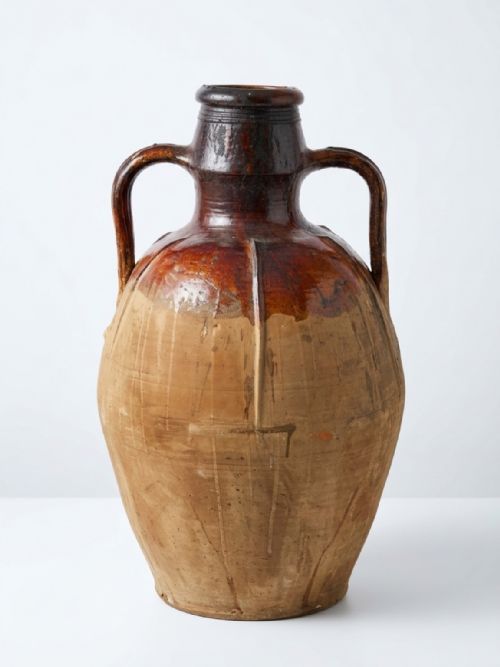
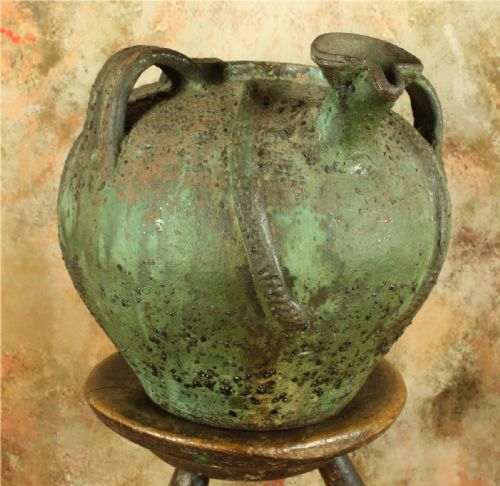


Large Terracotta Amphora
A large terracotta amphora brings earthy Mediterranean presence to a garden or hall through historic vessels shaped for wine, oil, and olives.
Large Terracotta Amphora
When you search for a large terracotta amphora, you encounter heavy historic storage vessels built for agricultural utility across the Mediterranean. These pieces originate from French, Italian, Portuguese, and Turkish workshops, spanning centuries of traditional potting.
You are most likely to meet 19th-century country examples alongside earlier 18th-century pieces and later 20th-century garden vessels. Forms range from multi-handled olive jars and wine containers to wide-necked ewers and tall storage pots.
Many examples arrive mounted on wrought iron stands or bear remnants of lime wash and historic paint over raw earthenware. Their scale makes them substantial focal points for interior spaces or sheltered garden settings.
How they were made
These vessels are built from natural clay and earthenware, shaped by hand or on heavy wheels to achieve monumental proportions. Artisans fired the local earth in large kilns, resulting in porous ceramic bodies designed to mature outdoors.
Surface treatments recorded on these pieces include simple glazes, lime wash, and historic paint applications. Many jars feature functional handles applied before firing to aid in the heavy lifting of wine and oil.
Some olive jars carry up to five handles, proving that hauling heavy oil around a Mediterranean farm was strictly a team sport.
What varies in quality
Quality in a large terracotta amphora rests upon the purity of the thrown form and the character of the aged clay surface. Superior vessels display harmonious proportions across their massive bodies, with handles integrated securely into the structural design.
The passage of time adds depth through weathering, lime wash patination, and historic paint wear. Better examples retain their structural integrity while showing the honest marks of agricultural labour and coastal exposure.
The Large Terracotta Amphora Glossary
- Amphora
- A two-handled ancient storage vessel with a narrow neck, used historically for wine and oil. Later country iterations adopt this form for grand garden display.
- Earthenware
- Porous pottery fired at relatively low temperatures. This traditional material breathes slightly, suiting it for garden urns and planters.
- Lime wash
- A traditional coating made from slaked lime applied to exterior walls and pots. It weathers softly over terracotta to create a chalky, historic patina.
- Ewer
- A large jug with a wide spout and handle for carrying liquids. These decorative forms often feature sculptural handles.
- Terracotta
- Baked earth fired from clay, ranging in colour from pale buff to deep reddish-orange. It remains the principal medium for Mediterranean garden vessels.
Large Terracotta Amphora: Frequently Asked Questions
Where should I place a large terracotta amphora?
These monumental vessels suit sheltered garden terraces, courtyards, or grand entrance halls where their scale can be fully appreciated. Their earthen tones anchor interior spaces particularly well when paired with neutral plaster or stone.
Because traditional earthenware is porous, protect delicate indoor flooring if you plan to plant directly inside the vessel. Many owners prefer them empty as sculptural objects or fitted with wrought iron stands.
Can I leave terracotta outside in winter?
Historic Mediterranean terracotta is prone to frost damage if moisture trapped inside the porous clay freezes and expands. In colder climates, move vessels under cover or empty them and wrap them securely during winter months.
Elevating the base slightly on feet or a stand prevents the pot from absorbing standing moisture from damp winter ground.
How do I date an old amphora?
Dating relies upon examining the forming techniques, tool marks on the clay, and the specific style of the handles and rim. Earlier 18th-century vessels often display heavier potting and distinct regional throw marks compared to later 19th-century production.
Surface patination, such as historic lime wash or layered paint, also helps indicate age when evaluated alongside the origin of the clay.
Were these jars used for wine or oil?
Mediterranean agricultural pots served primarily to store and transport essential commodities like olive oil and wine. Larger vessels with multiple handles made it easier for workers to hoist and tilt the heavy earthenware.
Over time, these utilitarian farm vessels transitioned from agricultural utility into decorative garden urns and architectural ornaments.