


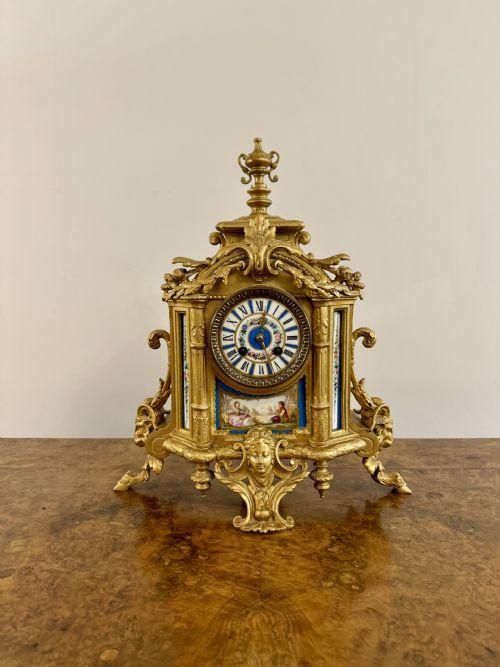


Ornate Gold Mantel Clock
An ornate gold mantel clock brings heavy gilt metal and elaborate French styling directly to the chimney piece.
Ornate Gold Mantel Clock
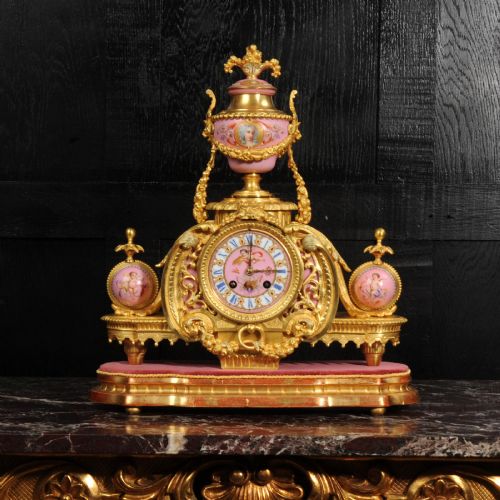
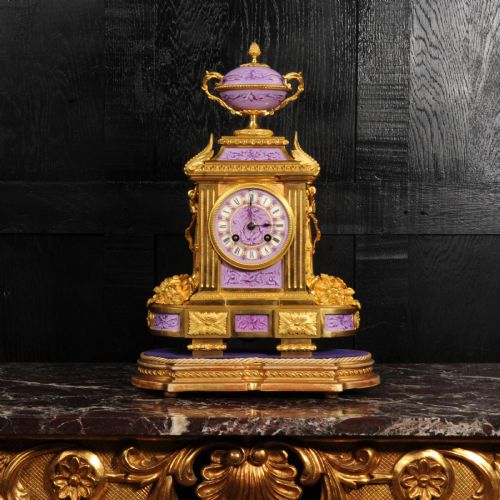
When hunting for an ornate gold mantel clock, you encounter substantial Victorian and nineteenth-century French designs driven by ornate styling. The selection heavily favours gilt brass, ormolu, and gilt bronze formats originating from Continental makers.
Most examples lean into French Rococo, Louis XVI, and Baroque revivals, often incorporating porcelain panels or glass sides. These objects function as commanding decorative focal points designed to dominate a parlour or drawing room mantelpiece.
Mantel clocks and larger clock sets dominate the offerings, occasionally accompanied by smaller carriage clocks housed in engraved brass cases. The aesthetic relies entirely on high-relief casting, scrollwork, and rich metallic finishes.
Materials and construction
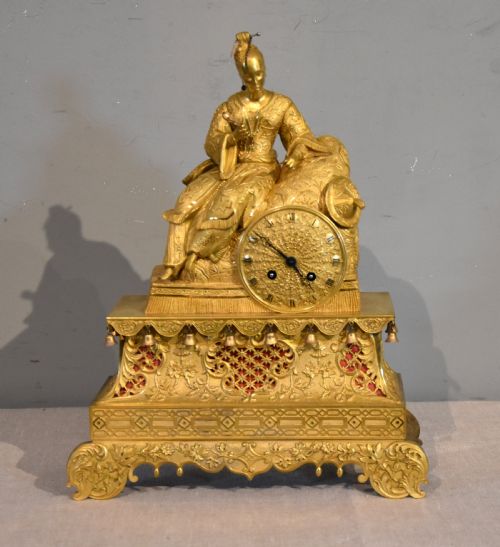
Foundational structures combine cast brass and bronze treated with mercury gilding or modern ormolu finishes to create a brilliant golden surface. Mechanical movements inside rely on precision brass gears, frequently housing eight-day striking mechanisms.
Enamel dials with delicate painted numerals are protected behind bevelled glass, while luxury models integrate Sèvres-style porcelain plaques or champlevé enamel detailing. Master founders cast these heavy shells in sections before hand-chasing the intricate foliage and figural motifs.
Current listings feature materials including ormolu, gilt bronze, champlevé enamel, and Sèvres porcelain.
Judging the standard of execution
Quality reveals itself in the crispness of the chased ornamentation and the depth of the gilding rather than mere surface shine. Finer pieces display sharply defined acanthus leaves and cherubs without the softening typical of secondary casting runs.
The integration of signed movements by known makers elevates a piece above standard decorative items. Heavy bronze and thick glass panels further separate superior specimens from lighter brass alternatives.
Achille Brocot·Samuel Marti·Japy Freres·John Barwise·Remond
The Ornate Gold Mantel Clock Glossary
- Ormolu
- A golden metallic finish produced by applying finely ground high-carat gold to a bronze base. This technique creates a rich, matte lustre characteristic of fine French decorative arts.
- Champlevé
- An enamelling technique where troughs are dug into a metal surface and filled with coloured vitreous paste before firing. The resulting patterns sit flush with the surrounding brass or bronze frame.
- Garniture set
- A matched ensemble consisting of a central clock flanked by matching decorative ornaments such as urns or candelabra. These sets created a symmetrical display on nineteenth-century mantelpieces.
- Grand Sonnerie
- A complex clock striking mechanism that chimes the hours and the quarters automatically on every quarter hour. It represents a high level of horological engineering.
- Four glass clock
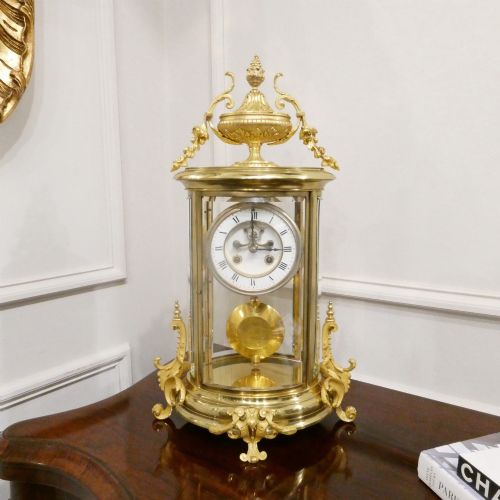
- A mantel clock housed within a brass frame holding four bevelled glass panels that expose the swinging pendulum and movement. This design allows light to pass directly through the centre of the case.
Ornate Gold Mantel Clock: Frequently Asked Questions
What is the difference between ormolu and gilt brass?
Ormolu specifically denotes a gold-mercury amalgam fired onto a bronze substrate, yielding a deep and durable golden tone. Gilt brass typically employs a thinner electroplated golden layer over a lighter yellow metal base.
Bronze provides significantly more weight and allows for sharper, deeper hand-chasing of decorative motifs than stamped brass.
How do I spot a French Rococo revival clock?
Look for asymmetrical scrolls, C-scrolls, shell motifs, and naturalistic floral cascades framing the clock face. These pieces embrace curving lines rather than rigid geometric symmetry.
Foundries often cast these elaborate frames in heavy bronze with deep undercuts and rich gilding.
Where should I place a heavy bronze mantel clock?
Position the piece on a sturdy, level surface such as a fireplace mantel or a heavy wooden sideboard. The sheer weight of cast bronze requires solid support.
Keep the clock away from direct sunlight and damp exterior walls to protect the delicate enamel dial and the gilded finish.