

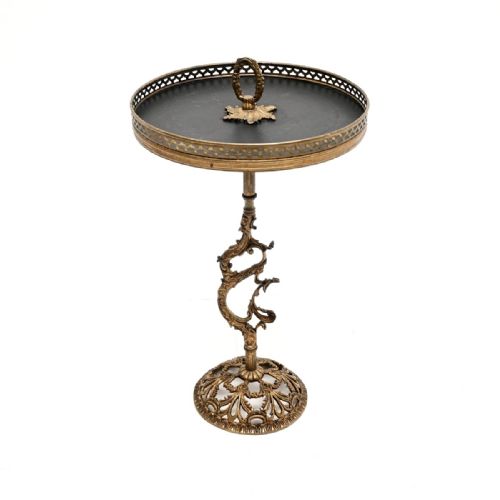
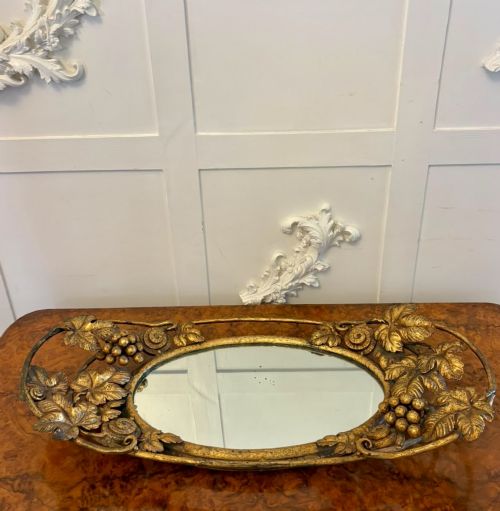


Ornate Brass Tray
An ornate brass tray brings weight and texture to a room, offering a functional surface shaped by Victorian, Edwardian, and Continental hands.
Ornate Brass Tray
When you search for an ornate brass tray, you encounter desk sets, small pin dishes, and drinks servers spanning the Victorian period through to the early twentieth century.
The pieces on this page draw from English, French, and Indian workshops, mixing domestic utility with decorative metalwork.
You are most likely to meet mid-to-late nineteenth-century examples configured as desk accessories, inkstands, or vide poche dishes rather than large platters.
Materials and construction methods
Metalworkers utilised cast brass, gilt bronze, and ormolu to achieve crisp relief and weighted forms.
Surface enrichment often includes champleve enamel panels, glazed ceramic inserts, and inset mirrored glass bases.
Components were assembled mechanically or cast as singular sections, then hand-finished to highlight chased botanical and scroll motifs.
Ornate Brass Tray Retail Price Guide 2026
Typical asking prices for ornate brass tray among the pieces listed under this phrase on Sellingantiques today, from the lower quarter to the upper quarter. They describe what is for sale here now, not the wider market.
Several trays double as inkstands, reminding us of an era when people wrote letters with bird feathers.
Assessing quality and craftsmanship
Superior examples display deep, clean chasing in the metalwork where vine leaves and rococo scrolls retain sharp definition rather than soft, worn edges.
The integration of secondary materials such as enamel, glass, or onyx dictates the grade of the piece, separating standard production items from bespoke desk appointments.
Substantial gauge metal and secure, tight joints distinguish a master-workshop casting from lighter, mass-produced domestic wares.
James Cartland and Sons·Elkington
The Ornate Brass Tray Glossary
- Ormolu
- Gilded bronze or brass, used extensively on decorative French metalwork to imitate solid gold.
- Vide poche
- A small tray or bowl designed for emptying pockets of coins and keys at the end of the day.
- Champleve
- An enamelling technique where troughs are dug into the metal surface and filled with vitreous paste before firing.
- Chamberstick
- A short candlestick fitted with a wide drip pan and a loop handle for carrying around a house.
Ornate Brass Tray: Frequently Asked Questions
How are ornate brass trays cleaned?
Dust accumulates in the recessed crevices of cast scrollwork and champleve enamel panels over decades of display.
Use a soft natural bristle brush to clear debris without disturbing patinated surfaces or delicate gilding.
Can these trays hold drinks?
Many Edwardian mirrored models were designed specifically to serve glassware and small decanters in formal reception rooms.
Check that the backing board and silvered mirror plate remain sealed against moisture before placing wet glasses on the surface.
What is champleve enamel?
Craftsmen carved channels directly into a thick brass or bronze base plate to form intricate geometric or floral patterns.
Coloured glass paste was packed into these recessed cells and fired at high temperatures until fused to the metal.
How do I spot French pieces?
French trays from the nineteenth century frequently employ ormolu casting, Louis XVI styling, and vide poche forms.
The inclusion of champleve enamel work and Paris maker signatures also points toward continental workshops.