



Ormolu Cylinder Bureau
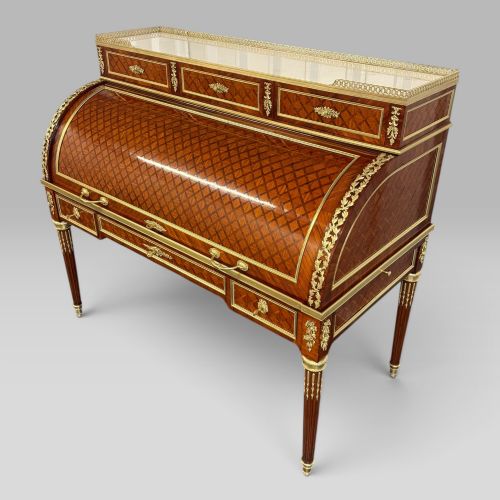
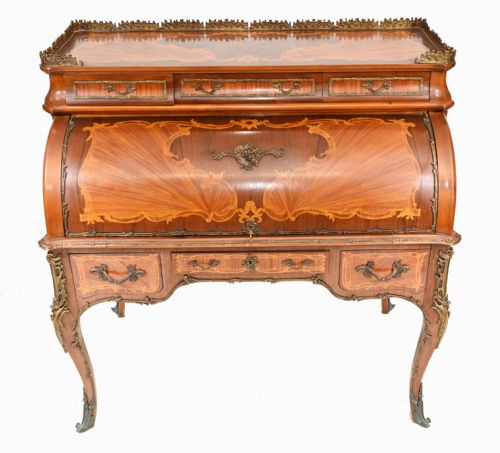
An ormolu cylinder bureau is a refined writing desk with a curved rolling shutter, combining French revival styles with rich decorative mounts.
Ormolu Cylinder Bureau
An ormolu cylinder bureau represents a sophisticated class of writing furniture originating from French revival traditions. When you examine an ormolu cylinder bureau on this page, you encounter pieces primarily from the nineteenth century, including Victorian examples and specific decades such as eighteen-fifty and eighteen-ninety. The forms encompass desks, writing desks, and secretaire cabinets, reflecting a heritage of continental craftsmanship.
The aesthetic vocabulary draws heavily upon Louis XVI style, French Rococo revival, Louis XV, and French Empire designs. These desks often incorporate complex veneering techniques alongside the characteristic rolling cylinder that conceals the writing surface and internal compartments.
How they were made
The construction of these pieces relies on a foundation of dense hardwoods such as mahogany, flame mahogany, walnut, rosewood, and kingwood. Artisans applied intricate parquetry and marquetry patterns across the surfaces, utilising contrasting timber grains to create geometric or pictorial compositions.
Gilt bronze and ormolu mounts are applied meticulously to highlight structural outlines, corners, and key escutcheons. These metallic embellishments complement the polished wooden carcasses and provide the signature flash of gilded highlights associated with nineteenth-century revival furniture.
Materials recorded across the inventory include brass, kingwood, rosewood, walnut, mahogany, flame mahogany, and gilt bronze ormolu.
What varies in quality
The distinction between standard examples and the finest pieces rests upon the precision of the cabinetwork and the crispness of the bronze casting. Superior desks exhibit seamless parquetry alignment across moving parts and substantial, finely chased ormolu mounts that integrate harmoniously with the timber.
The choice of underlying veneers also dictates the character of the piece, with richly figured kingwood, rosewood, and flame mahogany elevating the visual depth. Lesser examples may rely on simpler mahogany constructions with less intricate marquetry detailing.
Francoise Linke
The Ormolu Cylinder Bureau Glossary
- Ormolu
- Gilded bronze applied as a decorative mount to furniture. This technique was widely utilised in French cabinetmaking during revival periods.
- Cylinder bureau
- A writing desk featuring a quarter-cylinder rolling shutter that encloses the writing surface and pigeonholes. It provides a neat enclosure for correspondence.
- Parquetry
- Geometric wood inlay forming patterns such as cubes or chequers. It creates a structured, decorative surface on the desk carcase.
- Marquetry
- Elaborate veneer work depicting floral or pictorial scenes using varied timber species. It showcases the skill of the marqueter.
- Vernis Martin
- A type of simulated Japanese lacquer developed in France, often featuring painted scenes on a polished ground. It appears on select revival pieces.
Ormolu Cylinder Bureau: Frequently Asked Questions
What is an ormolu cylinder bureau?
An ormolu cylinder bureau is a nineteenth-century writing desk featuring a rolling wooden shutter that conceals the inner workspace. These desks are decorated with gilt bronze mounts and detailed wood veneers.
They draw upon French decorative traditions like the Louis XVI and Empire styles, blending practical workspace storage with ornamental design.
How do you open the cylinder?
The curved wooden cylinder slides backward into the body of the desk on hidden tracks, often operating in tandem with a rising writing slide.
Operating this mechanism reveals internal small drawers, compartments, and a leather-lined writing surface.
Where were these desks made?
The pieces listed originate primarily from nineteenth-century French workshops or British makers working in the French revival taste.
Cabinetmakers in Paris and provincial centres produced these elaborate desks to satisfy demand for revivalist furniture.
How do I care for the wood and ormolu?
Maintain the timber surfaces by applying appropriate wax polishes sparingly and buffing with a soft cloth to preserve the grain. Keep the furniture away from direct heat sources and sunlight to prevent the veneers from drying out.
Clean the ormolu mounts gently with a dry brush, avoiding harsh chemical cleaners that can strip the gilding from the bronze.
What woods were used?
Cabinetmakers utilised a variety of fine timbers including kingwood, rosewood, walnut, and mahogany, frequently selecting flame mahogany for prominent panels.
These woods provided contrasting natural colours and grain patterns suitable for detailed marquetry and parquetry designs.