

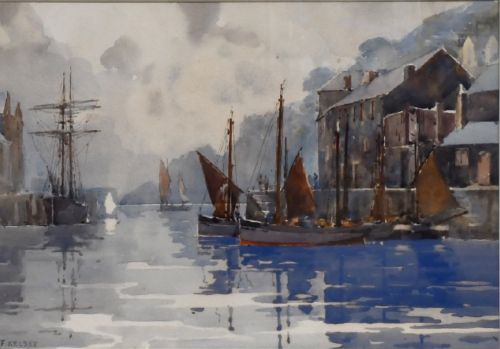


Original Sailing Ship Watercolour
Original sailing ship watercolour pieces capture maritime history on paper, offering buyers authentic glimpses of nineteenth and early twentieth century coastal life.
Original Sailing Ship Watercolour
When searching for an original sailing ship watercolour, collectors encounter marine art spanning the Victorian, Edwardian and mid-century periods. These works depict clipper ships, river shipping, coastal harbours and turbulent seas painted directly on paper.
The most common examples on this page date from the nineteenth century through to the 1930s. They range from detailed depictions of named vessels like the Mary Brack to atmospheric harbour sketches produced by regional artists.
How these watercolours were produced
Artists painted these maritime scenes using watercolour pigment and ink on paper, often applying washes to capture translucent sea and sky effects. Many works incorporate highlights in bodycolour to render the white foam and sails of ships in motion.
Framing materials recorded in the evidence include glass, wood and gilt wood, alongside specialised hand enamelled polychrome frames. These protective surrounds often reflect the framing fashions of the Victorian and Edwardian eras.
Sailors occasionally moonlighted as watercolourists, though most of these detailed ship portraits were painted by artists with very dry feet.
What determines the quality of a painting
Quality in an original sailing ship watercolour rests on the artist's command of maritime rigging, vessel perspective and atmospheric movement on the water. Skilled hands convey the weight of a man-of-war or the brisk chop of coastal waters with economy and precision.
The sophistication of the secondary components, such as a hand enamelled polychrome frame or period gilt wood moulding, elevates the overall standing of the piece. Preservation of the paper support and watercolour pigment without excessive fading also defines superior examples.
William Frederick Settle·Thomas Bush Hardy·Frank Kelsey·Frank Wood·Rowland Henry Hill·Frederick William Booty·Frank Wasley·Edward Aubrey Hunt·Henry Scott Tuke
The Original Sailing Ship Watercolour Glossary
- Watercolour
- A painting method in which the paints are made of pigments suspended in a water-based solution. It allows for transparent washes that suit the depiction of sea and sky.
- Seascape
- A work of art depicting the sea, coastal views or maritime scenes. These paintings often focus on ships, harbours and changing weather conditions.
- Gilt wood
- Wood that has been treated with gold leaf or a gold-coloured metallic finish. It frequently appears on traditional frames housing nineteenth-century pictures.
- Victorian Marine Art
- Paintings produced during the reign of Queen Victoria that focus on ships, naval engagements and coastal life. This genre encompasses both romanticized harbour views and accurate vessel portraits.
Original Sailing Ship Watercolour: Frequently Asked Questions
How do I date an antique marine painting?
Examine the costume of any figures, the rigging of the vessels, and the framing style. Victorian and Edwardian works often carry signatures or inscriptions on the reverse.
Papers and pigments also offer clues, as nineteenth-century watercolours utilise specific paper watermarks and hand-mixed hues distinct from later periods.
Where should I hang a paper watercolour?
Keep watercolours away from direct sunlight to prevent the pigments from fading over time. Indirect natural light in a stable indoor environment suits them best.
Ensure the room maintains moderate humidity levels to protect both the historic paper and its original wooden or gilt frame.
How are different ship types identified?
Artists often recorded specific vessel classes, from tall ships and clippers to steam and sail hybrids. The hull shape, number of masts, and arrangement of sails distinguish a man-of-war from a working coastal barge.
Inscribed titles on the mount or reverse frequently name the exact ship or location depicted, such as the River Humber or Yarmouth.